8 Benefits of Remote Work for Organizations
See the 8 benefits of remote work for organizations, including lower costs, global talent access, higher productivity, stronger retention, and faster scaling.
Leading a remote team often feels like trying to keep multiple moving parts aligned without ever being in the same room, productivity slips, communication breaks down, and costs quietly spiral. Without clear systems in place, even motivated employees can feel disconnected, leading to inconsistent performance and lower engagement. The benefits of remote work can help organizations build a flexible workforce while improving efficiency, reducing costs, and supporting long-term business growth.
This blog covers eight key benefits of remote work for organizations. It also explains how remote work can improve productivity, retention, scalability, and business resilience.
What Remote Work Really Means for an Organization
Remote work is not just working from home. It changes how organizations operate and manage teams across different locations. The key aspects are explained below.
- A Location-independent Workforce: Employees can perform their roles outside a traditional office, whether from home, a coworking space, or another approved location.
- Flexible Work Structures: Organizations can support remote, hybrid, or distributed teams based on job requirements and business needs.
- Digital-first Collaboration: Communication, meetings, file sharing, project management, and daily workflows depend on digital tools, with less reliance on physical presence.
- Outcome-focused Performance: Managers need clear goals, measurable outcomes, regular feedback, and reliable performance visibility to support distributed teams.
- Wider Access to Talent: Removing geographic limits allows organizations to recruit skilled professionals from broader talent pools.
- Different Cost Structures: Remote work can reduce spending on office space, utilities, and other workplace costs, although organizations may need to invest more in technology and remote work infrastructure.
- Greater Operational Flexibility: Teams can continue working when office access is disrupted, helping organizations maintain essential operations during unexpected events.
- A Stronger Focus on Employee Experience: Remote work requires organizations to support communication, inclusion, collaboration, and employee well-being across locations. It can also help employees feel more satisfied and balanced when they have greater control over where and how they work.

Did You Know?
The U.S. Bureau of Labor Statistics reported that 22.6% of workers teleworked or worked at home for pay in March 2026, showing that remote work remains a significant part of the U.S. workforce.
Benefits of Remote Work for an Organization
Remote work is no longer just a flexibility perk, it has become a strategic advantage for organizations. When implemented effectively, it can lower costs, boost productivity, strengthen employee retention, and create a more resilient workforce.
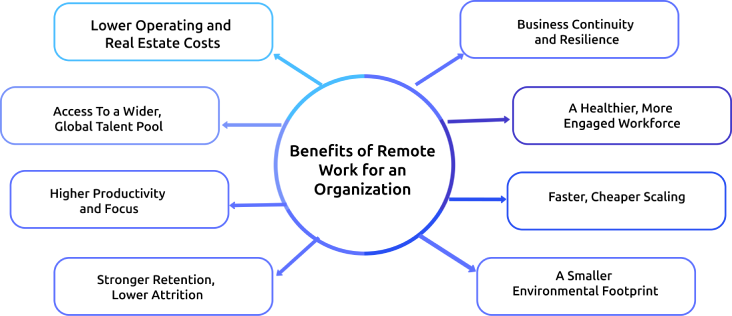
1. Lower Operating and Real Estate Costs
Remote work can reduce the need for large offices, daily utilities, furniture, and other workplace expenses. Organizations can use smaller office spaces or flexible arrangements based on actual business needs.
These savings can free up resources for technology, employee development, and other strategic priorities. A well-planned remote model can also lower costs as the organization grows.
2. Access To a Wider, Global Talent Pool
Traditional office-based work often limits hiring to candidates who can commute or relocate. Remote work removes many geographic barriers and gives organizations access to skilled professionals from different cities, regions, and countries.
A wider talent pool can make it easier to find people with specialized skills. It also gives organizations more flexibility when hiring for roles that are difficult to fill locally.
Did You Know?
Government Accountability Office report found that experts see telework as a way to expand workforce participation among caregivers, workers with disabilities, older workers, and two-career couples.
3. Higher Productivity and Focus
Remote work can give employees greater control over their working environment. With fewer office interruptions and more flexibility, employees may find it easier to focus on important tasks and manage their workday effectively.
Organizations can support this productivity by setting clear goals, tracking outcomes, and maintaining strong communication. The right processes help teams stay focused while managers maintain visibility into remote team productivity.
Finding it difficult to measure productivity across remote teams?
Use Time Champ to gain clear visibility into work patterns and productivity.
4. Stronger Retention, Lower Attrition
Employees often value flexibility when choosing whether to stay with an organization. Remote work can help employees manage work alongside personal responsibilities without the daily demands of commuting.
Greater flexibility can improve the overall employee experience and strengthen retention. Organizations can also widen their talent reach, making it easier to maintain skilled teams when local hiring becomes challenging.
5. Business Continuity and Resilience
Organizations need to keep operations moving when unexpected events affect office access. Remote work gives teams the ability to continue working from different locations when circumstances make traditional office work difficult.
A distributed workforce can reduce dependence on a single physical location. With secure systems, clear processes, and reliable communication tools, organizations can respond faster to disruptions and maintain essential operations.
6. A Healthier, More Engaged Workforce
Remote work can give employees greater control over their schedules and working environments. Reduced commuting time and greater flexibility can help employees manage their work and personal responsibilities more effectively.
Better work experience can support engagement and morale when organizations also provide regular communication and meaningful support. Managers can maintain connection through clear expectations, feedback, and consistent team interactions.
7. Faster, Cheaper Scaling
Expanding an office-based workforce often requires more desks, office space, equipment, and other physical resources. Remote work allows organizations to add employees without making the same level of investment in physical infrastructure.
This flexibility can make expansion more efficient, especially when hiring across different locations. Organizations can build teams based on business needs without being limited by available office capacity.
8. A Smaller Environmental Footprint
A remote workforce can reduce the need for daily commuting and lower dependence on large office facilities. Fewer commutes can help reduce transportation-related emissions, while smaller offices may require less energy and physical resources.
These changes can support an organization's broader sustainability goals. Remote work alone does not guarantee a lower environmental impact, but thoughtful workforce planning can help reduce unnecessary resource use.
How Time Champ Helps Organizations Manage Remote Work
Managing remote teams becomes easier when organizations have clear visibility into time, productivity, attendance, and workload. Time Champ is comprehensive employee monitoring software with built-in remote work management features that centralize time tracking, productivity, attendance, and workload. It helps managers support remote teams effectively without relying on constant check-ins.
Key features that make Time Champ useful for remote workforce management include:
- Real-Time Activity and App Tracking: Provides employee activity and app and website usage in real time. This helps managers understand work patterns and identify productivity gaps while maintaining visibility across distributed teams.
- Accurate Time and Productivity Tracking: Tracks work hours and productivity trends to identify peak and low-productivity periods. Managers can use these insights to improve workflows and support stronger remote team productivity.
- Break and Idle Time Insights: Identifies irregular break patterns, understands idle time, and sets alerts for extended idle periods. This can help teams address workflow roadblocks and maintain healthy work habits.
- Location-Based Attendance: Manages attendance across remote locations with automatic clock-ins and location-based features. This gives organizations a more consistent way to manage attendance across distributed teams.
- Smart Shift Scheduling and Timesheets: Schedules shifts around employee availability and time zones, while managing work hours, absences, overtime, and timesheets in one place. This supports smoother workforce coordination and payroll processes.
- Project and Task Management: Assigns projects, prioritizes tasks, sets deadlines, and tracks progress through centralized task views. This helps remote teams stay aligned and reduces confusion around responsibilities and deadlines.
- Workforce Analytics: Compares productivity and efficiency across teams while viewing focused hours and work-life balance reports. These insights can help managers identify workload concerns and support healthier remote work practices.
- Burnout and Work-Life Balance Insights: Provides work-life balance reports to identify employees who may be at risk of burnout. Managers can then review workloads and take timely action to support employee well-being.
Struggling to keep remote teams productive and accountable?
Use Time Champ to track productivity, attendance, and work hours in one place.
Conclusion
Remote work has become a practical strategy for organizations seeking greater flexibility and efficiency. The benefits of remote work extend from lower operating costs and wider talent access to stronger productivity, retention, and business resilience. However, these benefits depend on clear processes, effective communication, and the right tools to manage distributed teams. Organizations also need to support employee well-being while maintaining visibility into workloads and performance. With a balanced approach, remote work can create a more adaptable workforce and support sustainable business growth. The right systems can help organizations manage remote teams while maintaining productivity, accountability, and a positive employee experience.

Anjali

Table of Content
 What Remote Work Really Means for an Organization
- Benefits of Remote Work for an Organization
- How Time Champ Helps Organizations Manage Remote Work
- Conclusion
Related Blogs
Want a happier team and lower costs? See how a remote work culture can boost productivity and make your company thrive!
Jahnavi Pulluri | Mar 12, 2025
Boost remote team productivity with practical management tips, proven best practices, key metrics, and tools that help your remote teams perform better.
Anjali | Jul 16, 2026
Learn how time tracking improves remote team productivity through better visibility, accountability, performance tracking, and smarter team management.
Anjali | May 16, 2026
Discover if remote workers are truly less productive. Explore key insights, challenges, and benefits of remote work in boosting employee productivity.
Shabana Shaik | May 30, 2023
Remote workforce management, also called virtual workforce management, helps teams stay engaged. Explore its definition, benefits, challenges & tools.
Thasleem Shaik | Sep 16, 2025
Avoid common remote team management mistakes that hurt productivity. Learn how to handle communication, collaboration, and efficiency challenges effectively.
Jahnavi Pulluri | Mar 15, 2025


 4.7/5 avg.
Ready to Manage Your Workforce Smarter?
Join our family of 1500+ companies using smart insights to redefine workforces!

Free Trial
No Credit Card Required