The Average Salary in China and Top 3 Outsourcing Industries
Discover insights into the average salary in China and how wage trends impact industries and economic growth across the country.

The average salary in China for 2024 is 29,400 CNY (USD 4,025) per month. However, these figures tell only half of the story, as wages are pretty uneven across industries and geographies. These variations give rise to questions about economic growth, workforce trends, and factors influencing compensation. This article examines the salary landscape in China to give a comprehensive view of the data and what it reflects about the changing economy of the nation.
What is the Average Salary in China?
Average Salary in China
The average monthly salary in China for 2024 is 29,400 CNY (USD 4,025) while the average annual salary is 353,000 CNY (USD 48,300). These are national averages and highly vary by city, industry, and experience. A very high salary is often reported coming from a major city like Beijing or Shanghai, while a city or rural area is several thousand below. In highly in-demand industries like technology or finance, pay will also be higher.
Median Salary in China
The median salary in China is 26,900 CNY (3692.72 USD). It means that half of the working population is paid below this amount and half are paid above this amount. High-income sectors and cities tend to raise the average salaries, so the median will be a better metric to assess general earnings.
Minimum Wage in China
China’s minimum wages are gradually going up, with Shanghai reporting the highest monthly minimum wage of 2,690 CNY (370 USD) and Beijing having the highest hourly minimum wage of 26.4 CNY (3.7 USD). More than 27 regions, which comprise major provinces such as Guangdong, Jiangsu, and Zhejiang, have their monthly minimum wages set at above 2,000 CNY (275 USD).
The minimum wage at the lower end of the wage spectrum is 1,540 CNY per month in Xinjiang. Many provinces have recently increased their wage standards, reflecting ongoing efforts to improve worker earnings across the country.
| Provision / Region | Class | City / Urban Area | Monthly Minimum Wage (CNY) | Hourly Minimum Wage (CNY) |
|---|---|---|---|---|
| Heilongjiang | A | Harbin (except certain districts) Daqin | 2,080 | 19 |
| B | Qiqihar Mudanjiang Jiamusi Suihua | 1,850 | 17 | |
| C | Heihe Yinchun Daxinganling | 1,750 | 16.5 | |
| Henan | A | Zhengzhou Luoyang Anyang | 2,100 | 20.6 |
| B | Kaifeng Puyang Nanyang | 2,000 | 19.6 | |
| C | Weihui | 1,800 | 17.6 |
Source: China Briefing
Annual Average Salary Increase in China
The annual average salary increase in China shows notable trends. Urban non-private sector salaries grew by 6.7%, reaching CNY 114,029 (approximately USD 15,946), while private sector salaries grew by 3.74%, reaching CNY 65,237 (USD 9,123). Salary growth varies across industries, with IT and finance leading in compensation. Over the last decade, non-private sector salaries grew at a faster annual rate (8.28%) than private sector salaries (7.15%). Regional disparities persist, with eastern regions reporting the highest wages.
Factors Affecting Salaries in China
Understanding the determinants of wages in China can provide a clear image of the wage distribution of the country. Below is an overview of how education, experience, profession, location, and gender impact earnings.
By Education
Educational qualifications are key factors that have a wide impact on salary levels in China. Higher degrees such as Master’s and Doctorate have higher pay than secondary schooling. Average annual salaries by education are detailed below:
| Education | Average Annual Salary (CNY) |
|---|---|
| Master’s Degree | 456,468 |
| Doctorate Degree | 441,514 |
| High School | 341,817 |
| Bachelor’s Degree | 331,135 |
| Any College Degree | 293,393 |
| Below High School | 134,302 |
Source: AverageSalarySurvey
By Experience
Experience plays an important role in the country’s salary progression. Experienced staff with more than 20 years of experience receive higher salaries than the lowest rank workers in the country. It demonstrates the value of expertise and years of service. Average annual salaries by experience are shown below:
| Experience (in years) | Average Annual Salary (CNY) |
|---|---|
| 20+ Years | 667,256 |
| 16-20 | 702,150 |
| 12-16 | 513,438 |
| 8-12 | 400,211 |
| 4-8 | 300,514 |
| 2-4 | 239,272 |
| 1-2 | 183,726 |
| 0-1 | 155,954 |
Source: AverageSalarySurvey
By Profession
Salaries vary widely depending on the profession, with industries like construction, agriculture, and healthcare offering higher wages than manufacturing and IT. The following table summarizes average annual salaries by profession.
| Profession | Average Annual Salary (CNY) |
|---|---|
| Construction & Labor Workers | 1,172,861 |
| Agriculture & Fishing | 549,044 |
| Health Care & Medical | 454,332 |
| Law | 447,923 |
| Finance & Banking | 435,105 |
| Manufacturing | 363,893 |
| IT & Programming | 347,514 |
Source: AverageSalarySurvey
By City
The locations differ significantly in wages, such as Shangqiu, Yantai, and Suzhou. The high-tier cities usually pay the highest salaries in comparison with the other cities. Urban areas usually have more job opportunities and better packages. Here are the average salaries by city.
| City | Average Annual Salary (CNY) |
|---|---|
| Shangqiu | 2,136,359 |
| Yantai | 507,741 |
| Suzhou | 490,650 |
| Keelung | 457,893 |
| Tianjin | 447,211 |
| Shanghai | 442,226 |
| Datong | 422,287 |
| Chengdu | 405,196 |
| Ningbo | 388,105 |
| Shenzhen | 385,256 |
| Changzhou | 373,150 |
| Guiyang | 363,893 |
| Beijing | 353,893 |
| Guangzhou | 346,802 |
| Luoyang | 345,378 |
Source: AverageSalarySurvey
By Gender
The gender pay gap in China is still quite striking, as men receive on average about 13% more than women in 2024. Factors such as career interruptions for maternity leave, underrepresentation in leadership roles, and societal expectations that impact job choices contribute to this gap. Income inequality is even worse because women are mostly concentrated in lower-paying industries.
Legal Provisions for Employment and Wages in China
China has established a robust legal framework to safeguard employee rights and regulate fair employment practices. Key laws are the 1995 Labor Law and the 2008 Labor Contract Law amended in 2013 that control important features of wages, working hours, contracts, benefits, and termination.
Highlights of Legal Provisions:
1. Employment Contracts:
-
Employers must get into contracts with employees to provide terms of offer, description of the work, remuneration, and working hours (Labor Contract Law, Article 10).
-
Probation periods, safety measures at the workplace, and contributions made to social insurance should be laid down during contract drafting (Article 17).
2. Working Hours and Overtime:
-
Standard working hours will be 40 hours per week, and there are two days off (1995 State Council Provisions). Flexible hours are available under special circumstances.
-
Compensation for overtime work on workdays is 150% of normal wages, on rest days 200%, and public holidays 300% (Labor Law, Article 44). Overtime cannot exceed three hours per day or 36 hours per month (Labor Law, Article 41).
3. Wage Payments:
-
Salaries must be paid monthly without undue delays (Labor Law, Article 50). Delays or non-payments will carry legal charges.
-
Every employee is eligible to be paid extra for statutory holidays, leaves, and termination compensations depending on years of service (Labor Contract Law, Article 47).
4. Paid Leave:
-
The employer has to give paid leave for statutory holidays, marriage, funerals, and maternity (Labor Law, Article 51).
5. Termination Rules and Severance:
-
Termination should follow the statutory provision and severance pay is based on the years of service of the employee. Reasons for termination are gross misconduct, inability to perform duties after medical leave, or company closure.
Why Should You Outsource to China?
Outsourcing to China has several advantages that can greatly help in the development of businesses. The following are the factors that have put China as a strategic outsourcing nation.
Cost Efficiency
One of the main reasons companies look to outsource to China is the prospect of saving a lot of money. Labor costs in China are generally lower compared to Western countries, allowing businesses to reduce production expenses. For example, it may cut between 30% and 80% of production costs if manufacturing is outsourced to China.
Government Support and Incentives
The Chinese government’s “1,000-100-10” plan aims to develop 10 cities as outsourcing hubs, attract 100 international businesses, and support 1,000 medium and large outsourcing vendors. The Ministry of Commerce (MOFCOM) has supported many policies aimed at increasing infrastructure, intellectual property protection, and tax incentives for outsourcing in China.
Abundant Skilled Workforce
China produces over 4.7 million STEM graduates annually; it is among the most significant providers of skilled labor. Assisted by the Ministry of Education, this talent pool provides outsourcing firms with access to technical professionals, engineers, and researchers. Most of the Chinese graduates from international universities ranked top, which provides talent to the labor market.
Advanced Infrastructure and Technology
The country’s infrastructure has been fast in modernization, with state-of-the-art logistics and communication structures. The Chinese government has significantly invested in “smart cities” and industrial zones for the support of outsourcing needs. Among China’s cities, such as Shenzhen and Shanghai recognized by the Ministry of Industry and Information Technology are equipping themselves with highly qualified facilities to accommodate big-scale outsourcing services.
Outsourcing to China presents a compelling opportunity for businesses seeking cost efficiency, a highly skilled workforce, and advanced infrastructure. With strong government support and significant savings, China stands out as a top destination for companies looking to streamline operations and enhance their global reach.
Top 3 Industries to Outsource to China
Thousands of businesses globally now outsourcing operations to China based on cost advantage, an efficiently skilled workforce, and a strategically positioned market. Here’s an overview of the top three industries commonly outsourced to China:
1. Manufacturing
Often called the “world’s factory”, China is renowned for its efficiency and cost-effectiveness in manufacturing. In electronics, textiles, and more, companies worldwide transfer the production line to China simply to benefit from its scalability and supply chains.
2. Information Technology (IT) and Software Development
The tech hub in China is rapidly gaining momentum and has a considerable pool of skilled IT professionals available for outsourcing. This is attractive to several start-ups and foreign multinational companies, who engage many Chinese companies for developing applications, doing AI research, and providing cybersecurity solutions. Businesses can obtain cost savings that do not compromise on quality as a result of good salaries provided to IT professionals along with innovation.
3. Customer Service
For businesses trying to reach Mandarin or Cantonese-speaking markets, outsourcing a customer service operation to China would be the most obvious choice for several reasons. China has huge bilingual professional pools, which makes a cost-effective solution for establishing call centers and customer service teams. The average annual call center agent salary is much smaller compared to the Western states, making it a financially rational choice. Outsourcing of customer service to China enables effective communication with local customers, but at the same time reduces operational costs.
How Does Time Champ Support Outsourcing?
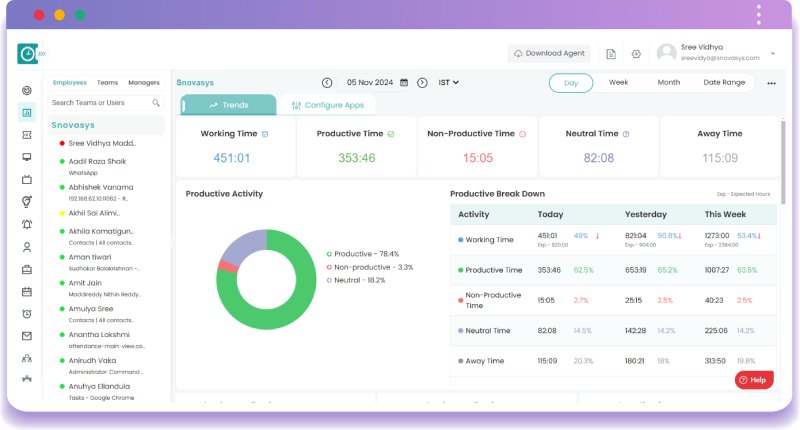
Time Champ is a powerful tool to optimize outsourcing operations by providing features that support productivity, task management, and scalability. This powerful tool will help businesses to efficiently manage remote teams, smooth workflows, and enhance performance metrics.
1. Comprehensive Time Tracking
Time Champ simplifies time tracking for remote teams, providing accurate data on working hours, breaks, and idle time. Through this feature, managers track productivity across multiple tasks with the help of focused schedules and ensure team members’ attention to scheduled work processes. The feature also helps businesses determine areas of improvement and work processes that need to be optimized to increase efficiency overall.
2. Data-Driven Insights and Reporting
Time Champ produces detailed reports that help businesses analyze performance trends over time. This feature gives managers the data that they need to make informed decisions regarding team productivity, identify bottlenecks, and optimize outsourcing strategies. With easy-to-understand analytics, businesses ensure they are getting the best out of their remote workforce.
3. Scalability for Global Operations
Whether you outsource to a small team or handle a large, global operation, Time Champ is flexible in its features. It caters to diverse industries like customer service, IT, and design by working according to the specific requirements of various workflows. This means that businesses of any size, can have an easy time managing their outsourced teams irrespective of their location. Its adaptability and scalability make it a go-to solution for managing both small teams and large-scale operations.
Ready to boost your outsourcing success?
Try Time Champ today and take control of your remote team management!
Conclusion
In a nutshell, China presents a fluctuating salary scale depending on many factors, including industry, city, and experience. Competitive wages, in manufacturing, IT, and customer services, make China one of the top destinations for outsourcing. Its vast talent pool, low labor costs, and government support all increase the appeal of this economy for global businesses. Understanding these factors can be very useful both for companies and professionals, making decisions regarding interaction with the economy of China.

Thasleem Shaik

Table of Content
-
 What is the Average Salary in China?
-
Factors Affecting Salaries in China
-
Legal Provisions for Employment and Wages in China
-
Why Should You Outsource to China?
-
Top 3 Industries to Outsource to China
-
How Does Time Champ Support Outsourcing?
-
Conclusion
Related Blogs

Discover The Average Salary in Bangladesh and outsourcing impact. Learn why it’s a rising player in global outsourcing.
Shabana Shaik | 25 February 2025
Discover the key factors influencing the average salary in India across industries, regions, and job levels, as well as insights
Mounika Sai | 10 January 2025
Explore the average salary in Ukraine, key trends, and expert tips to boost earnings across various sectors, helping you make
Thasleem Shaik | 2 January 2025
Explore the average salary in Finland, its impact on businesses, and how outsourcing can provide a cost-effective solution for growth
Thasleem Shaik | 2 January 2025
Explore the current Average Salary in the Philippines and gain insights into profitable outsourcing trends & discover wage statistics of
Sai Keerthi Uppala | 19 December 2024
Get a clear picture of the average salary in Dubai across various industries and job roles, based on experience, skills, and market demand.
Thasleem Shaik | 30 June 2025


 4.7/5 avg.
Ready to Manage Your Workforce Smarter?
Join our family of 1500+ companies using smart insights to redefine workforces!

Free Trial
No Credit Card Required