Internal Mobility: What It Is, Types & Best Practices
Learn how internal mobility helps retain talent through internal moves. Explore types, challenges, best practices, and success metrics for long-term growth.

What usually happens when a role opens up in a company? A job gets posted, recruiters start searching, interviews are scheduled, and the hunt for external talent begins.
But here's a quick question: Did anyone first look inside the organization?
Chances are, there's already someone who understands the business, knows the culture, and has the skills, or the potential, to succeed in that role. Yet in many companies, those employees are overlooked.
That's why internal mobility has become more than just an HR initiative. Let's look at what it really means, the different types of internal moves, the common roadblocks that hold mobility programs back, and the best practices for making them successful.
What is Internal Mobility?
Internal mobility is the process of moving employees into new roles, teams, projects, or locations within the same organization. These moves can take many forms, including promotions, lateral transfers, job rotations, temporary assignments, or cross-functional projects. Instead of looking outside the company to fill every vacancy, organizations first tap into the talent they already have.
What Internal Mobility Isn't
Internal mobility is often misunderstood, so it's important to separate it from a few related concepts.
- It's Not Just About Promotions: While promotions are part of internal mobility, they're only one type of movement. Lateral transfers, cross-functional assignments, job rotations, and temporary projects all help employees gain experience and prepare for future opportunities.
- It's Not the Same as Internal Recruitment: Internal recruitment is the process of filling a vacancy with an existing employee. Internal mobility is the broader strategy that creates career opportunities and makes internal hiring possible in the first place.
- It's Not Just a Software Tool: An internal talent marketplace or career portal can support mobility, but technology alone isn't enough. Without clear policies, manager support, and transparent career paths, even the best platform becomes little more than an internal job board.
What Are the Types of Internal Mobility?
Internal mobility is much more than promotion. Employees can grow in different ways depending on business needs, career goals, and skill requirements. In fact, many internal moves don't even require an open position, making them especially valuable during hiring freezes or periods of limited recruitment.
Here are the seven most common types of internal mobility:
| Type of Internal Mobility | What It Looks Like | Best Used When |
|---|---|---|
| Vertical Move (Promotion) | An employee moves to a higher-level role with greater responsibilities and decision-making authority. | A high-performing employee is ready for more responsibility, and there's a genuine leadership or senior-level opening. |
| Lateral Move | An employee shifts to a different role at the same level, often in another team or department. | Someone has outgrown their current role but still has plenty of potential to contribute to a new area. |
| Cross-Functional Move | An employee transitions into a completely different function, such as moving from sales to marketing or finance to operations. | The organization wants to build versatile talent and develop skills that are difficult to hire externally. |
| Job Rotation | Employees rotate through multiple teams or roles over a fixed period to gain broader experience. | Developing future leaders, onboarding early-career employees, or building succession pipelines. |
| Secondment | An employee is temporarily assigned to another team, business unit, client, or location before returning to their original role. | Another department needs short-term expertise without permanently transferring the employee. |
| Project or Internal Gig | Employees contribute part-time to projects outside their primary role while keeping their existing responsibilities. | Testing new skills, supporting strategic initiatives, or exploring a potential career move before making it permanent. |
| Location or Entity Transfer | An employee moves to a different office, region, country, or legal entity while continuing in a similar role. | Supporting business expansion, improving regional coverage, or accommodating an employee's relocation request. |
Each type of internal mobility supports employee growth while helping organizations make better use of existing talent. Instead of waiting for the perfect opening, companies can create opportunities that build skills, boost engagement, and meet evolving business needs.
Benefits of Internal Mobility
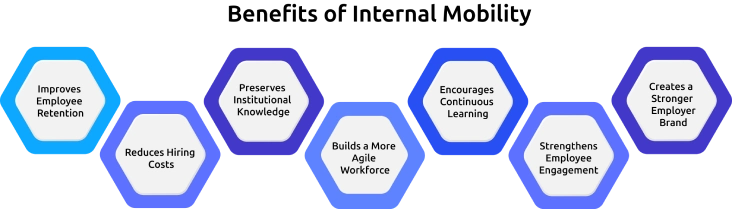
1. Improves Employee Retention
Employees are more likely to stay when they have opportunities to grow within the organization. Internal mobility provides clear career paths, reducing the need to look elsewhere for advancement.
2. Reduces Hiring Costs
Filling roles internally lowers recruitment expenses, shortens hiring timelines, and minimizes onboarding costs. Internal hires also become productive faster because they're already familiar with the company's culture and processes.
3. Preserves Institutional Knowledge
When employees move to new roles within the organization, they carry valuable business knowledge, customer insights, and company experience with them. This continuity reduces disruption and helps teams perform more effectively.
4. Builds a More Agile Workforce
As business priorities and skill requirements evolve, internal mobility enables organizations to redeploy talent instead of depending only on external hiring. Employees can move into new roles after upskilling or reskilling, helping the business adapt more quickly.
5. Encourages Continuous Learning
Knowing that new opportunities are available motivates employees to develop new skills, take on cross-functional projects, and prepare for future roles.
6. Strengthens Employee Engagement
Employees who see a future within the organization are generally more engaged and motivated. Providing internal career opportunities fosters trust, improves morale, and increases job satisfaction.
7. Creates a Stronger Employer Brand
Companies known for promoting from within are more attractive to both current and prospective employees. A reputation for career growth can improve retention while making it easier to attract high-quality talent.

Did You Know?
According to Deloitte Insights, organizations that promote employees internally are 32% more likely to be satisfied with the quality of their hires.
How to Identify Employees Ready for Internal Mobility
Being ready for a new role isn't just about years of experience or consistently high performance ratings. It's about recognizing employees who have outgrown their current responsibilities and are ready to take on more. The signs usually appear in daily work long before they show up in a performance review.
Signs an Employee Is Ready for a New Role
| Signal | What It Indicates |
|---|---|
| Responsibilities keep growing | The employee is already taking on work beyond their current role. |
| Consistently delivers high-quality work | They handle their responsibilities well and are ready for greater challenges. |
| Has time for additional work | They complete their tasks efficiently and actively look for new opportunities to contribute. |
| Applies newly learned skills | Training and certifications are reflected in their daily work. |
| Others seek their guidance | Colleagues trust them for advice, showing informal leadership. |
| Engagement starts to decline | A drop in enthusiasm or initiative can indicate they've outgrown their current role. |
Performance Doesn't Always Mean Readiness
A high-performing employee isn't automatically ready for the next role. Before making an internal move, consider four questions:
- Capability: Do they have the skills for the new role?
- Capacity: Can they take on more responsibility without becoming overloaded?
- Interest: Do they actually want the opportunity?
- Opportunity: Is there a suitable role or project available?
Looking at all four factors helps organizations make better mobility decisions and ensures employees move into roles where they can succeed.
Find Your Next Great Hire Internally
Identify the right people for the right opportunities with workforce insights
How to Build an Internal Mobility Program
You don't need expensive enterprise software to build an effective internal mobility program. With clear processes, manager support, and regular talent reviews, any organization can create opportunities for employees to grow within the business.

Step 1: Identify Frequently Filled Roles
Review your hiring data from the past one or two years. If the same roles are being filled externally again, they could be strong candidates for internal mobility. Prioritize these roles when creating career paths.
Step 2: Map Employee Skills
Create a simple skills inventory for each team. Identify the key skills required, who currently has them, and which employees are developing them. This makes it easier to match people with future opportunities.
Step 3: Advertise Roles Internally First
Before posting jobs externally, give existing employees a chance to apply. Keep internal job postings open for a few days, communicate them clearly, and provide timely feedback to every applicant.
Step 4: Encourage Managers to Support Mobility
Managers play a key role in internal mobility. Include employee development and internal talent movement as part of their performance goals, so they're encouraged to develop people instead of holding onto them.
Step 5: Plan for Backfills
Every internal move creates a new vacancy. Decide in advance how backfills will be handled, who approves them, and how responsibilities will be transferred to avoid disruptions.
Step 6: Create a Clear Internal Mobility Policy
Document the eligibility criteria, application process, approval steps, and timelines in a simple policy. A transparent process helps employees trust the program and encourages greater participation.
How to Measure Internal Mobility?
Tracking the right metrics helps you understand whether your internal mobility program is creating meaningful career opportunities or simply running in parallel with external hiring.
| Metric | Formula | What It Measures |
|---|---|---|
| Internal Mobility Rate | (Internal moves ÷ Average headcount) × 100 | Overall, internal movement. |
| Internal Fill Rate | (Roles filled internally ÷ Total roles filled) × 100 | How often vacancies are filled internally. |
| Promotion-to-Lateral Move Ratio | Promotions vs. lateral moves | Whether employees have varied career paths. |
| 12-Month Retention Rate | (Internal movers retained after 12 months ÷ Total movers) × 100 | Success for internal moves. |
| Time to Fill | Average time for internal vs. external hires | Speed of internal hiring. |
| Application-to-Move Conversion Rate | (Internal moves ÷ Internal applications) × 100 | How many internal applications result in successful moves. |
Don't evaluate these metrics in isolation. Compare the mobility rate with employee turnover and review the data by manager. This helps identify where internal mobility is thriving and where additional support is needed.
How Time Champ Supports Internal Mobility Decisions
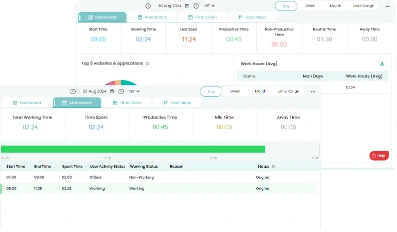
A successful mobility program depends on accurate workforce insights. Time Champ is an employee monitoring software that helps managers make informed mobility decisions by providing visibility into employee workload, productivity, and work patterns. It supports internal mobility by identifying employees who are ready for new opportunities, it doesn't replace your mobility strategy.
With Time Champ, you can:
- Track workload and capacity to identify employees who can take on new roles, projects, or job rotations.
- Analyze time and utilization data to understand how employees spend their time beyond their job descriptions.
- Identify skill development through application and website usage, revealing tools and technologies employees actively use.
- Detect burnout and attrition risks using behavioral insights, helping managers have career conversations before employees disengage.
- Compare teams and departments to see where internal mobility is thriving and where it needs more support.
- Integrate with HR platforms such as Workday, ADP, Lattice, and Culture Amp for a more complete view of employee data.
Make Smarter Internal Mobility Decisions
Track workload, capacity, and engagement to identify employees ready for new opportunities
Conclusion
Internal mobility is a win-win for employees and organizations. It helps employees grow their careers while enabling businesses to retain talent, reduce hiring costs, and close skill gaps faster. With the right strategy, transparent processes, and ongoing support, internal mobility can become a powerful driver of long-term workforce success.

Jahnavi Pulluri

Table of Content
 What is Internal Mobility?
- What Are the Types of Internal Mobility?
- Benefits of Internal Mobility
- How to Identify Employees Ready for Internal Mobility
- How to Build an Internal Mobility Program
- How to Measure Internal Mobility?
- How Time Champ Supports Internal Mobility Decisions
- Conclusion
Related Blogs

Discover 10 ways HR teams can use workforce intelligence to improve hiring, retention, performance management, and drive smarter data-driven HR decisions.
Anjali | Feb 11, 2026
What are HR goals? Learn the main types of HR goals and objectives, examples, and simple steps to set and track them.
Guna Lakshmi | Jul 27, 2026
HR Analytics vs People Analytics: Explore definitions, key differences, similarities, and practical use cases to make smarter, data-driven workforce decisions.
Anjali | Jun 13, 2024
Compare the 10 best employee time tracking software in 2026. Review features, pricing, pros and cons, and find the right fit for your team today.
Sai Keerthi Uppala | Aug 17, 2026
Create a clear time tracking policy to improve productivity, ensure accurate work-hour reporting, streamline compliance, and enhance team accountability.
Jahnavi Pulluri | Aug 24, 2026
Discover effective time tracking methods to boost efficiency, manage resources, and ensure timely project delivery. Find the best method for your organization.
Tarun Kumar Reddy | Aug 16, 2024


 4.7/5 avg.
Ready to Manage Your Workforce Smarter?
Join our family of 1500+ companies using smart insights to redefine workforces!

Free Trial
No Credit Card Required