Human Capital Analytics: Metrics, Examples & ROI
Learn what human capital analytics is, the key metrics to measure workforce performance, and how to improve productivity and maximize workforce ROI!
You probably know exactly how much you spend on your workforce every year. But do you know what you're getting in return? Human capital analytics helps you connect workforce data with business outcomes, giving you the insights you need to optimize performance, retain top talent, and increase workforce ROI.
In this guide, you'll learn what human capital analytics is, the key metrics to measure, practical examples, implementation best practices, and how to turn workforce data into smarter business decisions.
Ready to measure the value your workforce creates? Let's get started!
What Is Human Capital Analytics?
Human capital analytics is the process of collecting and analyzing workforce data to measure how employees contribute to business performance. It helps you evaluate key metrics such as productivity, engagement, retention, and workforce ROI, enabling informed decisions about hiring, workforce planning, talent development, and overall business growth.
It helps you evaluate key metrics such as productivity, engagement, retention, and workforce ROI, enabling you to make informed decisions about hiring, workforce planning, talent development, and overall business growth.
Why Does Human Capital Analytics Matter for Modern Organizations?
Hiring the right people is important, but knowing how they're contributing to your business is even more valuable. Let's explore why human capital analytics matters and how it helps you build a more productive, engaged, and profitable workforce.
- Measure Workforce ROI: Understand how your workforce contributes to revenue, profitability, and overall business success.
- Make Smarter Hiring Decisions: Identify the skills and roles that deliver the greatest business impact.
- Improve Employee Retention: Spot turnover trends early and take action to retain your top talent.
- Boost Workforce Productivity: Analyze performance metrics to uncover inefficiencies and improve team output.
- Strengthen Workforce Planning: Use data to forecast future talent needs and allocate resources effectively.
- Support Data-Driven HR Decisions: Replace guesswork with measurable insights when making workforce decisions.
- Increase Employee Engagement: Identify engagement patterns and address issues before they affect performance.
- Reduce Workforce Costs: Optimize staffing, minimize absenteeism, and improve resource utilization without compromising productivity.
What Metrics Are Used in Human Capital Analytics?
The success of your human capital analytics strategy depends on measuring the right metrics. Here are the key metrics that help you evaluate workforce performance, identify improvement opportunities, and measure the value your workforce brings to your business.
| Metric | What It Measures | Formula | Why It Matters |
|---|---|---|---|
| Human Capital ROI (HCROI) | The financial return generated from your workforce investment. | HCROI = (Revenue − Non-Labor Costs) ÷ Labor Costs | Helps you understand whether your people investments are delivering business value. |
| Human Capital Value Added (HCVA) | The value employees create after covering workforce costs. | HCVA = Revenue − (Operating Expenses − Employee Costs) | Shows how much value your workforce contributes to the organization. |
| Revenue Per Employee | The average revenue generated by each employee. | Revenue Per Employee = Total Revenue ÷ Average Number of Employees | Measures workforce efficiency and overall business productivity. |
| Cost Per Hire | The average cost of recruiting and onboarding a new employee. | Cost Per Hire = Total Hiring Costs ÷ Number of Hires | Helps you optimize hiring budgets and recruitment strategies. |
| Employee Turnover Rate | The percentage of employees who leave during a specific period. | Turnover Rate = (Number of Employee Departures ÷ Average Number of Employees) × 100 | Identifies retention challenges and workforce stability. |
| Absenteeism Rate | The frequency of employee absences. | Absenteeism Rate = (Total Days Absent ÷ Total Available Workdays) × 100 | Highlights attendance trends that may affect productivity. |
| Employee Utilization Rate | The percentage of productive or billable work compared to available working hours. | Utilization Rate = (Productive or Billable Hours ÷ Available Working Hours) × 100 | Helps you allocate resources more effectively and improve workforce efficiency. |
| Employee Productivity | The output employees generate over a given period. | Employee Productivity = Total Output ÷ Total Labor Hours | Reveals how efficiently your workforce contributes to business goals. |
| Employee Engagement Score | The level of employee commitment and satisfaction. | Engagement Score = Total Survey Score ÷ Number of Responses | Higher engagement often leads to better performance and lower turnover. |
| Training ROI | The business value generated from employee training and development. | Training ROI = (Training Benefits − Training Costs) ÷ Training Costs × 100 | Helps you determine whether learning programs deliver measurable results. |
Human Capital Analytics Examples
Human capital analytics helps organizations turn workforce data into better business decisions. Let's look at how leading companies use it in practice, followed by common ways you can apply it in your own organization.
1. Google Used Human Capital Analytics to Improve Employee Retention
Google analyzed workforce data and found that new mothers were leaving the company at a much higher rate after childbirth. Based on these insights, it extended paid maternity leave from 12 weeks to 18 weeks. The result was a 50% reduction in attrition among new mothers, helping Google retain experienced employees while reducing hiring and replacement costs. This is a great example of using human capital analytics to improve employee retention and maximize workforce ROI.
2. IBM Used Predictive Analytics to Reduce Employee Attrition
IBM used predictive workforce analytics to identify employees who were most likely to leave the company. The company analyzed workforce data to predict attrition risks, allowing managers to take proactive steps to retain valuable employees before they resigned. This approach helped IBM reduce turnover costs and strengthen its employee retention strategy.
3. Best Buy Used Employee Engagement Data to Measure Business Value
Best Buy used workforce analytics to understand whether employee engagement actually affected financial performance. The company analyzed the relationship between employee engagement and store performance and found that a 0.1% increase in employee engagement was associated with more than $100,000 in additional annual operating income per store. The finding helped Best Buy see employee engagement as a measurable business driver rather than just an HR metric.
How to Implement and Measure Human Capital Analytics (Step By Step)
Implementing human capital analytics becomes easier when you follow a clear process. Here are the key steps to help you turn workforce data into useful insights and measure the results of your decisions.
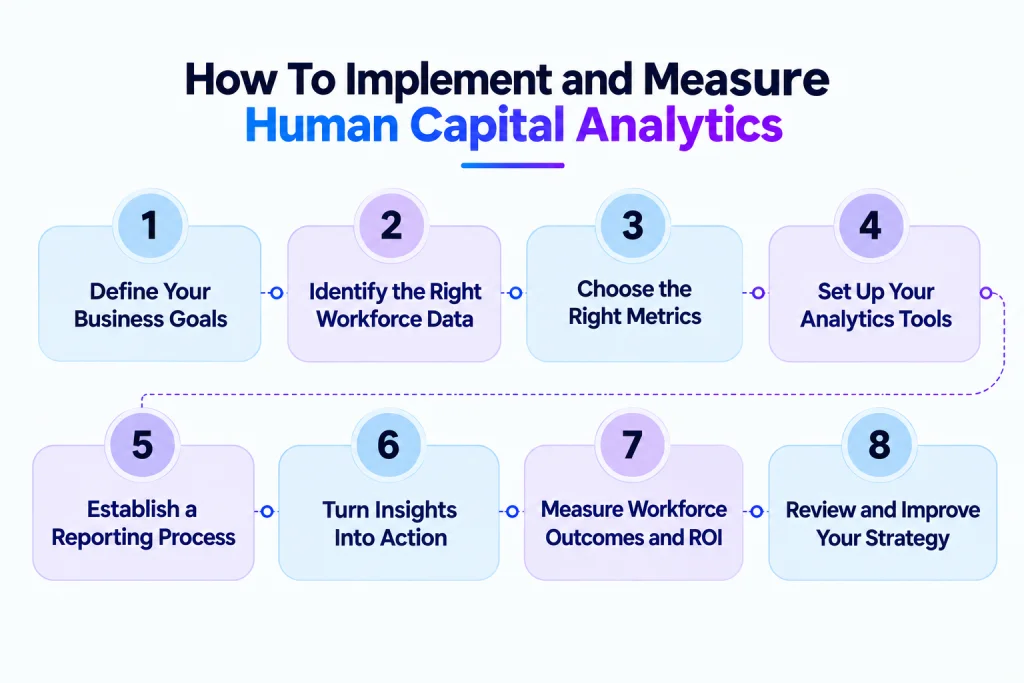
1. Define Your Business Goals
Start by deciding what you want to improve with human capital analytics. You might want to reduce employee turnover, improve productivity, control workforce costs, or plan your workforce more effectively. These goals will determine which data and metrics you need to track.
2. Identify the Right Workforce Data
Determine which workforce data can help you answer your business questions. This may include productivity, attendance, utilization, employee turnover, engagement, performance, hiring, and workforce cost data.
Focus on data that can help you answer specific business questions rather than collecting every available workforce metric.
3. Choose the Right Metrics
Select metrics that directly support your business goals. For example, turnover rate can help you understand retention, while utilization rate can show how effectively you use your workforce capacity. Choosing relevant metrics keeps your analysis focused and useful.
Keep your initial set of metrics focused so your analysis remains actionable.
4. Set Up Your Analytics Tools
Choose the systems and tools you need to collect, combine, and analyze your workforce data. You may use HR systems, time tracking software, performance tools, employee surveys, and analytics platforms depending on your requirements.
Where possible, connect these systems so you can analyze workforce information in one place instead of relying on disconnected data sources.
5. Establish a Reporting Process
Create a consistent process for reviewing your workforce metrics. Decide who will review the data, how frequently reports will be generated, and which metrics should be monitored regularly.
A consistent reporting process helps you identify changes early and keeps workforce analytics connected to ongoing business decisions.
6. Turn Insights Into Action
Use your findings to make specific workforce decisions. For example, you could adjust staffing levels, improve retention initiatives, address productivity issues, or redirect resources based on the patterns you identify.
The goal is to move from simply reporting workforce data to using it to guide decisions.
7. Measure Workforce Outcomes and ROI
After implementing changes, measure whether they produced the expected results. Compare your outcomes against your original goals using metrics such as productivity, turnover, workforce costs, revenue per employee, or other relevant KPIs.
This helps you determine whether your analytics-driven decisions are creating measurable business value.
8. Review and Improve Your Strategy
Human capital analytics works best as an ongoing process rather than a one-time analysis. Review your results regularly, update your metrics when business priorities change, and use new insights to improve your workforce strategy.
How Does Time Champ Support Human Capital Analytics?
Collecting reliable workforce data is an important part of human capital analytics. Time Champ makes this process easier by capturing workforce data and giving you clear insights into productivity, utilization, attendance, and employee activity.
Key Time Champ Features That Support Human Capital Analytics:
- Improve Workforce Productivity: Analyze productivity patterns and identify areas where teams can improve performance.
- Optimize Time and Workforce Utilization: Understand how working time is spent and how effectively workforce capacity is being used.
- Improve Attendance Visibility: Identify attendance patterns and workforce availability for better planning.
- Understand Employee Activity: Gain insights into employee activity and work patterns to support performance decisions.
- Make Better Workforce Decisions: Use workforce insights to support planning, resource allocation, and performance management.
Conclusion
The way you understand your workforce can shape the way you lead your business. Human capital analytics gives you a clearer perspective on the people, patterns, and decisions that shape your organization’s future. With the right insights, you can make workforce decisions with greater confidence and align them more closely with your business goals.
Ready to make smarter workforce decisions? Sign up for Time Champ for free and see how it can support your team.

Guna Lakshmi

Table of Content
 What Is Human Capital Analytics?
- Why Does Human Capital Analytics Matter for Modern Organizations?
- What Metrics Are Used in Human Capital Analytics?
- Human Capital Analytics Examples
- How to Implement and Measure Human Capital Analytics (Step By Step)
- How Does Time Champ Support Human Capital Analytics?
- Conclusion
Instant Signup
Thank you for your request!
We have received your signup request and our team will get back to you soon. In the meantime, you can book a demo to see Time Champ in action.
Book a DemoFree trial. No credit card required. Prefer a walkthrough? Book a demo.
Related Blogs

Want to know if your team is truly productive and balanced? Explore the 9 organizational health metrics that matter and learn how to track them.
Guna Lakshmi | Apr 20, 2026
HR Analytics vs People Analytics: Explore definitions, key differences, similarities, and practical use cases to make smarter, data-driven workforce decisions.
Anjali | Jun 13, 2024
Understand what HR analytics is, explore its four types, key metrics, benefits, and learn how to run your first HR analytics project for better HR decisions.
Jahnavi Pulluri | Aug 17, 2026
Learn why workforce analytics is essential for process reinvention, how it reinvents key business processes, best practices & how to measure success.
Anjali | Apr 02, 2026
Learn why workforce analytics drives business value, how to measure ROI with formulas, strategies for measurable returns, challenges, & business impact.
Thasleem Shaik | Feb 11, 2026
Learn what people analytics is, why it's important, real examples, implementation steps, key benefits, challenges & how it differs from HR analytics.
Thasleem Shaik | Feb 11, 2026


 4.7/5 avg.
Ready to Manage Your Workforce Smarter?
Join our family of 1500+ companies using smart insights to redefine workforces!

Free Trial
No Credit Card Required