First Call Resolution: What It Is and How to Improve It
First call resolution is a key customer service metric. See how to calculate FCR, why it matters, common challenges, and practical ways to improve it.

Your customer calls with a problem. The best outcome is to solve it during that first conversation. The customer gets the answer they need, and the issue is resolved without another call or follow-up. That is the goal behind first-call resolution.
FCR measures how often you resolve an issue during the first interaction without requiring another call or follow-up. When your FCR drops, the number can point to deeper issues such as poor routing, limited agent knowledge, or unnecessary escalations.
This guide covers what FCR means, how to calculate and measure it, what makes a good FCR rate, and practical ways to improve it.
What Is First Call Resolution (FCR)?
First call resolution, or FCR, is a customer service metric that shows how often a customer issue is solved during the first interaction. In simple terms, it answers one question: did the customer get what they needed without contacting support again for the same problem?
For example, if a customer calls about a billing error and the agent explains the charge, corrects the mistake, and confirms that no further action is needed, that case can be counted as resolved on the first call. But if the customer has to call back later for the same issue, it should not be counted as FCR.
First Call Resolution vs First Contact Resolution
These terms sound similar, but they do not cover exactly the same thing. The main difference comes down to the type of customer interaction you measure.
The table below shows how first call resolution and first contact resolution differ in scope, channels, and use.
| Feature | First Call Resolution | First Contact Resolution |
|---|---|---|
| What it Measures | Issues resolved during the first phone call | Issues resolved during the first customer interaction |
| Channel Coverage | Phone calls only | Phone, chat, email, messaging, and other support channels |
| Main Focus | Phone support performance | Overall support experience across channels |
| When it Counts as Resolved | You solve the issue during the first call without any further interaction | You solve the issue during the first contact without any further interaction |
| Best Suited For | Call centers that want to track phone resolution | Support operations that handle customers across multiple channels |
Not sure where your agents lose time during the workday?
Use Time Champ to track your agent time and productivity effectively.
Why Is First Call Resolution Important?
FCR is more than just a number on a dashboard. It shows how effectively your agents solve customer issues, how much your support operations cost, and how likely your customers are to stay with you. Here are the key reasons why it matters for your support team.
1. Higher Customer Satisfaction
When you solve an issue in one call, the customer feels heard and helped right away. According to CSBA, every 1% rise in first call resolution rate brings a matching 1% rise in customer satisfaction. That correlation is one of the strongest in contact center research, which is why so many CX teams treat FCR as a leading indicator for CSAT.
2. Lower Operating Costs
Every repeat contact adds more handle time, staffing demands, and cost to your support operation. When you improve your FCR, you reduce callbacks, follow-up emails, and escalations. This helps your team spend less time and fewer resources resolving the same issue more than once.
3. Stronger Customer Loyalty
Customers remember how easily their problems get solved. When your agents resolve issues during the first interaction, they create a smoother experience and build trust with your customers. That trust can encourage customers to return, support better reviews, and reduce the chances of customers looking for alternatives.
4. Better Agent Morale and Efficiency
Resolving an issue in one call gives your agents a clear sense of progress instead of adding to a growing backlog of reopened tickets. Fewer repeat interactions also reduce the frustration of handling the same issue more than once. This helps your agents focus on new issues, manage their workload better, and can reduce attrition caused by ongoing stress and repetitive work.
How to Measure First Call Resolution?
Measuring FCR goes beyond counting how many calls your agents close. You need to know whether the customer actually got a complete solution during the first interaction and whether another contact followed for the same issue. Your measurement method should give you a consistent view of both outcomes.
Here are the main steps to measure FCR accurately.
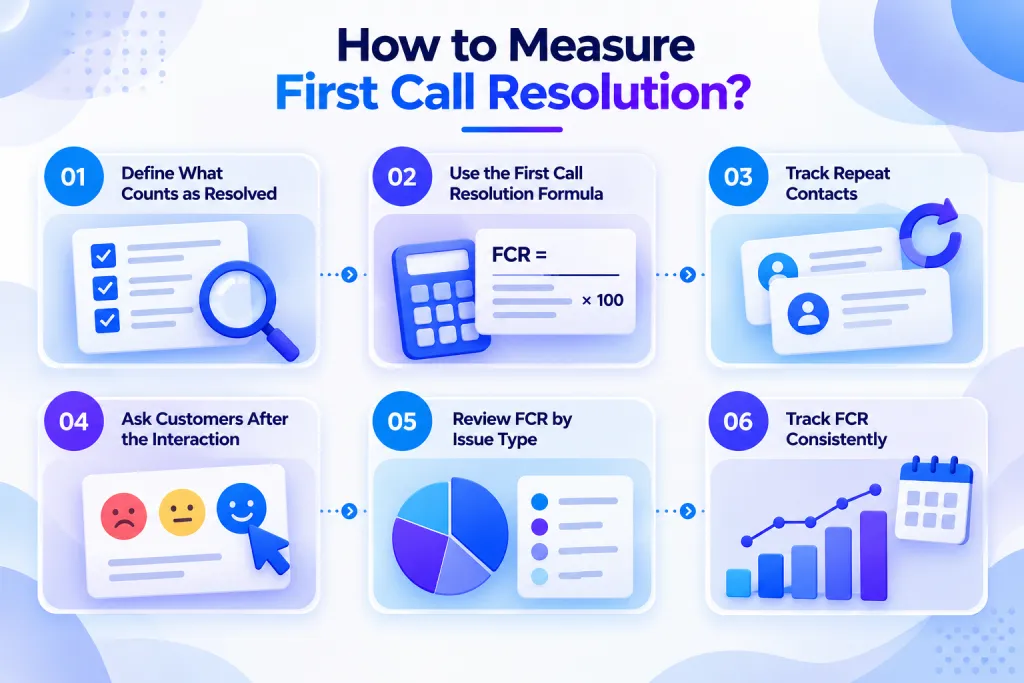
Step 1. Define What Counts as Resolved
Start with a clear definition of a successful resolution. Count an interaction as FCR when your agent fully resolves the customer's issue during the first contact without requiring another call, follow-up, or transfer.
Keep the same definition across your support process. A closed ticket does not automatically mean the issue reached a first-contact resolution. Your definition should focus on whether the customer's issue was actually solved during that first interaction.
Step 2. Use the First Call Resolution Formula
The first call resolution calculation uses a simple formula.
FCR Rate = (Issues Resolved on First Contact ÷ Total Issues) × 100
For example, if your team handles 500 customer issues and resolves 375 during the first contact, your FCR rate would be 75%.
FCR Rate = (375 ÷ 500) × 100 = 75%
The calculation is simple, but accurate results depend on using the same criteria for every interaction. This keeps your first call resolution rate consistent and makes it easier to track changes over time.
Step 3. Track Repeat Contacts
One practical way to measure FCR is to check whether your customer contacts you again about the same issue within a defined period.
For example, you could track repeat contacts within seven days. If the same customer contacts your support team again about the original issue during that window, you would not count the first interaction as a successful FCR.
This method gives you behavioral data instead of relying only on what your agent records. However, you need to track customers and issues accurately because a later contact may be about a different problem.
Step 4. Ask Customers After the Interaction
You can also measure FCR by asking customers directly whether your team resolved their issue during the first interaction.
A simple question such as "Was your issue fully resolved today?" can give you direct feedback about the outcome. Post-contact surveys can capture the customer's view, but response rates can limit how representative the results are.
For a more reliable picture, compare customer feedback with repeat-contact data instead of depending on one method alone. Your operational data shows what happened after the interaction, while customer feedback tells you whether the customer felt the issue was actually resolved.
Step 5. Review FCR by Issue Type
Your overall FCR rate can hide the areas where your support process struggles most. Break the metric down by issue type, such as billing, technical support, account access, or product questions.
This helps you see which issues create the most repeat contacts and where your agents may need better knowledge, training, routing, or tools. You can then focus your improvement efforts on the issues that create the most repeat work.
Step 6. Track FCR Consistently
Choose a measurement method, define your rules, and apply them consistently across your reporting periods. Changing your definition or repeat-contact window can make one period look better or worse without any real change in support performance.
Your goal is not simply to produce a higher first call resolution rate. Your goal is to create a reliable measure that shows whether your customers are getting complete solutions the first time.
What are the Best Practices to Improve First Call Resolution?
Fixing FCR is not a single change. It is a set of small, consistent habits across your agents, tools, and processes that add up over time. Here are the first call resolution best practices that actually move the number.
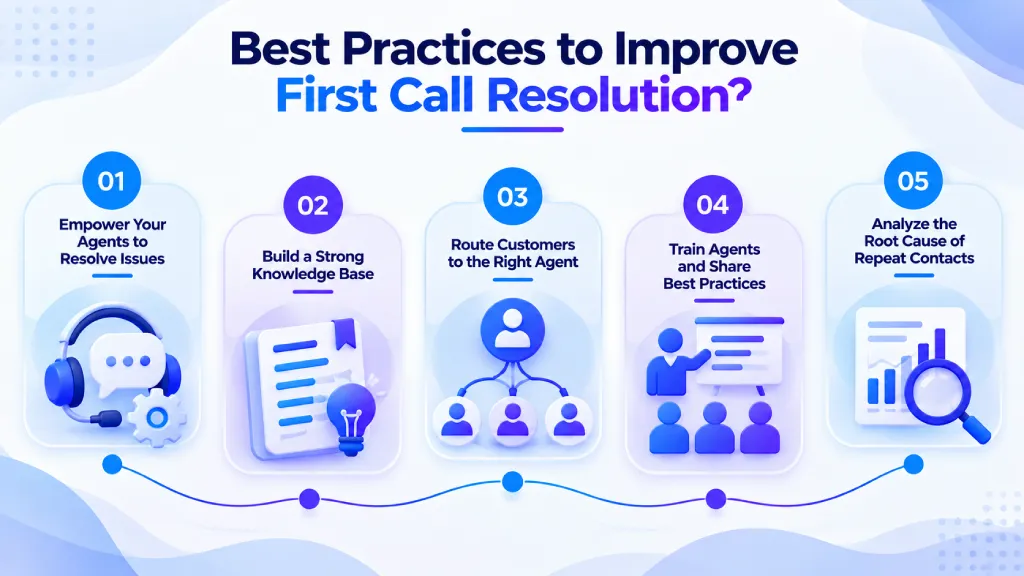
1. Empower Your Agents to Resolve Issues
When an agent has to escalate every unusual request or wait for approval, the call ends without a resolution. Give your frontline team the authority to issue refunds, waive fees, or make judgment calls within clear limits. The fewer approvals an agent needs, the more issues they close on the first try.
2. Build a Strong Knowledge Base
Your agents should not have to search through scattered documents while speaking with a customer. A clear and searchable knowledge base gives them quick access to accurate answers, troubleshooting steps, and resolution procedures.
Keep the content current and organize it around the issues your customers actually raise. When your agents can quickly access the right information, they have a better chance of resolving the issue during the first interaction.
3. Route Customers to the Right Agent
A customer who reaches the wrong agent may need a transfer, escalation, or another call before getting a solution. Skills-based routing can help match each issue with an agent who has the right knowledge and experience. Review which issue types create the most transfers and repeat contacts. Use those patterns to improve your routing rules and send customers to the right support skill from the start.
4. Train Agents and Share Best Practices
Training should not stop after onboarding. Your agents need regular opportunities to strengthen product knowledge, practice difficult scenarios, and improve how they diagnose customer issues.
Pay attention to how your strongest agents handle common problems. Share those approaches with the wider team so your first-call resolution strategies come from real interactions rather than theory.
5. Analyze the Root Cause of Repeat Contacts
A repeat contact tells you that something did not work the first time, but the number alone does not tell you why. Look at the issue behind each repeat contact and identify the pattern.
You may find that customers keep calling about the same product issue, policy, process, or type of request. Once you identify the cause, you can fix the underlying problem instead of simply trying to handle repeat calls faster. This helps your team prevent the same issues from creating repeat contacts.
Common Challenges in Improving FCR
Improving FCR can be difficult when your support process creates repeat work before your agents can fully resolve an issue. These are some of the common challenges that can keep your first call resolution rate from improving.
- Unclear Resolution Criteria: You and your agents may not agree on what counts as "resolved," and this inconsistency skews your call resolution numbers and hides the real gaps in performance.
- High Agent Turnover: Frequent turnover can leave your team with less experienced agents. New agents need time and training to build the knowledge and skills required to resolve issues confidently.
- Sudden Spikes in Call Volume: A sudden increase in call volume can put extra pressure on your agents. When your team has to handle more calls with limited capacity, rushed interactions can increase the chances of repeat contacts.
- Multiple Support Channels: Your customers may contact your team through calls, chat, email, and social media. Tracking whether an issue was fully resolved across these channels can become more difficult than tracking phone interactions alone.
- Disconnected Support Systems: When your CRM, ticketing system, and call platform do not share information, your agents may not have the complete customer history. Missing context can make it harder to resolve issues during the first interaction and can lead to avoidable follow-up calls.
Are workload gaps making it harder to keep customer support performance on track?
Try Time Champ to track focus patterns and see where productivity gets disrupted.
Conclusion
First call resolution is ultimately about solving the right problem the first time. A healthy FCR rate can reduce repeat contacts, support better customer experiences, and help your agents spend less time on repeated work. Keep your focus on the issues behind repeat contacts, not just the number on your dashboard.
If you are looking for better visibility into agent productivity, Time Champ can support your coaching and performance efforts with useful work data. This can help you strengthen the practices that contribute to better FCR.

Thasleem Shaik

Table of Content
 What Is First Call Resolution (FCR)?
- First Call Resolution vs First Contact Resolution
- Why Is First Call Resolution Important?
- How to Measure First Call Resolution?
- What are the Best Practices to Improve First Call Resolution?
- Common Challenges in Improving FCR
- Conclusion
Related Blogs
Learn simple ways to measure and boost call center productivity, helping your team work more efficiently and improve customer service.
Jahnavi Pulluri | Jan 10, 2025
How to start a call center using a complete setup process covering costs, software, staffing, compliance, operations, and business planning.
Thasleem Shaik | Jul 29, 2026
Discover the 10 best call centre quality assurance software for 2025. Compare features, pricing, pros, and cons to boost service quality and performance.
Thasleem Shaik | Nov 07, 2025
Discover the ultimate guide to call centre workforce management. Learn key functions, pros, cons, optimisation tips, and how real-time WFM boosts ROI.
Thasleem Shaik | Oct 01, 2025
The Candidate Call Back Rate indicates the number of candidates who are contacted for the next steps of the job application process.
Vijaya Lakshmi | Apr 02, 2024
Discover the 18 global best call center outsourcing companies to optimize customer support. Choose from leading names for exceptional service and efficiency.
Mounika Sai | Nov 16, 2023


 4.7/5 avg.
Ready to Manage Your Workforce Smarter?
Join our family of 1500+ companies using smart insights to redefine workforces!

Free Trial
No Credit Card Required