How to Build a Call Center QA Scorecard: Steps + Examples
Build a call center QA scorecard that supports consistent call reviews. See essential criteria, scorecard types, scoring methods, and real examples.
A call center can handle hundreds or even thousands of conversations in a day. But the real question is not just how many calls are answered. It is how well those calls are handled.
Did the agent understand the customer? Was the answer accurate? Was the process followed? Was the issue resolved properly?
A QA scorecard helps you answer these questions with clarity instead of assumptions. In this blog, we’ll show you how to build a call center QA scorecard step by step, along with examples that make the process easier to apply.
What Is a Call Center QA Scorecard?
A call center quality assurance scorecard is a structured evaluation form used to score customer interactions based on a set of weighted criteria. Instead of judging a call by personal opinion, you rate specific behaviors, such as how the agent started the call, solved the customer’s issue, and followed required compliance steps. These ratings are then combined into one consistent score.
This structure makes the scorecard useful. Without it, one evaluator might consider a call to be “good service,” while another might mark it down because the agent missed a required disclosure. A scorecard removes this guesswork by setting clear standards. This ensures that every agent is evaluated in the same way and that each score has the same meaning across the team.
Why Does a Call Center Need a QA Scorecard?
A good call should meet more than one standard. You need a way to check whether the agent communicated clearly, handled the issue correctly, followed required processes, and gave the customer a positive experience. A QA scorecard brings these checks into one clear framework.
Here are the main ways it helps you keep call quality consistent and turn evaluations into useful action.
- Keep Every Evaluation Consistent: A clear scorecard gives you the same criteria for every review. You can reduce guesswork and make sure different evaluators judge the same behaviors against the same standards.
- Make Coaching More Focused: An overall score can show that a call did not meet expectations, but the individual criteria help you understand what went wrong. You can then identify gaps in communication, issue resolution, compliance, or call handling and use this information to guide your next coaching conversation.
- Track Quality Beyond a Single Call: One evaluation gives you a snapshot. Repeated evaluations help you spot patterns across calls, agents, and call types. You can see whether quality is improving, where problems keep appearing, and which areas need more attention.
- Turn Quality Standards into Measurable Results: Terms like good communication or great service can mean different things without clear definitions. A scorecard turns those expectations into specific criteria and scores, giving you a more practical way to measure whether your calls meet the standard.
Do you know how productive your agents are beyond their QA scores?
Try Time Champ to see your team’s productivity and focus time in one clear view.
What Are the Different Types of QA Scorecards?
Not every scorecard measures the same thing. Using the wrong type can make your QA program less useful. Here are the main types and when to use each one.
1. By Channel
A scorecard designed for phone calls does not always work well for chat or email because the skills being evaluated are different.
- Voice call scorecards focus on tone, listening skills, and how well the agent manages the conversation in real time. These scorecards often require call center monitoring software or a recording system to review the interaction later.
- Chat and email scorecards focus on response time, grammar, and how clearly the agent explains the resolution in writing. Tone of voice is not a factor in these channels.
- Social media and omnichannel scorecards consider the added impact of public interactions. Criteria such as brand consistency and response speed may carry more weight than they would in a private call.
2. By Call Type or Purpose
The purpose of the interaction determines what “good” looks like.
- Inbound support scorecards focus mainly on problem resolution and empathy because the customer usually contacts the team with an existing issue.
- Outbound sales scorecards evaluate persuasion, objection handling, and whether the agent follows the pitch structure without sounding scripted.
- Compliance-focused scorecards center on required disclosures and proper data handling. These scorecards are also more likely to include auto-fail criteria. Teams handling regulated processes often rely on dedicated QA software because manual reviews alone may not catch every risk.
- Onboarding or new-hire scorecards are more forgiving about polish. They focus on whether the agent is following the basic process correctly. This makes them useful for teams that are starting a call center or training new employees.
How to Build a Call Center QA Scorecard: Step by Step
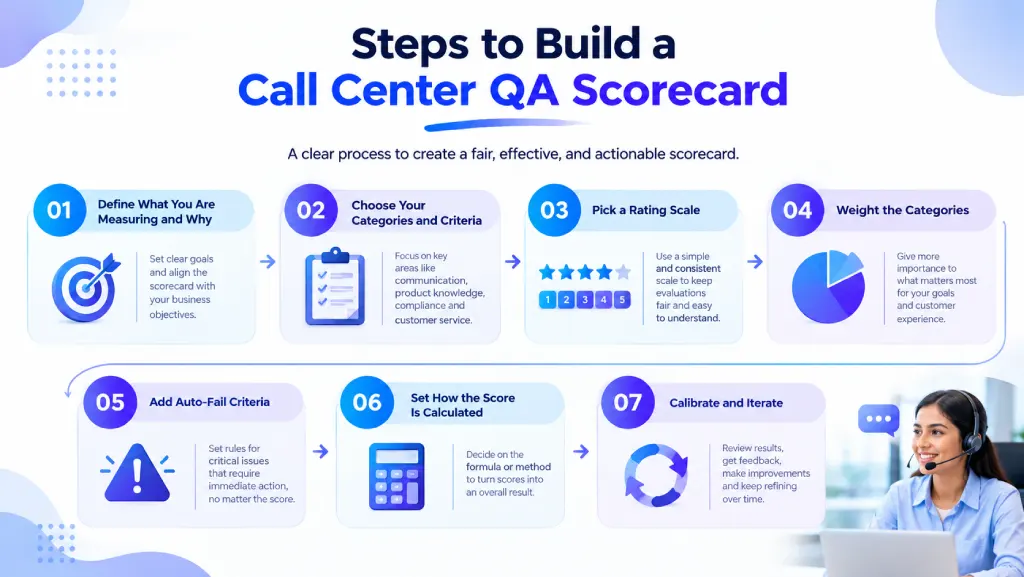
A useful scorecard starts with a clear purpose. Before you add questions or choose a rating scale, decide what you want the evaluation to tell you. From there, you can build the criteria, assign the right weights, set critical fail rules, and create a scoring method that reflects your priorities.
Follow these steps to build a scorecard that gives you consistent and useful evaluations.
Step 1: Define What You Are Measuring and Why
Start by deciding what a successful interaction looks like for your call center. Your goals should guide everything that follows.
If you want to improve customer satisfaction, your scorecard may give more attention to communication, empathy, and resolution. If compliance matters most, you may give greater importance to required disclosures and data handling. You can also align the scorecard with goals such as QA score, first-contact resolution, or customer satisfaction.
A clear purpose keeps your scorecard focused and prevents you from adding criteria that do not help you measure quality.
Step 2: Choose Your Categories and Criteria
Most scorecards, regardless of industry, cover the same core categories. Here's a ready-to-use starting point:
| Category | Example Criteria |
|---|---|
| Opening and verification | Used the correct greeting, branded the call, and verified identity or account per policy |
| Communication skills | Spoke clearly, used a positive tone, listened actively, showed empathy |
| Problem resolution | Diagnosed the issue, gave accurate information, resolved it (ideally on first contact) |
| Compliance and process | Gave required disclosures, followed the process and scripts, and protected customer data (often auto-fail) |
| Professionalism | Stayed courteous and patient, personalized the interaction, managed hold time |
| Closing | Summarized the resolution, set clear next steps, ran a satisfaction check |
The table above includes the categories used on most scorecards. Adjust the individual criteria to fit your call types. For example, a billing dispute call and a technical support call may use the same category headings but need different criteria.
Step 3: Pick a Rating Scale
Choose a scoring method that fits the level of detail you need.
A binary scale works well when an item has a clear yes or no answer. A 1 to 3 scale keeps evaluations simple while adding some room for judgment. A 1 to 5 scale gives you more room to distinguish between different levels of performance.
You can also combine methods. For example, you can use yes or no for compliance requirements and a 1 to 5 scale for communication or empathy.
Keep the scale easy to understand. More rating options do not automatically give you better evaluations. They can also make scoring harder to apply consistently. Zendesk currently supports binary, 3-point, 4-point, and 5-point rating scales for this reason.
Step 4: Weight the Categories
Not every part of a call has the same impact. Give more weight to the areas that matter most to your goals.
For example, you may give problem resolution and compliance more weight than the opening greeting. If a missed disclosure creates serious risk, that requirement should carry more importance than a minor issue with call flow.
Step 5: Add Auto-Fail Criteria
Some mistakes are too serious to offset with strong performance in other areas. Mark these as auto-fail items.
Common examples include a serious compliance breach, unauthorized disclosure of customer information, or abusive behavior. If an agent triggers an auto-fail condition, the entire evaluation can receive a zero even when the rest of the call scores well.
Step 6: Set How the Score Is Calculated
Once you have your criteria, rating scale, and weights, decide how you will turn the results into one overall score.
For a straightforward percentage-based model, use this formula:
QA Score (%) = (Points Earned ÷ Total Possible Points) × 100
For example, if an evaluation earns 84 points out of a possible 100, the QA score is 84%.
If the evaluation triggers an auto-fail, the critical rule overrides the regular calculation and sets the final score to zero.
Make the calculation easy to follow. A clear formula helps you explain the result and keeps the scoring process transparent.
Step 7: Calibrate and Iterate
A scorecard is not a one-time document. Hold calibration sessions where multiple evaluators score the same call and compare their results. If their scores differ significantly, clarify the criteria and add specific examples.
Review the scorecard regularly as products, policies, and customer expectations change. Update the categories and weights when needed, so the scorecard remains accurate and useful.
Does your QA score explain why performance is falling short?
Try Time Champ to uncover the performance patterns behind the numbers.
QA Scorecard Examples for Different Call Types
Your evaluation criteria should match the channel you use to serve customers. A voice interaction needs a different quality check than a chat or email response. The following examples show how you can adjust your quality assurance scorecard to focus on the behaviors that matter most for each channel.
1. Voice Call QA Scorecard
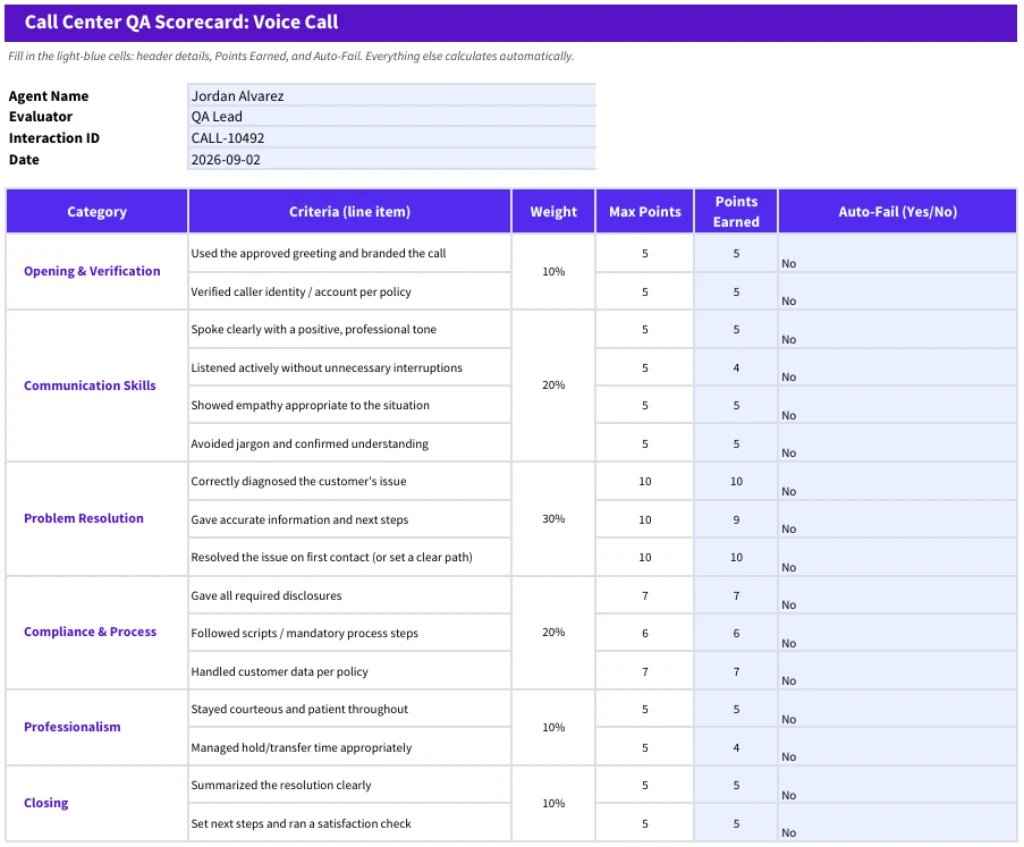
A voice call scorecard focuses on how effectively the agent handles a live conversation from start to finish. It covers the opening and caller verification, communication skills, problem resolution, compliance, professionalism, and closing. The template also gives more weight to problem resolution, so you can place greater importance on diagnosing the issue, providing accurate next steps, and resolving the request during the interaction.
2. Chat QA Scorecard
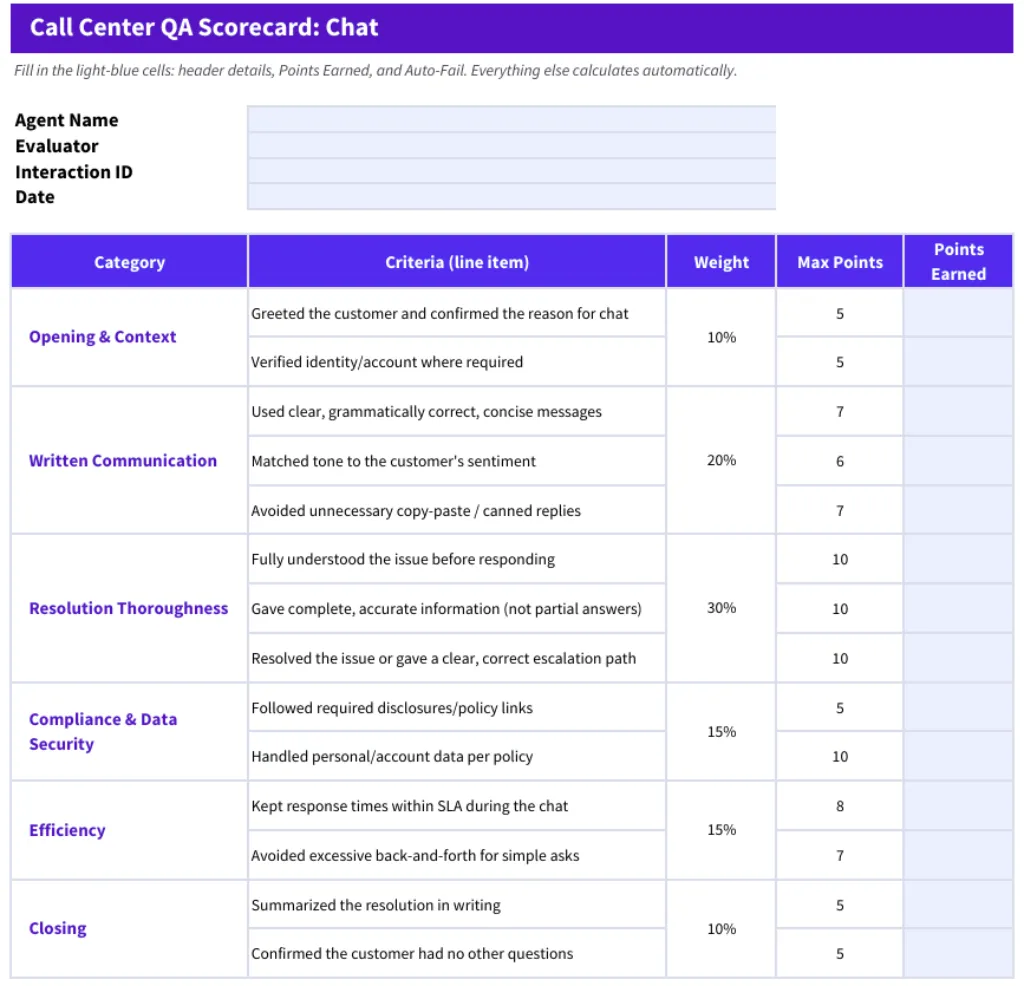
A chat scorecard evaluates the quality of written conversations while also considering how efficiently you respond. It checks whether you understand the customer's issue, communicate clearly, avoid unnecessary back-and-forth, and provide a complete resolution. The template also includes response-time expectations, compliance, and data security to help you evaluate both the customer experience and the accuracy of the interaction.
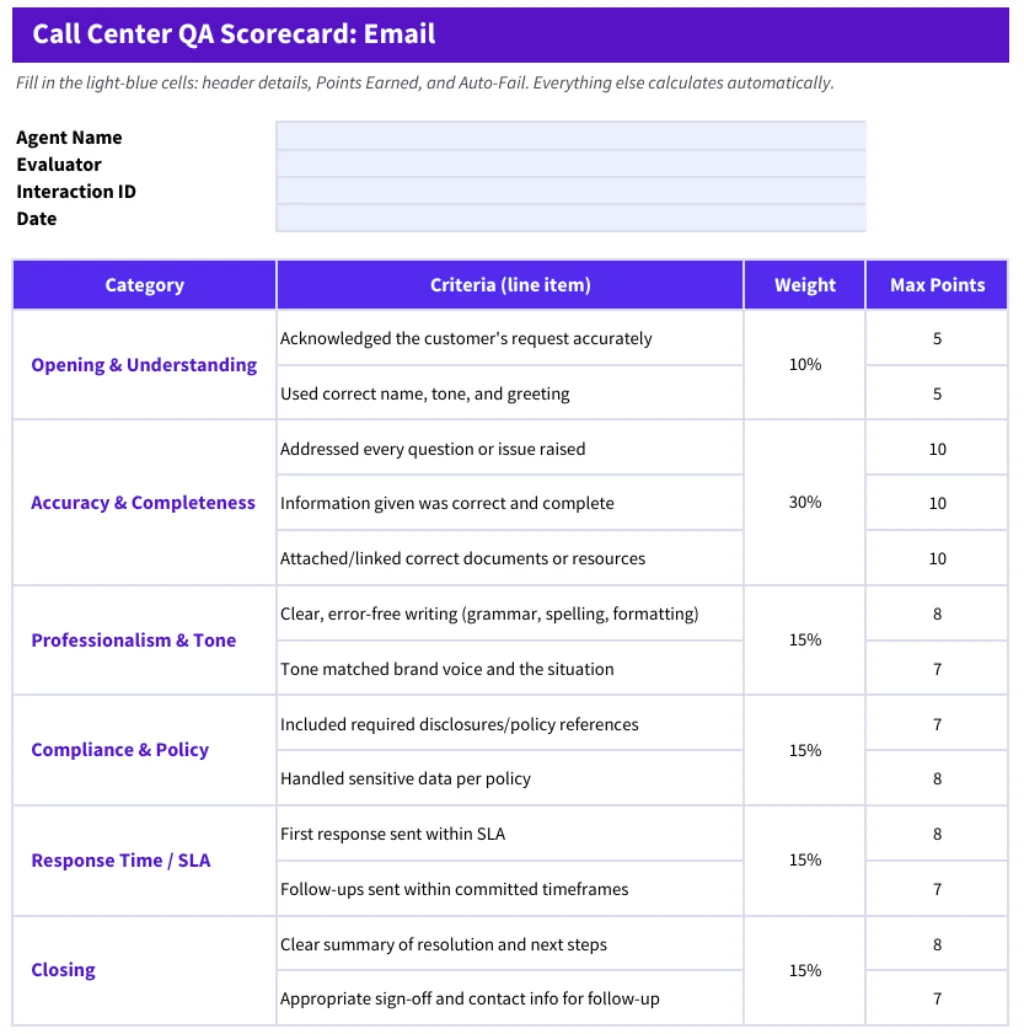
3. Email QA Scorecard
An email scorecard focuses on accuracy, completeness, and professional written communication. It checks whether you address every question, provide correct information, include the right resources, follow required policies, and respond within the expected timeframe. The template also evaluates the closing so you can confirm that the customer receives clear next steps and appropriate follow-up information.
Call Center QA Scorecard Best Practices
A good scorecard only helps when it is used well. These practices separate a scorecard that improves quality from one that simply sits in a spreadsheet:
- Keep criteria observable, not subjective. Evaluators should score what they can see or hear, not guess the agent’s intent.
- Review enough calls per agent to identify meaningful patterns, not just one or two calls.
- Weight categories based on business risk and customer impact, rather than giving every category the same weight.
- Always pair a numeric score with written feedback so agents know what to improve.
- Hold regular calibration sessions so evaluators score the same call in a consistent way.
- Review and update the scorecard regularly as products, policies, and priorities change.
- Remember that a quality score shows how well a call was handled, not how productively the agent worked. For a broader view of performance, you can use Time Champ to see how agents manage their time, productivity, and adherence.
Want a clearer view of agent performance beyond QA scores?
Try Time Champ to track team productivity and identify where agents need support.
Conclusion
A strong quality assurance scorecard turns call reviews into clear, measurable feedback. With the right structure, you can see where interactions meet expectations, where gaps appear, and what needs attention next. When you want to connect those quality insights with how efficiently your team works, Time Champ helps you add productivity and adherence data to the picture.

Thasleem Shaik

Table of Content
 What Is a Call Center QA Scorecard?
- Why Does a Call Center Need a QA Scorecard?
- What Are the Different Types of QA Scorecards?
- How to Build a Call Center QA Scorecard: Step by Step
- QA Scorecard Examples for Different Call Types
- Call Center QA Scorecard Best Practices
- Conclusion
Related Blogs
Learn simple ways to measure and boost call center productivity, helping your team work more efficiently and improve customer service.
Jahnavi Pulluri | Jan 10, 2025
Discover the 18 global best call center outsourcing companies to optimize customer support. Choose from leading names for exceptional service and efficiency.
Mounika Sai | Nov 16, 2023
Discover the 10 best call centre quality assurance software for 2025. Compare features, pricing, pros, and cons to boost service quality and performance.
Thasleem Shaik | Nov 07, 2025
How to start a call center using a complete setup process covering costs, software, staffing, compliance, operations, and business planning.
Thasleem Shaik | Jul 29, 2026
Contact center services help businesses manage customer support across multiple channels. Compare types, benefits, costs, technologies, and AI trends.
Thasleem Shaik | Aug 10, 2026
Explore the essential metrics to accurately measure and enhance your sales productivity, helping your team work smarter and achieve higher results.
Jahnavi Pulluri | Jan 11, 2025


 4.7/5 avg.
Ready to Manage Your Workforce Smarter?
Join our family of 1500+ companies using smart insights to redefine workforces!

Free Trial
No Credit Card Required