What Is BPO Capacity Planning? Formula, Steps & Strategies
BPO capacity planning helps you avoid overstaffing and capacity gaps. See the formula, planning process, strategies, and ways to improve resource use.
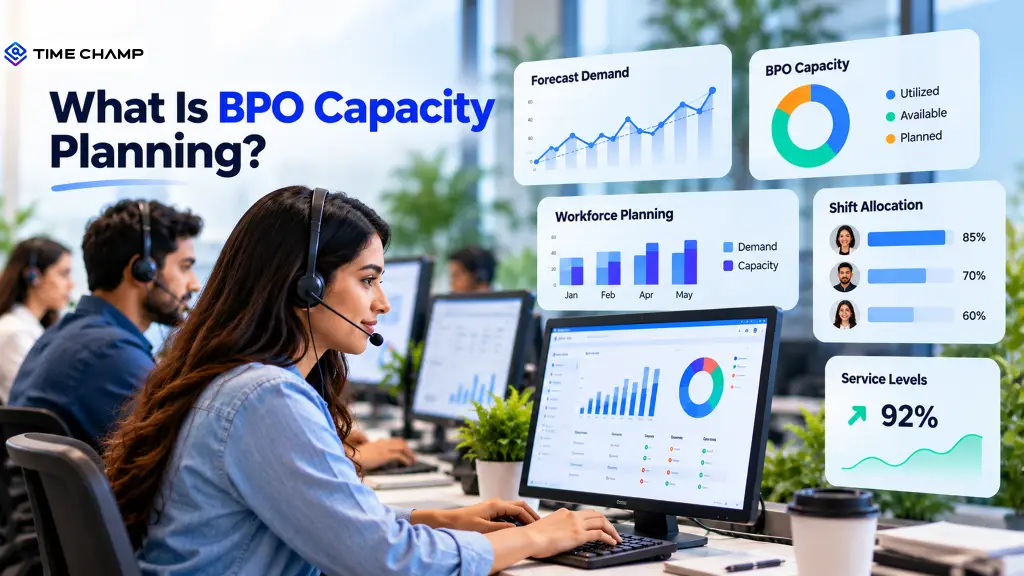
Capacity planning in BPO is not just about filling seats. It is about making sure the right number of people, with the right skills, are available at the right time to handle the work without delays, burnout, or unnecessary costs.
This guide explains BPO capacity planning in a simple way, including how to calculate capacity, how the planning process works, and what strategies can help you manage resources with more control and confidence.
What Is BPO Capacity Planning?
BPO capacity planning is the process of working out how much agent capacity you need to handle your forecasted workload while meeting service levels and controlling costs. It answers one core question. Do you have enough productive hours and headcount to handle the demand coming your way without overspending or burning out your team?
This isn't limited to voice. Capacity planning in BPO also covers chat and email queues, since each channel has its own volume patterns and handling times. It also isn't a one-time exercise. You use it for your current operations to identify daily and weekly gaps, and you use it to plan for future growth, new client ramps, and seasonal spikes. This helps you scale your headcount before demand outpaces your capacity, rather than reacting after the gap appears.
Capacity Planning vs Manpower Planning
Capacity planning and manpower planning work together, but they answer different questions. Capacity planning tells you how much productive capacity your workload requires. Manpower planning turns that requirement into the workforce you need to hire, schedule, and place.
Here’s a quick comparison to show where each one fits.
| Factor | Capacity Planning | Manpower Planning |
|---|---|---|
| What It Measures | Productive hours and available bandwidth | Headcount and staff on payroll |
| Core Question | Do you have enough productive hours to cover the forecasted workload? | How many agents do you need to hire and place on the roster? |
| What It Accounts For | Forecasted volume, AHT, shrinkage, occupancy | Hiring timelines, attrition, and shift allocation |
| Output | Required FTE and productive hours per interval | Headcount targets, hiring plan, roster, and shift schedule |
| Time Horizon | Short to mid-term, tied to demand cycles | Mid to long term, tied to hiring cycles |
| Where It Sits in the Process | Comes first, turns demand into a productive hour requirement | Comes next, turns that requirement into hiring and scheduling decisions |
Do you know where your planned workforce capacity is actually going?
Use Time Champ to track productive and idle time for clearer capacity insights.
Why Capacity Planning Matters in BPO
BPO demand can change quickly, while your available workforce cannot always adjust at the same pace. A strong capacity plan helps you prepare for those changes before they turn into service gaps, unnecessary labor costs, or pressure on your team.
Here are the key reasons capacity planning matters in BPO operations.
- Protects Service Levels: You can align your available capacity with expected workload and give your team enough coverage to meet SLA targets. This helps you avoid long queues, missed response targets, and service disruptions when demand rises.
- Controls Labor Costs: Labor makes up a major part of BPO operating costs. Capacity planning helps you avoid carrying more capacity than you need during slower periods while reducing the need for costly overtime when demand increases.
- Reduces Workload Pressure: When your capacity falls short of demand, your team has to handle more work with fewer productive hours available. Planning ahead helps you maintain a healthier workload balance and reduce the risk of sustained pressure, burnout, and rising attrition.
- Supports Growth and Client Ramps: A new client, seasonal spike, or higher service volume can quickly change your staffing requirements. Capacity planning gives you time to prepare your workforce, training, and coverage before the additional workload reaches your operation.

Did You Know?
Annual agent turnover across the call center industry runs 40 to 45 percent, with first-year attrition reaching 65 to 70 percent, according to Insignia Resources. This level of turnover makes proactive capacity planning essential for maintaining stable coverage and reducing the operational impact of frequent agent replacement.
The BPO Capacity Planning Formula
Once you know the workload ahead, the next step is turning that demand into the productive capacity you need. The calculation starts with forecasted volume and average handle time, then accounts for the hours your team can realistically spend handling work.
The basic model is
Required productive hours = Forecasted volume × AHT
Effective hours per agent = Scheduled hours × Occupancy × (1 − Shrinkage)
FTEs required = Required productive hours ÷ Effective hours per agent
This gives you a practical estimate of the workforce capacity required for a given period. Your actual staffing plan can also depend on service-level targets, channel mix, skills, and interval-level demand.
Inputs You Need
Before you run the calculation, you need a few reliable inputs.
- Forecasted Contact Volume: Start with the expected number of calls, chats, or emails for the period you are planning.
- Average Handle Time (AHT): Use the average time required to handle each contact, including the relevant after-contact work.
- Shrinkage: Account for time when your scheduled workforce cannot handle customer work, such as breaks, training, meetings, leave, and absence.
- Occupancy: Set a realistic target for the share of available time your team spends actively handling work. Your target should balance capacity with a sustainable workload.
- Scheduled Hours: Use the actual hours each agent is scheduled to work during the planning period.
Worked Example
Suppose you expect 5,000 calls per day and your average handle time is 6 minutes.
First, calculate the total workload.
5,000 × 6 minutes = 30,000 minutes
That gives you 500 productive hours of required workload.
Now assume each agent has an 8-hour shift, with a 75% occupancy target and 30% shrinkage.
8 × 0.75 × (1 − 0.30) = 4.2 effective hours per agent
Now divide the total workload by the effective hours available from each agent.
500 ÷ 4.2 = 119.05
You would need to plan for 120 agents after rounding up.
The example shows why scheduled headcount alone can give you a misleading picture. From an 8-hour shift, only 4.2 hours count toward the planned productive capacity after applying occupancy and shrinkage assumptions. A small change in either factor can significantly change the FTE requirement.
The BPO Capacity Planning Process: Step by Step
A reliable capacity plan starts well before you calculate your final headcount. Start with real data from your operation. Then account for the time your team spends away from customer work and prepare for changes in demand.
Here’s how the process works from start to finish.
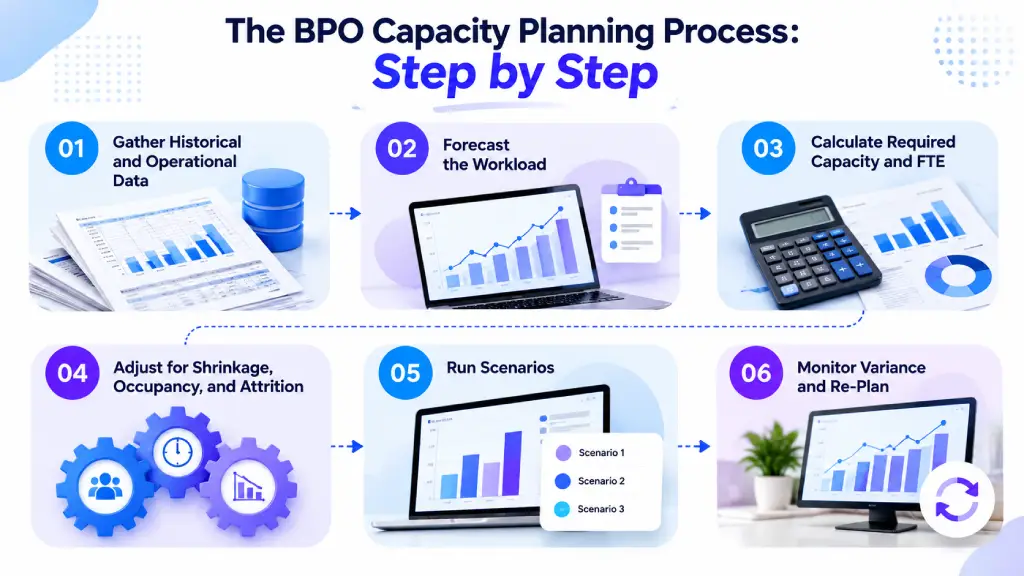
Step 1: Gather Historical and Operational Data
Start with your own data, not assumptions. Review volume history by interval, average handle time, shrinkage, occupancy, and attrition from at least the past few cycles. If your business is seasonal, compare the same period from the previous year. Your plan is only as reliable as the data behind it, so correct any issues with attendance or productive-hours records before making calculations.
Step 2: Forecast the Workload
Use your historical data to forecast demand for the upcoming period. Include expected volume and AHT for voice, chat, and email, as well as seasonality, marketing campaigns, and account growth. Capacity planning does not predict demand; it turns the forecast into the number of people you need.
Step 3: Calculate Required Capacity and FTE
Now convert the expected workload into the productive hours you need. Use forecasted volume and AHT to calculate the workload, then apply your capacity formula to estimate the required FTEs.
Run the calculation for the periods that matter to your operation, whether that means intervals, days, weeks, or months. For voice operations with specific service-level targets, interval staffing may require more detailed queueing methods such as Erlang C.
Step 4: Adjust for Shrinkage, Occupancy, and Attrition
Your raw FTE number assumes that every scheduled hour is productive, but that is never the case. Account for shrinkage, target occupancy, and expected attrition so the headcount you plan for matches the number of people you will actually have available to handle calls. Also, include ramp time for new hires, since trainees rarely reach full productivity during their first few weeks.
Step 5: Run Scenarios
Do not build your plan around one outcome. Create different scenarios for expected demand, higher-than-expected demand, and lower demand.
Consider seasonal peaks, client growth, campaign activity, and other events that could change your workload. Scenario planning helps you decide when to add capacity, adjust schedules, or prepare additional coverage before a gap affects service levels.
Step 6: Monitor Variance and Re-Plan
A capacity plan is a living document, not a one-time deliverable. Regularly compare planned and actual volume, AHT, shrinkage, and adherence. Re-plan when the gap becomes significant. This process connects your capacity plan to day-to-day intraday management and closes the loop between what you planned and what actually happened in the operation.
Are workforce data gaps making it harder to plan the right capacity?
Try Time Champ to bring attendance, productivity, and idle-time data into clear view.
Best Strategies for Capacity Planning in BPO
Good capacity planning is not only about choosing the right number of employees. Customer demand and employee availability can change, and your estimates may not always match actual results.
Here are practical strategies that can help you keep your capacity plan realistic and responsive.
1. Plan Across Multiple Time Horizons
Don't rely on a single annual number. Build your capacity plan at three levels: a monthly view for budgeting and hiring, a weekly view for shift and roster adjustments, and a daily intraday view for real-time coverage. Each level helps you manage the next. The monthly plan sets the overall direction, while weekly and daily adjustments keep your staffing aligned with actual demand.
2. Keep Occupancy at a Sustainable Level
Avoid planning for maximum utilization. A healthy occupancy target gives your team enough room to handle work without creating constant pressure. Your target should reflect the nature of the work and the service levels you need to maintain.
3. Use Flexible Staffing Options
Your staffing model should give you room to respond when demand changes. Cross-training, shift adjustments, part-time coverage, temporary staffing, or other flexible options can help you add capacity during peaks without carrying the same level of staffing during slower periods.
4. Use Real Operating Data
Base your decisions on what your workforce actually delivers, not just scheduled hours. Accurate attendance, productive time, idle time, and utilization data can give you a clearer picture of your available capacity.
How Time Champ Improves Capacity Planning in BPO
A capacity plan is only as strong as the attendance, shrinkage, and productivity data behind it. Many BPOs create these plans using assumptions or last month’s spreadsheet. Then, they wonder why the actual workforce numbers do not match the forecast. Closing this gap requires BPO time tracking software that records attendance, idle time, and productive hours in real time instead of weeks later.
Time Champ brings these workforce signals into one place, helping you build capacity plans on reliable operational data and compare planned capacity with actual workforce availability.
Here is how Time Champ provides reliable data for your capacity planning process:
- Attendance Tracking: Track attendance, working hours, breaks, and absences to see how much scheduled capacity your workforce actually provides.
- Productivity Tracking: Measure productive hours and productivity trends across teams to see how much of your available work time contributes to customer work.
- Idle Time Detection: Identify idle periods and gaps in active work to separate scheduled hours from the time your workforce actually spends working.
- Shift Scheduling: Plan shifts around employee availability, working hours, and time zones. Track shift coverage and spot late arrivals, absences, or coverage gaps that can affect available capacity.
- Resource Allocation: Review workload, task hours, and workforce availability to make better resource allocation decisions and avoid leaving available capacity unused.
- Workforce Analytics: Compare work hours, attendance, productivity, and utilization trends across teams and time periods. Use these insights to check whether your capacity assumptions match actual operating patterns.
Worried about losing capacity when shift coverage changes unexpectedly?
Try Time Champ to monitor shift attendance and keep your available workforce visible.
Conclusion
BPO capacity planning helps you match workforce capacity with the workload ahead while keeping service levels, costs, and team workload in balance. A reliable plan starts with accurate data and regular adjustments as demand changes. If you want clearer visibility into attendance, productive hours, idle time, and workforce availability, Time Champ can give you the data you need to support better capacity decisions.

Thasleem Shaik

Table of Content
 What Is BPO Capacity Planning?
- Capacity Planning vs Manpower Planning
- Why Capacity Planning Matters in BPO
- The BPO Capacity Planning Formula
- The BPO Capacity Planning Process: Step by Step
- Best Strategies for Capacity Planning in BPO
- How Time Champ Improves Capacity Planning in BPO
- Conclusion
Related Blogs
Download free capacity planning templates in Excel, Word, and PDF to plan workloads, balance team capacity, and manage resources with clarity.
Thasleem Shaik | Apr 03, 2026
Find the best capacity planning software tools for IT, manufacturing, and more. Compare features, pricing, pros, and cons to choose the right tool for 2025.
Guna Lakshmi | Nov 07, 2025
Learn why billing breakdowns damage BPO trust, why clients value workforce intelligence billing, how it strengthens billing models & implementation steps.
Thasleem Shaik | Feb 11, 2026
Learn how to kickstart your BPO business with this comprehensive step-by-step guide, covering everything from planning to execution. Get insights now!
Tarun Kumar Reddy | Nov 17, 2023
Explore the various types of Business Process Outsourcing (BPO) services, their benefits, and how they streamline operations for businesses.
Mounika Sai | Nov 21, 2023
Business process outsourcing (BPO) vs Knowledge process outsourcing (KPO). Discover definitions of BPO and KPO, key functions, similarities, and use cases.
Guna Lakshmi | Apr 02, 2026


 4.7/5 avg.
Ready to Manage Your Workforce Smarter?
Join our family of 1500+ companies using smart insights to redefine workforces!

Free Trial
No Credit Card Required