Attrition vs Retention: The Difference & Why It Matters
Understand attrition vs retention with simple definitions, formulas, key differences, and why a low attrition rate doesn't always indicate strong retention.
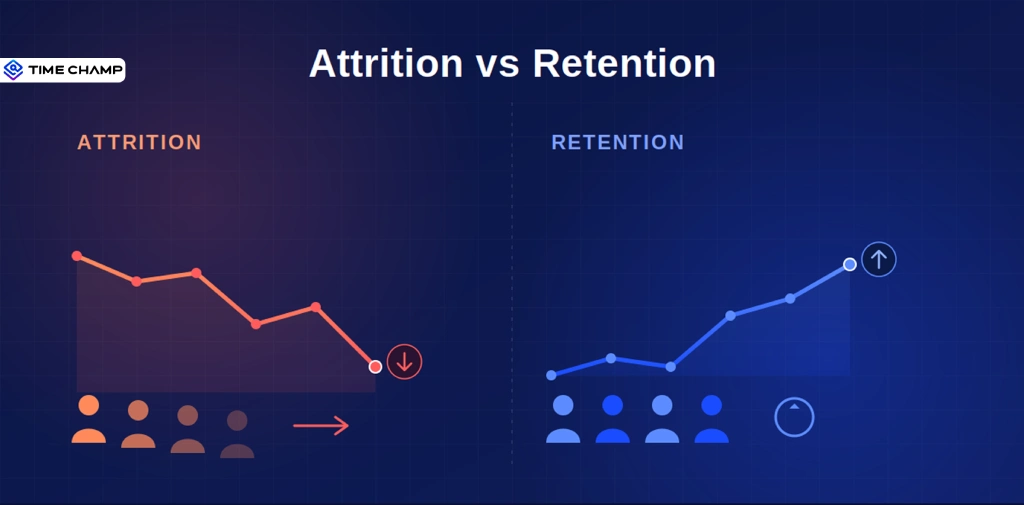
A low attrition rate looks good on a dashboard. But does it always mean your organization is keeping the right people?
Not necessarily.
That's because attrition and retention measure different aspects of your workforce. Attrition tells you how many employees left the company. Retention tells you how successful you are at keeping the people who matter most. Looking at one without the other can leave you with an incomplete picture.
In this blog, I’ll break down the difference between attrition and retention, explain how each metric is calculated, and show why understanding both is essential for building a stronger workforce.
What is Attrition?
Attrition is the gradual reduction of an organization's workforce as employees leave over time. These exits can happen for many reasons, employees may resign, retire, or leave because their role has been eliminated. In HR, attrition is typically measured as the percentage of employees who leave during a specific period, such as a month or a year.
The term attrition isn't exclusive to HR. You'll also come across phrases like customer attrition or military attrition. In this blog, however, we're talking specifically about employee attrition, the loss of employees that reduces an organization's headcount.
What is Retention?
Employee retention is an organization's ability to keep its employees over a given period, usually measured as the percentage of people who remain with the company. While attrition focuses on who left, retention focuses on who stayed.
But retention is about more than simply keeping people on the payroll. Strong retention means holding on to skilled, high-performing employees by creating an environment where they choose to stay and grow.
Attrition vs. Retention: The Key Difference
While attrition and retention are closely related, they measure different aspects of your workforce. Attrition tracks employee exits, while retention reflects your ability to keep the people who matter most.
| Aspect | Attrition | Retention |
|---|---|---|
| What it measures | Employees leaving | Employees staying |
| Focus | Employee exits | Employee loyalty and continuity |
| Direction | Backward-looking (what happened) | Forward-looking (what you're building) |
| Nature | A workforce metric | A talent strategy and business outcome |
| Success looks like | Lower attrition | Keeping high-performing, engaged employees |
| Key question answered | "How many employees left?" | "Are we keeping the right people, and why?" |
| Limitation | Doesn't reveal who stayed or whether losing those employees mattered | Requires identifying which employees are most critical to retain |
The simplest way to remember it: Attrition tells you the score. Retention tells you how to win the game.
How to Calculate Attrition Rate and Retention Rate
The formulas for attrition and retention are similar, but they measure two different things: who left and who stayed. Here's how to calculate each one.
Attrition Rate Formula
Attrition rate is the percentage of employees who left during a specific period, based on the average number of employees during that period.
Attrition Rate = (Employees Who Left ÷ Average Number of Employees) × 100
Example: If 22 employees left during the year and your average headcount was 200:
(22 ÷ 200) × 100 = 11%
Your attrition rate is 11%.
Retention Rate Formula
Retention rate measures the percentage of employees who were with the organization at the start of the period and stayed through the entire period.
Retention Rate = (Employees Who Stayed the Entire Period ÷ Employees at the Start) × 100
Example: If you started the year with 200 employees and 180 of them were still there at the end:
(180 ÷ 200) × 100 = 90%
Your retention rate is 90%.
One Important Point: When calculating retention, don't include employees who joined during the period. Retention is about how many of the people you started with stayed.
The Types of Attrition Worth Knowing
Every employee exit is not a problem. That's why looking at attrition as one overall percentage can hide what's really happening. Breaking it into different types gives you a clearer picture of where action is needed.
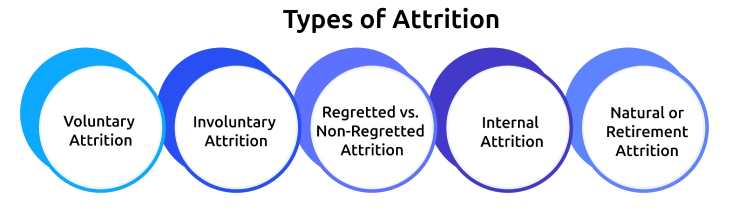
- Voluntary Attrition: Employees choose to leave. This is often the most actionable type because it can point to issues with pay, management, growth, workload, or workplace culture.
- Involuntary Attrition: Employment is terminated by the organization due to performance-related issues, business restructuring, or other operational requirements.
- Regretted vs. Non-Regretted Attrition: Every departure doesn’t have the same impact. Losing a high-performing employee can be costly, while losing someone who isn't a good fit may actually benefit the organization.
- Internal Attrition: An employee moves to another team or role within the organization. You lose the person from one position, but not from the company.
- Natural or Retirement Attrition: Employees leave because they retire or naturally move on from the workforce. These departures are often expected and can usually be planned for.
Why Low Attrition Isn't the Same as Strong Retention
A low attrition rate can look like a sign of a healthy workforce, but it doesn't tell you why people are staying.
Employees may remain with a company because they are engaged and committed, but they may also stay because they're comfortable, uncertain about their options, or simply going through the motions. The attrition number doesn't tell the difference.
That's the trap. You can have low attrition while your most talented employees are disengaging or preparing to leave. When they finally leave, that low attrition rate may not look like much of a win.
Strong retention is about keeping the right people, keeping them engaged, and giving them good reasons to stay.
And the engagement gap is real. Gallup's State of the Global Workplace report found that only 21% of employees globally are engaged at work. So, a workforce with low attrition isn't necessarily a thriving one.
Low attrition tells you people stayed. Strong retention tells you they stayed for the right reasons.
Look Beyond Employee Turnover!
Measure engagement, identify hidden challenges, and build a workplace where employees thrive.
How to Shift from Tracking Attrition to Driving Retention
If you want to move beyond simply tracking exits, start focusing on the factors that make people stay.
- Break Down Your Attrition: Separate voluntary and involuntary exits and distinguish regretted departures from healthy ones. Ten routine exits may matter less than one key employee choosing to leave.
- Identify the People You Most Want to Retain: Retention starts with knowing which employees, skills, and roles are critical to your organization.
- Track Engagement, Not Just Exits: Look for early signs of disengagement, falling performance, low participation, poor manager relationships, or declining motivation, before they become resignations.
- Act Before People Decide to Leave: Regular stay conversations can uncover concerns while there's still time to address them. An exit interview tells you what went wrong; a stay conversation gives you a chance to change it.
- Look Beyond the Company-Wide Number: Review attrition and retention by team, department, role, and manager. A healthy overall rate can easily hide a team that's steadily losing its best people.
How Time Champ Helps You Go Beyond Attrition
Time Champ is an employee monitoring and time-tracking software with workforce intelligence capabilities. It doesn't calculate attrition or retention rates; that data comes from your HR records. Instead, it helps you look beyond those numbers by showing patterns that may indicate disengagement, burnout, or potential flight risk.
On the retention side, Time Champ can help you identify:
- Identify Attrition Risks Early: Spot employees who may be at risk of leaving, giving you time to take proactive steps before a resignation occurs.
- Engagement and Activity Patterns: Find changes in work patterns and activity levels to identify disengagement early and improve employee satisfaction.
- Burnout and Workload Signals: Detect signs of overwork or underutilization, helping you balance workloads, support employee well-being, and improve retention.
The goal is to give managers and HR teams better visibility so they can have the right conversations at the right time.
Don’t Wait for Employees to Leave!
Find early signs of disengagement, burnout, and attrition risk before they turn into resignations
Conclusion
Attrition tells you how many employees left, while retention tells you how many stayed. But neither number tells you whether the right people are staying or why they chose to stay. That’s why a low attrition rate alone doesn’t mean you have strong retention. Looking at employee exits, engagement, and retention together gives you a better understanding of what’s happening across your workforce.

Jahnavi Pulluri

Table of Content
 What is Attrition?
- What is Retention?
- Attrition vs. Retention: The Key Difference
- How to Calculate Attrition Rate and Retention Rate
- The Types of Attrition Worth Knowing
- Why Low Attrition Isn't the Same as Strong Retention
- How to Shift from Tracking Attrition to Driving Retention
- How Time Champ Helps You Go Beyond Attrition
- Conclusion
Related Blogs

Learn what workforce management software is, how it works, its key features, benefits, types, and how to choose the best solution for your team in 2026.
Jahnavi Pulluri | Aug 07, 2026
Improve workforce productivity with attendance reports that simplify attendance tracking, support workforce planning, and help you make better decisions.
Anjali | Aug 17, 2026
Discover how field service workforce management improves scheduling, boosts team productivity, lowers operational costs, and enhances customer satisfaction.
Jahnavi Pulluri | Aug 22, 2025
Workforce resilience explained: discover its definition, core elements, importance & practical strategies to build adaptability, plus ways to measure success
Chethana Choudary | Sep 01, 2025![Workforce Management vs Workforce Optimisation-[2025]](https://www.timechamp.io/images/workforce-development.webp)
Discover workforce development: definition, strategies, and examples. Learn how to create effective programs, boost skills, and achieve business goals.
Guna Lakshmi | Sep 01, 2025
Workforce Forecasting explained: A step-by-step guide covering importance, models, tools, and implementation to help HR leaders plan smarter for the future.
Thasleem Shaik | Sep 01, 2025


 4.7/5 avg.
Ready to Manage Your Workforce Smarter?
Join our family of 1500+ companies using smart insights to redefine workforces!

Free Trial
No Credit Card Required