7 Types of Team Effectiveness Models for (2026)
Learn what a team effectiveness model is, why it matters, the key types of models, and the pros and cons of using these models to build high-performing teams.
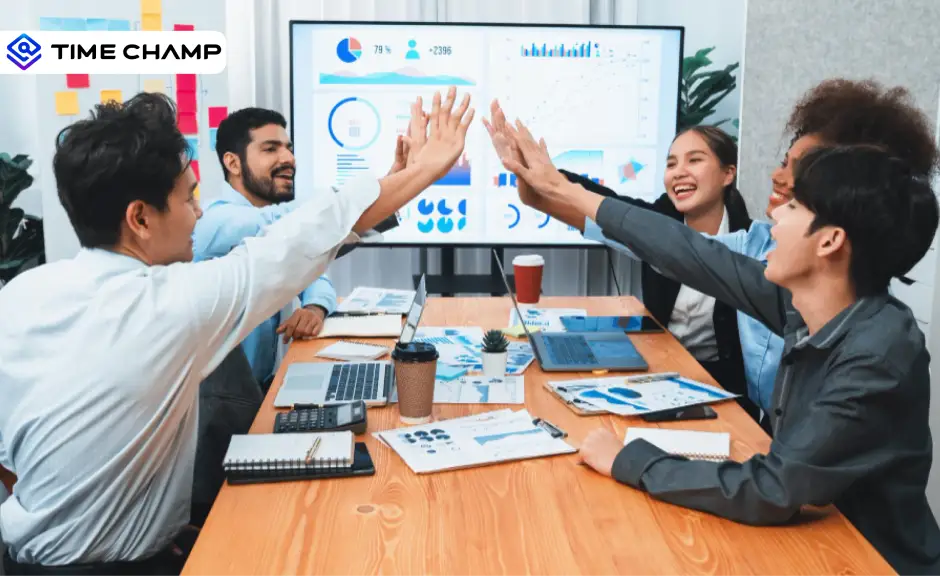
Every day, your team shows signs of how work is actually happening. These can be missed handoffs, overloaded schedules, repeated follow-ups, quiet disengagement, or moments where everything falls into one place. Most of this goes unnoticed until performance drops or deadlines start slipping. Strong best team communication apps compounds over time; each cycle of feedback improves the next rollout.
Team effectiveness models help you read these signals before problems escalate. They turn everyday team behavior, how people collaborate, communicate, and make decisions, into clear insights you can act on. These models help you measure teamwork, identify gaps, and improve collaboration in a structured way.
This guide will teach you what a team effectiveness model is, why it is essential in 2026, the main types of models used by successful organizations, the advantages and disadvantages of using them, and how team leaders can use them to develop high-performing teams in remote workplaces and hybrid workplaces.
What is a Team Effectiveness Model?
The team effectiveness model is an organized framework that explains the key factors influencing how well a team works together and achieves its goals. It provides factors such as objectives, roles, trust, communication, leadership, and processes that directly influence team performance. These models go beyond individual metrics and look at how teamwork actually functions day to day.
You know what? Research by Gallup says that teams with high engagement show 21% higher profitability and 17% higher productivity, proving that team effectiveness directly affects business results.
When team effectiveness is weak, small problems slowly turn into larger issues. Deadlines get extended, misunderstandings increase, and employee morale drops. This proves that improving team effectiveness helps in delivering work better and also creating a stable and motivated work environment.
Importance of Team Effectiveness
Team effectiveness is the main foundation of high performance. When a team works well together, goals become clearer, communication improves, and greater results can be achieved. Here are the main reasons why team effectiveness is important for every organization:
- Improves collaboration and reduces miscommunication
- Increases productivity and output quality
- Helps prevent burnout through balanced workloads
- Builds trust and psychological safety
- Supports faster decision-making
- Enables leaders to manage team effectiveness proactively
Want to see how your team is really performing every day?
Start tracking workload patterns with Time Champ.
What are the 7 Types of Team Effectiveness Models?
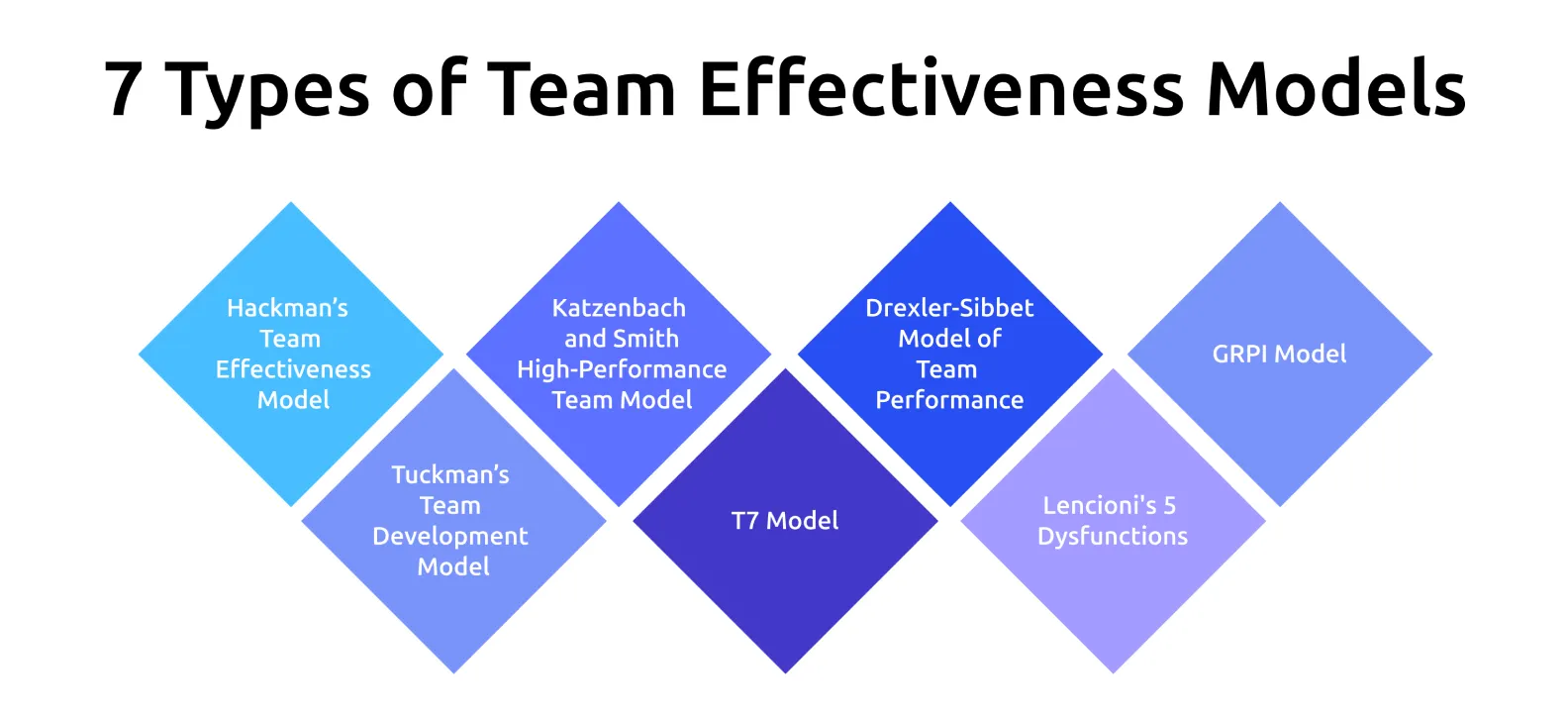
Here are the most popular team effectiveness and teamwork models that you can apply in the creation of high-performance teams.
1. Hackman’s Team Effectiveness Model
Hackman believed that most team problems start with poor design rather than poor effort. Hackman’s model answers one simple question: “Did we design this team properly?” He says that people do not make teams fail due to laziness. They fail because the foundation is weak. His model reminds leaders that setting up the right structure from the beginning prevents many future conflicts. Even talented teams cannot work without clear goals, confusion in roles or lack of support. Hackman shifts the focus from blaming people to fixing the system around them.
Key Elements of Hackman’s Model
- Clear and shared goals that guide daily work
- Well-defined roles and responsibilities
- Right mix of skills within the team
- Supportive organizational systems
- Ongoing coaching and feedback
Best For
- Leadership teams
- New or newly restructured teams
- Organizations struggling with role confusion
- Teams with strong talent but inconsistent results
2. Tuckman’s Team Development Model
Many leaders worry when conflict appears in a team, but Tuckman’s model shows that tension is a normal part of growth. Understanding the stages in Tuckman’s model helps you stay patient and provide the right guidance instead of assuming the team is failing. Tuckman shows that teams naturally go through these phases:
Forming → Storming → Norming → Performing → Adjourning
This model breaks team development into clear phases to assist you in knowing the type of support a team requires during each phase. He found a key insight “Struggles are normal. Ignoring them is the real problem.”
Stages of Team Development
- Forming - Team members are polite but unsure
- Storming - Conflicts and power struggles appear
- Norming - Trust improves, and workflows stabilize
- Performing - Team works efficiently toward goals
- Adjourning - Team wraps up and reflects
Best For
- Growing teams
- Cross-functional teams
- Project-based teams
- Managers new to leadership roles
3. Katzenbach and Smith High-Performance Team Model:
If you’re managing a team that delivers results but lacks strong ownership or accountability, this model helps you understand what’s missing. This model highlights that performance improves when team members feel personally responsible for shared outcomes. According to Katzenbach and Smith, high performance cannot be achieved through talent, it comes from shared commitment and responsibility.
Key Elements of a Katzenbach and Smith High-Performance Team
- Clear and shared purpose
- Specific performance goals
- Complementary skills
- Strong commitment from all members
- Mutual accountability
Best For
- Leadership teams
- Teams with high talent but low accountability
- Organizations aiming for execution excellence
Also Read: 10 Workforce Planning Models Every HR Should Know
4. T7 Model:
If your team has the right people but fails to align with each other, the T7 Model can assist you in digging deeper. According to this model, the effectiveness of a team is based on the internal team factors and external leadership support. It emphasizes that even powerful teams cannot perform effectively when they are not supported by the proper leadership and culture, or systems.
Seven Factors of the T7 Model
- Thrust - Clear and shared goals
- Trust - Confidence among team members
- Talent - Right skills and capabilities
- Teaming skills - Ability to work together
- Task skills - Capability to execute work
- Team leader fit - Leadership alignment
- Team support - Organizational backing
Best For
- Teams that are dependent on leadership direction
- Organizations improving leadership team effectiveness
- Teams affected by organizational changes
- Managers identifying performance issues beyond the team

Did You Know?
Research by Deloitte says that “53 % of executives reported that team-based work improved organizational performance significantly compared to more individual work structures.”
5. Drexler-Sibbet Model of Team Performance:
If your team feels busy all the time but progress feels slow, this model is especially useful for you. The Drexler-Sibbet model assists you in locating the gaps in clarity, whether it is purpose, trust, roles, or commitment. It focuses on how teams move from confusion to high performance by answering critical questions at each stage of collaboration.
Key Elements Drexler-Sibbet Model:
- Purpose and direction clarity
- Role definition and accountability
- Trust and open communication
- Commitment to shared goals
- Continuous review and improvement
Best For
- Hybrid and remote teams
- Teams that are struggling with alignment
- Scaling organizations
- Long-term strategic teams
6. Lencioni's 5 Dysfunctions:
If conflict feels uncomfortable in your team or if accountability is avoided, this model helps explain why. Lencioni shows that failure in teams often begins with a lack of trust. The model helps you in recognizing behavioral problems that silently affect teamwork and performance.
Five Common Dysfunctions
- Absence of trust
- Fear of conflict
- Lack of commitment
- Avoidance of accountability
- Inattention to results
Best For
- Leadership teams
- Teams facing trust or communication issues
- Organizations improving team culture
- Managers addressing behavioral challenges
7. GRPI Model (Goals, Roles, Processes, Interpersonal Relationships):
If you feel that team meetings are not productive and responsibilities are continuing to overlap, then the GRPI model will assist you in knowing where the issues are going wrong. It describes how most problems in teams begin at the top, with unclear goals and move downwards.
Key Components of GRPI:
- Goals - Clear and shared objectives
- Roles - Defined responsibilities
- Processes - Agreed workflows and decision paths
- Interpersonal relationships - Trust and communication
Best For
- Teams facing role confusion
- Process-heavy organizations
- Teams that are struggling with execution
- Managers improving team effectiveness step by step
| Pros | Cons |
|---|---|
| Helps you understand how teams actually work | Need proper interpretation from leaders |
| Makes it easier to spot the real causes of performance issues | Can feel theoretical and difficult if not applied correctly |
| Improves clarity around goals, roles, and accountability | Results depend on consistent follow-ups |
| Supports better leadership and decision-making | Sometimes does not fully reflect every team’s unique situation |
| Useful for remote, hybrid, and on-site teams | Require adjustments as teams grow or change |
How Workforce Intelligence Strengthens Team Effectiveness Models
Teamwork models help you understand what a strong team is supposed to look like, including clear goals, defined roles, trust, and accountability. But in actual workplaces, the main issue is visibility. As a leader, you may know the model yet still struggle to see where collaboration breaks down, workloads become uneven, or pressure starts building inside the team.
This is where Time Champ workforce intelligence bridges the gap. It strengthens team effectiveness by showing the flow of work across teams with automatic time tracking, workload analysis, and productivity insights. Having insight into the active hours, idle time, and team effort patterns, you can apply these models accurately, timely manner, and create a high-performing team that can remain productive without burnout.
Ready to build a high-performing team without burnout?
See how Time Champ helps you manage team effectiveness with clarity.
Conclusion
Building effective teams in 2026 is about understanding how work actually happens inside your team. Team effectiveness models help you read everyday signals, uncover what’s slowing team collaboration. When these models are supported by accurate visibility of workload, effort and collaboration trends, you can ensure teams are able to work regularly without losing their balance and resilience.

Table of Content
-
 What is a Team Effectiveness Model?
-
What are the 7 Types of Team Effectiveness Models?
-
2. Tuckman’s Team Development Model
-
3. Katzenbach and Smith High-Performance Team Model:
-
4. T7 Model:
-
5. Drexler-Sibbet Model of Team Performance:
-
6. Lencioni's 5 Dysfunctions:
-
7. GRPI Model (Goals, Roles, Processes, Interpersonal Relationships):
-
How Workforce Intelligence Strengthens Team Effectiveness Models
-
Conclusion
Related Blogs

Learn what work management is, why it matters, how it differs from project management, its types, process, benefits, and workforce challenges.
Thasleem Shaik | Feb 11, 2026
Stay ahead with 10 workforce management trends that are redefining business success. From digital tools to staff growth, see what’s driving the future of work.
Guna Lakshmi | September 25, 2025
Remote workforce management, also called virtual workforce management, helps teams stay engaged. Explore its definition, benefits, challenges & tools.
Thasleem Shaik | September 16, 2025
Discover the secrets of a remote workforce management with maximum efficiency. Our expert guide offers proven strategies to boost productivity and success.
Mounika Sai | Jun 06, 2023
Workforce management software is a set of tools and processes designed to improve employee productivity in a business.
Mounika Sai | Jan 08, 2024
Learn what workforce optimization (WFO) is, how it works, key components, top strategies, industry uses, software tips, and how WFO differs from WEM in detail.
Guna Lakshmi | September 15, 2025


 4.7/5 avg.
Ready to Manage Your Workforce Smarter?
Join our family of 1500+ companies using smart insights to redefine workforces!

Free Trial
No Credit Card Required