Shared Services vs BPO: Which One Should You Choose?
Compare shared services vs. BPO across ownership, control, scalability, and flexibility, with practical guidance on when each model works best for you.
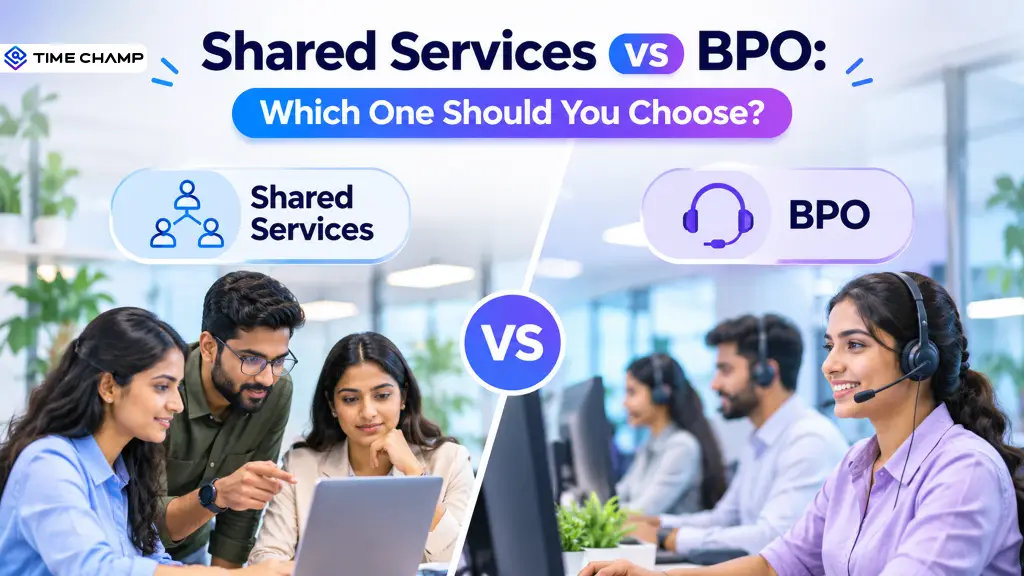
Choosing between shared services and BPO depends on how you want to manage your business processes. Shared services and BPO can both simplify that complexity, but the right choice depends on how much control, speed, and flexibility you need.
In this guide, we’ll look at the differences between BPO and shared services, where each one fits, and when using both can give you a stronger setup.
What Are Shared Services?
Shared services is an operating model in which a company brings common support functions, such as finance, human resources, IT, and procurement, into one central internal team. Instead of having each department manage the same tasks separately, this team delivers standardized services across the organization. This model helps reduce duplicated work, improve consistency, and maintain greater control over processes and business knowledge.
You'll usually see these functions consolidated first, since they involve high transaction volume and repeatable steps.
- Finance and Accounting: Accounts payable, accounts receivable, general ledger, and expense processing.
- Human Resources: Payroll, onboarding, benefits administration, and employee record management.
- IT Support: Help desk, access provisioning, and infrastructure maintenance.
- Procurement: Purchase order processing, vendor management, and contract administration.
What Is Business Process Outsourcing (BPO)?
Business Process Outsourcing (BPO) is a business model where you hire an external service provider to handle specific business processes for you. Instead of building and managing an internal team for that work, you rely on a provider with the staff, skills, systems, and capacity to deliver the process under an agreed contract.

Did You Know
The global BPO market was valued at $328.4 billion in 2025 and is projected to climb to $695.8 billion by 2033, growing at a compound annual rate of 9.9%. That growth shows that BPO is not just a short-term way to reduce costs. It has become a regular part of how many companies manage their operations, alongside the work they keep in-house.
Shared Services vs BPO: What Are the Differences?
You already know that both models exist. The main differences come down to who owns the work, who pays for it, and how much control you keep once it is running. The table below explains the key differences between BPO and shared services side by side, so you can clearly see where each model has an advantage.
| Aspect | Shared Services | BPO |
|---|---|---|
| Ownership | You own the center and everything inside it | A third-party provider owns the operation |
| Who hires the staff | You hire, train, and manage your own team | The provider hires and manages their own workforce |
| Cost type | Mostly fixed salaries, office space, tools | Mostly variable, you pay per transaction or per agreement |
| Time to launch | Takes many months to set up and stabilize | Ramps up in weeks since the provider already runs the setup |
| Control over process | You control every part of the process end to end | You influence the process through contracts and agreed terms |
| Talent and attrition | You handle hiring, training, and turnover yourself | The provider absorbs hiring and turnover on their side |
| Technology investment | You fund and build your own tools and systems | The provider funds tools and spreads the cost across clients |
| Scaling down | Difficult and slow, since you carry fixed staff and space | Easier, since contracts can adjust with notice |
| Data and compliance | Data stays fully inside your own systems | Data sits with the provider under contract terms and audits |
| Best fit for | Work that needs deep context, judgment, or sensitive data | High-volume, repeatable work with clear rules |
Not sure where your time and capacity are really going across your operations?
Use Time Champ to see work patterns, productivity, and performance more clearly.
When Is a Shared Service the Better Choice?
Shared services can make more sense when you want to keep control of the work while gaining the efficiency of a centralized operation. The model works especially well when your processes have steady demand, require business context, or support capabilities you want to build for the long term.
Here are the situations where shared services can be the stronger fit.
- Steady and Predictable Workloads: When your workload stays consistent throughout the year, you can keep your internal team productive and spread the cost of your operation across a stable volume of work.
- Greater Control Over Processes: You can set your own standards, change workflows, choose technology, and make decisions without relying on an external provider's contract or change process.
- Sensitive or Regulated Data: If your processes involve regulated sensitive data, client data, or strict data residency requirements, keeping the work within your own environment can give you more direct control over access and governance.
- Processes That Require Business Knowledge: Some work depends on your products, customers, policies, or commercial decisions. An internal team can build that knowledge over time and apply it directly to the work.
- Long-Term Capability Building: Shared services can give you a foundation for developing expertise in areas such as analytics, finance, technology, or process improvement instead of relying entirely on external capacity.
When Is Business Process Outsourcing (BPO) the Better Choice?
BPO can be the stronger option when you need capacity or specialized skills without building an entire operation yourself. It works especially well when your workload changes often, your process follows clear rules, or you need to get the operation running faster.
Here are the situations where BPO can be a better fit.
- Rapidly Growing Workloads: If your workload can rise faster than you can hire and train an internal team, a BPO provider can give you access to additional capacity without making you build it from the ground up.
- Fluctuating Demand: Seasonal peaks, campaigns, and unpredictable volumes can make permanent staffing difficult to manage. BPO lets you adjust capacity more easily as your workload changes.
- Well-Defined Processes: When you can document the workflow, define quality standards, and clearly measure expected output, you can set those requirements through a service agreement and hold the provider accountable.
- Specialized Skill Requirements: If hiring a specific skill takes too long or costs more than you can justify internally, a provider can give you access to an existing talent pool with relevant experience.
- Lower Upfront Investment: Setting up your own center can require significant spending on hiring, facilities, technology, and training. BPO can shift more of that investment to the provider and let you pay through an agreed pricing model.
What Are the Benefits and Challenges of Shared Services vs BPO?
Both Shared services and BPO models can improve how you deliver routine business processes, but they solve different problems. Shared services give you more control and help you build internal capabilities, while BPO gives you faster access to external capacity, skills, and established delivery resources.
The right choice depends on what you need most from the operation and which challenges you are prepared to manage. Here are the main benefits and challenges of each model.
Shared Services Benefits
- Greater Control: You control the team, processes, technology, and service standards.
- Process Consistency: You can standardize the same work across multiple business units and create one way of working.
- Long-Term Capability: You build knowledge and expertise inside your own operation instead of relying on an external provider.
- Better Business Context: Your internal team can develop a deeper understanding of your products, policies, customers, and internal processes.
- Process Improvement: You can change workflows, introduce automation, and improve the operation without negotiating every change with an external provider.
Shared Services Challenges
- Higher Upfront Investment: You need to fund hiring, technology, infrastructure, training, and process migration before the operation reaches its full value.
- Slower Setup: Building the team and moving processes into a new center can take significant time.
- Talent Responsibility: You handle hiring, training, retention, and skill development yourself.
- Less Flexible Capacity: You may carry internal costs even when your workload falls, which can make sudden changes in demand harder to absorb.
- Operational Complexity: You need strong governance, leadership, and process ownership to keep the center efficient as it grows.
BPO Benefits
- Faster Access to Capacity: You can use an established delivery operation instead of building one from scratch.
- Flexible Scaling: You can adjust capacity more easily when your workload changes, especially when demand rises or falls sharply.
- Specialized Skills: You can access existing talent and expertise that may take longer or cost more to develop internally.
- Lower Upfront Investment: The provider typically carries much of the initial spending on facilities, technology, and delivery infrastructure.
- Established Processes and Technology: You can benefit from tools, workflows, and delivery practices the provider already uses across its operations.
BPO Challenges
- Less Direct Control: You guide the work through contracts, service levels, and governance instead of managing the delivery team directly.
- Provider Dependency: Your operation can become dependent on the provider's processes, talent, technology, and ability to deliver.
- Change Management: Changes to scope, workflows, or service requirements may require formal discussions and contract updates.
- Data and Compliance Oversight: You need strong access controls, audits, contracts, and governance to protect sensitive information handled by the provider.
- Vendor Management: You still need internal oversight to review performance, resolve escalations, manage risks, and maintain service quality.
The Hybrid Model: Using Shared Services and BPO Together
Most companies never pick one model and stick with it forever. A hybrid model lets you divide processes based on what needs internal control and what can be handled more efficiently through an external provider.
In a hybrid setup, sensitive, judgment-heavy, or highly regulated processes can stay within your shared services center. Repetitive, high-volume, and well-documented work can move to a BPO provider. This approach gives you greater control over critical processes while creating more flexibility and efficiency for routine work.
Here is how this approach can work in practice.
- Stays In-house (Shared Services): Finance approvals, HR case management, anything involving regulated customer data, compliance reporting, and work that needs deep knowledge of your company
- Goes to a BPO Provider: Data entry, payroll processing, tier-1 customer support, invoice processing, and other standardized tasks with clear rules and limited judgment
This split only works if you document and standardize a process first. Sending a messy or undefined process to a provider does not fix it. It only moves the problem outside your walls, where it can be harder to control.
Deloitte's Global Outsourcing Survey found that 78% of companies were already running global in-house centers, while 80% planned to keep or increase their outsourcing spend at the same time. These were not two separate groups competing over which model would win. They were mostly the same companies using both models at once.
Separately, Deloitte's Shared Services data shows that around 65% of companies that build a shared services or GBS setup include outsourcing as part of the same strategy from the start, rather than using it as a fallback plan.
Want to know whether your delivery setup is actually improving productivity and capacity?
Try Time Champ to get clearer workforce insights and measure what is happening across your teams.
Conclusion
The best delivery model is the one that fits the work you need to get done. Shared services can give you greater control and long-term capability, while BPO can give you speed, flexibility, and access to specialized skills. You can also combine both when different processes need different approaches.
If you are looking for a clearer picture of day-to-day performance, Time Champ can help you turn workforce data into useful insights. You can see productivity trends and work patterns more clearly and use that information to improve how you run your operation.

Thasleem Shaik

Table of Content
 What Are Shared Services?
- What Is Business Process Outsourcing (BPO)?
- Shared Services vs BPO: What Are the Differences?
- When Is a Shared Service the Better Choice?
- When Is Business Process Outsourcing (BPO) the Better Choice?
- What Are the Benefits and Challenges of Shared Services vs BPO?
- The Hybrid Model: Using Shared Services and BPO Together
- Conclusion
Related Blogs

Business process outsourcing (BPO) vs Knowledge process outsourcing (KPO). Discover definitions of BPO and KPO, key functions, similarities, and use cases.
Guna Lakshmi | Apr 02, 2026
In-house vs outsourcing explained with key differences, pros, cons, costs, and practical tips to help you choose the best approach for your organization.
Anjali | Jul 02, 2026
Exploring offshore and onshore outsourcing: Compare popular services, advantages, and drawbacks to make informed business decisions.
Mounika Sai | Nov 20, 2023
Explore top BPO companies offering tailored solutions. Find the right partner to boost efficiency, cut costs, and drive your business growth!
Mounika Sai | Nov 24, 2023
Learn how to kickstart your BPO business with this comprehensive step-by-step guide, covering everything from planning to execution. Get insights now!
Tarun Kumar Reddy | Nov 17, 2023
Learn why billing breakdowns damage BPO trust, why clients value workforce intelligence billing, how it strengthens billing models & implementation steps.
Thasleem Shaik | Feb 11, 2026


 4.7/5 avg.
Ready to Manage Your Workforce Smarter?
Join our family of 1500+ companies using smart insights to redefine workforces!

Free Trial
No Credit Card Required