Time Champ > Blog > What Is People Analytics? Examples, Benefits & Strateg > Content
What Is People Analytics? Examples, Benefits & Strategy
Learn what people analytics is, why it's important, real examples, implementation steps, key benefits, challenges & how it differs from HR analytics.

Most organizations don’t struggle with a lack of people data. They struggle with making sense of it.You already have attendance figures, performance ratings, engagement figures, and attrition rates. But when a hiring plan fails, productivity dips, or good employees leave unexpectedly, those numbers rarely give you a clear answer. That gap between data collected and decisions made is exactly where people analytics comes in.
So, what is people analytics really about? It’s not dashboards for the sake of reporting. It’s about understanding how people actually work, spotting patterns that affect outcomes, and using those insights to make better workforce decisions. When done right, people analytics bridges the gap between behavior, performance and impact on business and enables you to take action based on evidence rather than mere assumptions.
In this guide, you will see what people analytics looks like in practice, explore real examples, understand the benefits that matter to leadership, and learn a strategy that turns insights into results, not just reports.
What Is People Analytics?
People analytics is the practice of using workforce data to understand how employees work, perform, and engage, and then turning those insights into informed decisions. It goes further than measuring headcount or attendance by looking at trends across behavior, performance and results in order to assist organizations in making smarter people-related decisions.
At its core, the purpose of people analytics is to give you clear insight into team performance and work patterns. It helps you see what’s actually happening inside teams, why certain outcomes repeat, and where small changes can create meaningful impact. People analytics offers evidence instead of reliance on intuition or past experience to make decisions related to hiring, productivity, retention, and workforce planning.
The evolution of people analytics reflects this shift in intent. It began with simple HR reports and compliance metrics, progressed to descriptive analysis using dashboards and tools, and now focuses on insights that link workforce behavior to business results. Modern people analytics software now helps organizations confidently take action on the data they gather.
Why Is People Analytics Important for Organizations?
Organizations increasingly recognize the importance of people analytics, yet very few are using it well. Despite growing focus and investment, only 23% of HR professionals say their organizations are highly effective at building and using people analytics in a way that delivers real value. This shows why turning workforce data into actionable insights remains a challenge. Here are the main reasons why you should start using people analytics to make smarter decisions today.
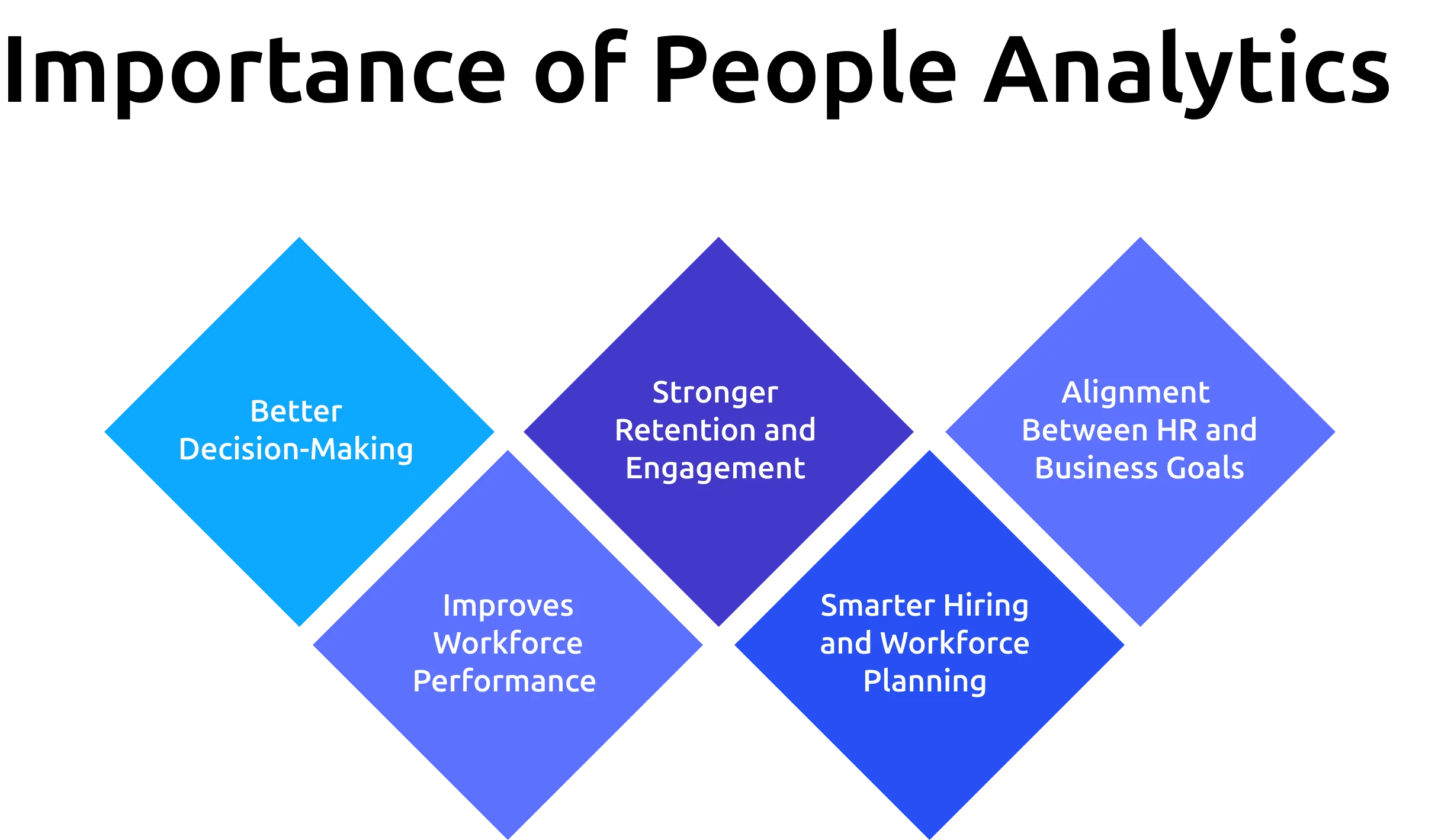
- Better Decision-Making: People analytics helps you replace gut-based choices with data-backed reasoning. Planning becomes more confident and less risky when workforce decisions rely on clear patterns and measurable trends.
- Improves Workforce Performance: When you can identify productivity bottlenecks and high-impact behaviors, you can design better workflows and support systems that elevate output and results.
- Stronger Retention and Engagement: Understanding what drives employee attrition, disengagement, or burnout allows you to address issues early. This reduces unwanted turnover and supports a more stable workforce.
- Smarter Hiring and Workforce Planning: The metrics of people analytics point out the kinds of roles, skills and team structures that deliver the most value. This helps in making better hiring choices and long-term capacity planning.
- Alignment Between HR and Business Goals: When people data connects to outcomes like delivery, revenue, or efficiency, HR people analytics becomes a strategic function rather than an operational one.
This is why people analytics is no longer optional for growing organizations, it provides the visibility leaders need to act with confidence.
Struggling to turn workforce data into confident decisions?
Use Time Champ to gain clear visibility into work patterns and performance trends.
What Are Some Examples of People Analytics?
Here’s a set of real people analytics examples from well-known organizations, showing how they actually used people analytics to influence decisions and outcomes. These examples show real-world applications with measurable results and tangible improvements.
1. Google: Redefining People Decisions with Data
Google used people analytics to understand what truly drives performance across teams. Through Project Oxygen, the company analyzed internal data to identify the behaviors of effective managers and used those insights to improve leadership practices. Google applied a similar approach to hiring by studying patterns in employee success. The analysis revealed that traits like communication, empathy, and team support mattered more than STEM expertise alone, leading to changes in how the company evaluates and develops talent.
2. Credit Suisse: Predicting Turnover to Save Millions
Credit Suisse applied people analytics to forecast employee turnover before it happened. The analytics team examined patterns in tenure, performance, and workplace signals to identify employees at high risk of leaving and take targeted retention actions. This predictive approach reportedly saved the bank roughly $70 million annually in reduced recruitment and training costs.
3. eBay: Boosting Retention Across the Employee Lifecycle
eBay used people analytics to understand and improve retention throughout the employee journey. Key workforce data was tracked and linked with career outcomes such as promotions and compensation changes. These insights helped the organization design targeted interventions that improved retention and made career development paths clearer for employees.
4. Cisco: Smarter Office Location Decisions
When Cisco, a multinational technology company headquartered in San Jose, California, with over 75,000 employees, planned to open a new regional office. The decision went far beyond real estate costs. With 266 offices across 87 countries, the people planning, analytics and tools team, led by senior director Ian Bailie, analyzed internal office usage data, operating costs, and local talent availability.
The analysis revealed that the location initially considered would make hiring difficult. Cisco used these insights to select a different location, making office expansion more efficient and better suited to workforce needs through people analytics.
5. Microsoft: Using Data to Predict Attrition and Skill Gaps
"One of the most forward-looking outcomes of our work is the ability to bring qualitative and quantitative data together. We build data models using employee survey inputs alongside quantitative signals such as attrition and diversity, then analyze them in an aggregated and de-identified way to surface broader insights," says Dawn Klinghoffer, Vice President of People Analytics at Microsoft.
This method enables Microsoft to go beyond individual measures and see patterns of the workforce on a large level, enabling leaders to determine where they need specific assistance, skills training, or strategic intervention.
How to Implement People Analytics Strategy in Organizations?
Building a people analytics strategy isn’t about adding more reports. It’s about setting up a clear system that helps you answer real workforce questions and act on them. Below is a practical, step-by-step approach you can follow to implement this in a way that delivers real value.
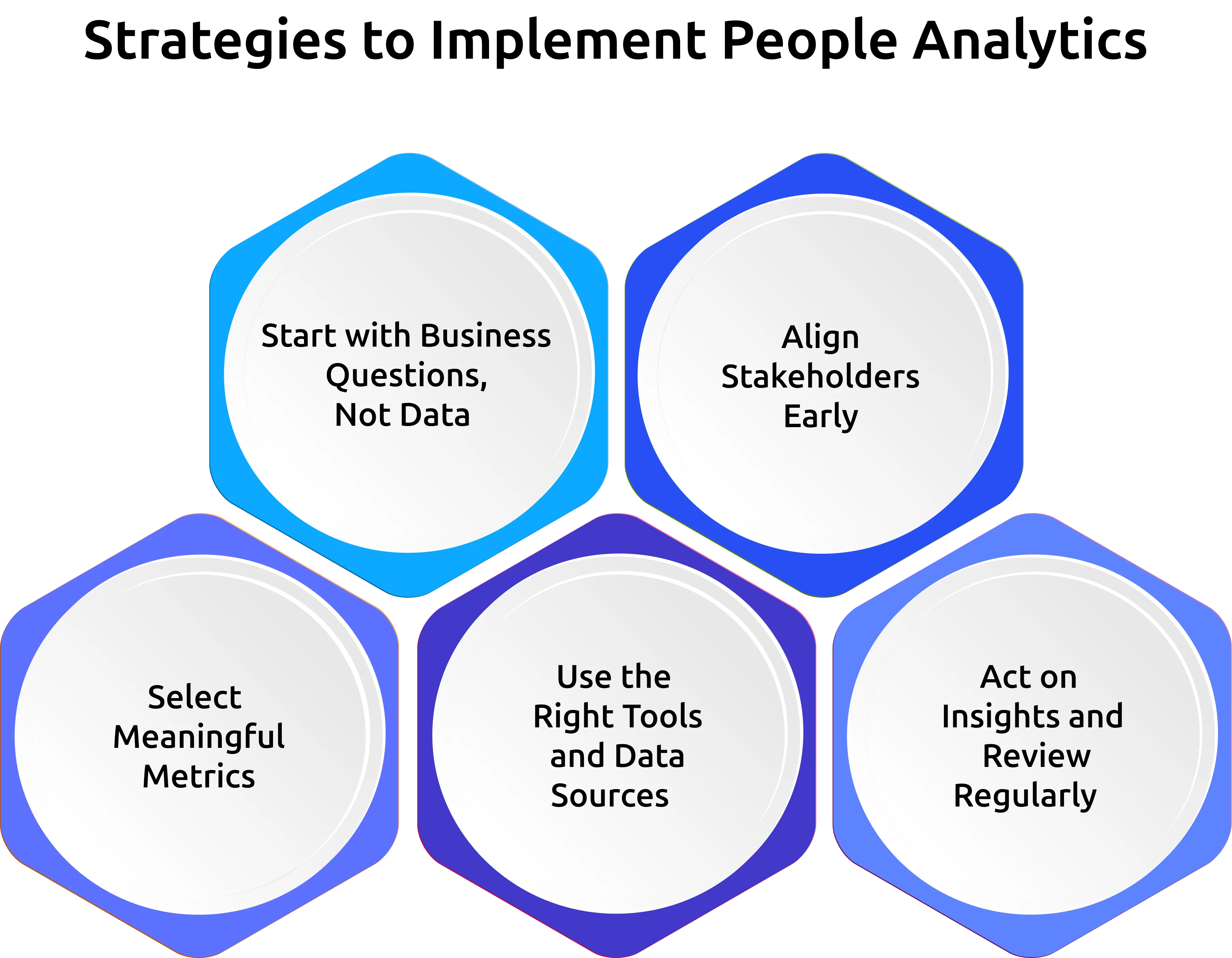
1. Start with Business Questions, Not Data
Start with the decisions that leadership has difficulty with. This may be related to the attrition rate, productivity rate, quality of hiring, or workforce capacity. A strong people analytics strategy starts with clear questions, not dashboards. When you define the purpose upfront, the data you collect remains relevant.
2. Align Stakeholders Early
People analytics succeeds when HRs, managers, and leadership work together from the beginning. Early alignment ensures everyone understands the goals and trusts the insights produced. This shared ownership increases the likelihood that findings will influence decisions, not just reports.
3. Select Meaningful Metrics
Choose people analytics metrics that reflect outcomes rather than surface-level activity. Focus on indicators linked to engagement, productivity, workload balance, and retention. Keeping metrics limited and purposeful makes insights easier to interpret and act on.
4. Use the Right Tools and Data Sources
Bring workforce data into a consistent structure using people analytics tools that highlight trends and patterns. Reliable tools reduce manual effort and improve visibility across teams. The goal is clarity, not complexity, so insights remain accessible to decision-makers.
5. Act on Insights and Review Regularly
Insights only create value when they lead to action. Share findings in clear, simple language so employees understand what’s changing and why it matters. Regularly review outcomes, gather feedback, and refine the approach to strengthen the people analytics strategy as the organization evolves.
What Are the Benefits of People Analytics?
People analytics gives you clear insights into how your teams work and how decisions affect outcomes. It helps you make smarter choices and improve overall performance. Here are the main benefits you can gain from using people analytics.
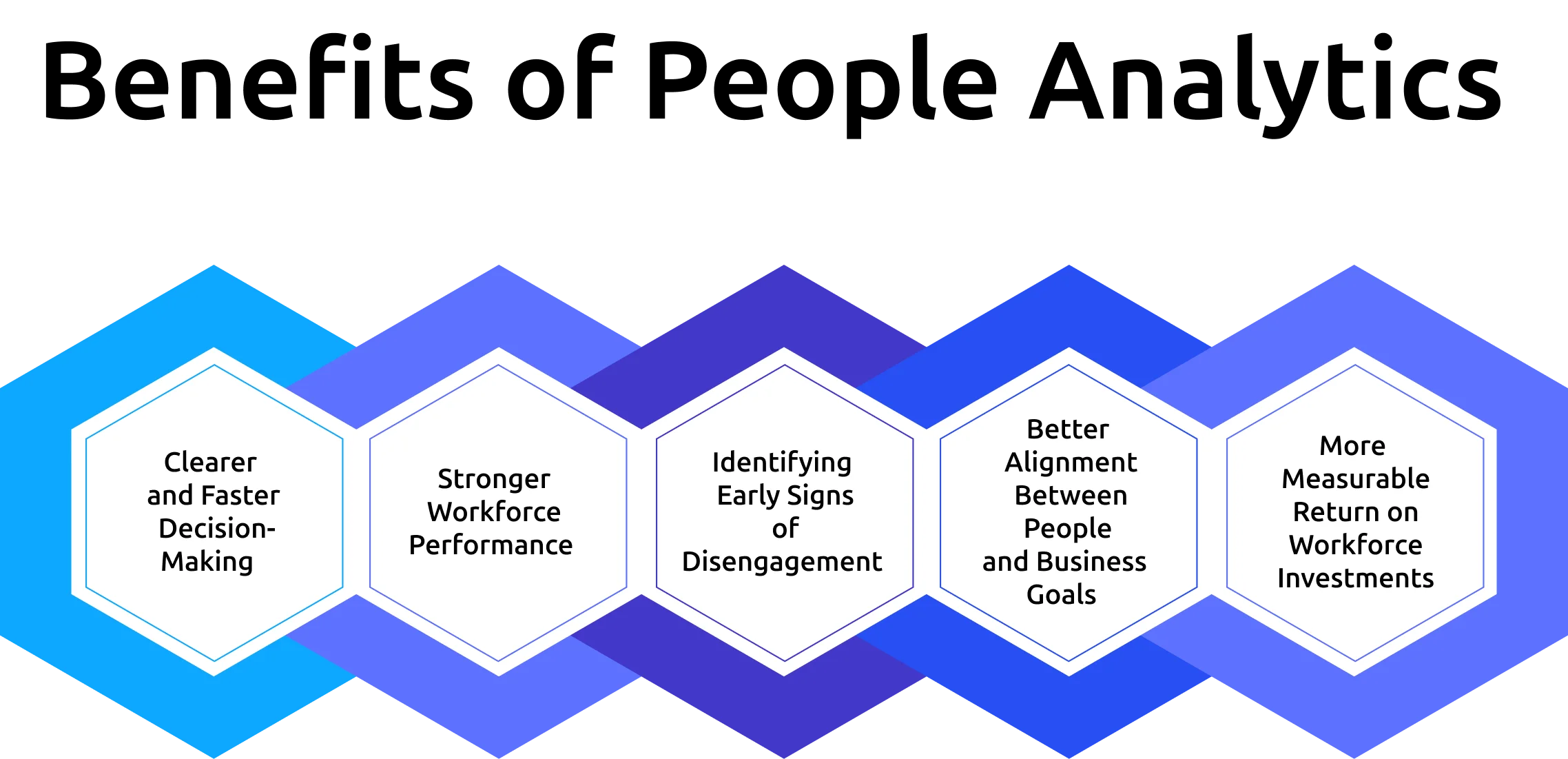
1. Clearer and Faster Decision-Making
Instead of relying on assumptions, you can gain a clearer view of what’s actually happening across teams. This is useful in enabling you to make quicker and more assured decisions in various areas, such as hiring, workload planning, and performance management.
2. Stronger Workforce Performance
Work patterns, productivity gaps, and high-impact behaviors become easier to identify with real workforce data. With this visibility, you can remove blockers, support teams more effectively, and create conditions that enable consistent performance.
3. Identifying Early Signs of Disengagement
Insights into employee behavior and feedback reveal early signs of disengagement or burnout. Acting on these signals helps you address issues before they lead to attrition, improving stability and long-term engagement.
4. Better Alignment Between People and Business Goals
When employee activity is linked to business priorities, teams understand how their work contributes to larger outcomes. This connection assists you in making people decisions that directly aid in growth, efficiency and consistent delivery rather than operating in silos.
5. More Measurable Return on Workforce Investments
Tracking workforce initiatives against real results shows where time and money are making a difference. You can quickly spot what delivers value, adjust what doesn’t, and invest more confidently in efforts that produce meaningful outcomes.
Unsure how people data turns into real performance?
Try Time Champ to gain clear insights and keep teams focused on results.
What Are the Challenges of People Analytics?
Introduction of people analytics is not always easy. Many organizations find it difficult to use workforce data in a way that truly supports everyday decisions. Below are common challenges of people analytics and how you can overcome them.
1. Disconnected and Messy Data
When employee data is spread across HR systems, engagement surveys, and performance tools, it becomes difficult to build a complete view of your workforce. Incomplete or inconsistent data leads to unclear insights.
How to Overcome: Start by cleaning and centralizing your data. Use workforce intelligence platforms like Time Champ that can bring multiple data sources together, standardize records, and keep everything up to date. This gives you a reliable foundation for analysis.
2. Lack of Clear Questions or Goals
Teams often start working with people analytics without setting clear questions or goals. When the purpose is unclear, data analysis turns into exploration without direction, making it hard to link insights to real decisions. This lack of focus leads to reports that look informative but do not help improve performance or guide actions.
How to Overcome: Before diving into tools, list the key decisions you need to improve, such as hiring, retention, performance, etc. Let those priorities guide your analysis. A clear purpose helps turn insights into meaningful actions that support real decisions.
3. Limited Skills or Confidence in Analysis
Many teams do not know what the data is and how to utilize it, even when the data is correct. Interpreting trends, patterns, or correlations can feel overwhelming without the right experience, which often slows decision-making.
How to Overcome: Invest in building analytical skills within your team or seek external support where needed. Workforce intelligence platforms often include ready-to-use dashboards and visuals that simplify analysis for non-technical users. The combination of training and easy-to-use tools helps teams work with data more confidently.
4. Insights Don’t Lead to Action
People analytics often produces insights about productivity trends, workload imbalances, skill gaps, or rising attrition risks. The problem starts when these insights stay limited to reports or dashboards and are not tied to decisions. Without clarity on what should change or who should act, even accurate insights fail to improve performance or outcomes.
How to Overcome: Turn insights from people analytics, such as productivity gaps, workload imbalance, skill shortages, or attrition risk, into clear and practical steps. Explain what the finding reveals, why it affects business results, and what action should follow. Assign responsibility and timelines so execution is clear. When these insights connect directly to decisions and ownership, they lead to real and measurable change.
5. Privacy and Trust Concerns
Privacy concerns increase when employees do not understand how the organization collects and uses their work data. If people analytics feels intrusive or poorly explained, trust drops and participation weakens. This directly affects data quality and reduces the value organizations can gain from analytics.
How to Overcome: Explain what data you collect and show how it supports better workplace decisions. Analyze information at a group level and follow strong privacy and data protection standards. When data use feels fair and transparent, trust improves, and adoption becomes easier.
How Does People Analytics Differ from HR Analytics?
People analytics and HR analytics both use workforce data, but they serve different purposes. One focuses on managing HR operations, while the other helps leaders understand how people impact business outcomes. The table below highlights the key differences in a clear and practical way.
| Aspect | HR Analytics | People Analytics |
|---|---|---|
| Primary Focus | Tracks HR operations and processes | Examines how employee behavior affects business results |
| Main Objective | Improve the efficiency of HR functions | Support better workforce and leadership decisions |
| Type of Questions Answered | What happened in HR activities? | Why did it happen, and what should be done next? |
| Data Used | Attendance, payroll, hiring, and compliance data | Performance trends, engagement signals, and work patterns |
| Level of Analysis | Descriptive and operational | Diagnostic and decision-oriented |
| Audience | HR teams and administrators | Leaders, managers, and decision-makers |
| Outcome | Reports on HR metrics to improve processes | Actionable insights on the workforce to guide business strategy |
| Business Impact | Optimises HR workflows | Influences productivity, retention, and growth |
How Does Workforce Intelligence Make People Analytics More Actionable?
Most organizations collect large volumes of workforce data, yet struggle to use it in day-to-day decision-making. Workforce intelligence platforms like Time Champ support people analytics efforts by transforming raw workforce data into insights that are easy to interpret and act on.
A clear visibility of workload trends, productivity changes, and performance trends enables you to utilize resources effectively, respond to risks at the initial stages, and adjust workforce decisions to business objectives. This creates a practical, results-focused people analytics approach that helps you make smarter decisions and drive measurable business impact as your organization grows.
Conclusion
People analytics helps you move from assumptions to clarity by showing how people, work, and outcomes connect. When you focus on the right questions and use insights with purpose, workforce data becomes a tool for better planning, stronger performance, and more confident decisions. With a clear strategy and practical approach, you can use people analytics to support employees, align teams with business goals, and drive meaningful, long-term impact.
Looking to connect people analytics with real workforce insights?
Use Time Champ’s workforce intelligence platform to gain clear visibility into how teams work!

Thasleem Shaik

Table of Content
-
 What Is People Analytics?
-
Why Is People Analytics Important for Organizations?
-
What Are Some Examples of People Analytics?
-
How to Implement People Analytics Strategy in Organizations?
-
What Are the Benefits of People Analytics?
-
What Are the Challenges of People Analytics?
-
How Does People Analytics Differ from HR
Analytics?
-
How Does Workforce Intelligence Make People Analytics More Actionable?
-
Conclusion
Related Blogs
Uncover the power of User Behavior Analytics (UBA) in fortifying security: Explore benefits and real-world use cases for a proactive defense strategy.
Mounika Sai | December 28, 2023
Discover workforce productivity analytics in 2025: what it is, why it matters, key metrics, benefits, and how AI enhances workforce performance
Thasleem Shaik | September 25, 2025
Discover workforce analytics: definition, types, and benefits. Explore how workforce analytics tools and metrics improve HR planning, retention & efficiency.
Chethana Choudary | September 01, 2025
Explore the best HR onboarding software and HR analytics tools for seamless integration of new employees, enhancing HR performance with a focus on personalization and efficiency.
Mounika | January 2, 2024
Discover the fundamentals of HR analytics, learn about its best practices, and explore its benefits for businesses.
Shabana Shaik | May 24, 2024
Learn what workforce engagement management (wem) is, why it matters in contact centers, components, benefits, and how to choose the right software.
Shabana Shaik | October 01, 2025


 4.7/5 avg.
Ready to Manage Your Workforce Smarter?
Join our family of 1100+ companies using smart insights to redefine workforces!

Free Trial
No Credit Card Required