What Is a Flexible Work Schedule? Types, Benefits, and Examples
Discover what a flexible work schedule is, explore its types and benefits, and see practical examples to choose the right approach for your team.
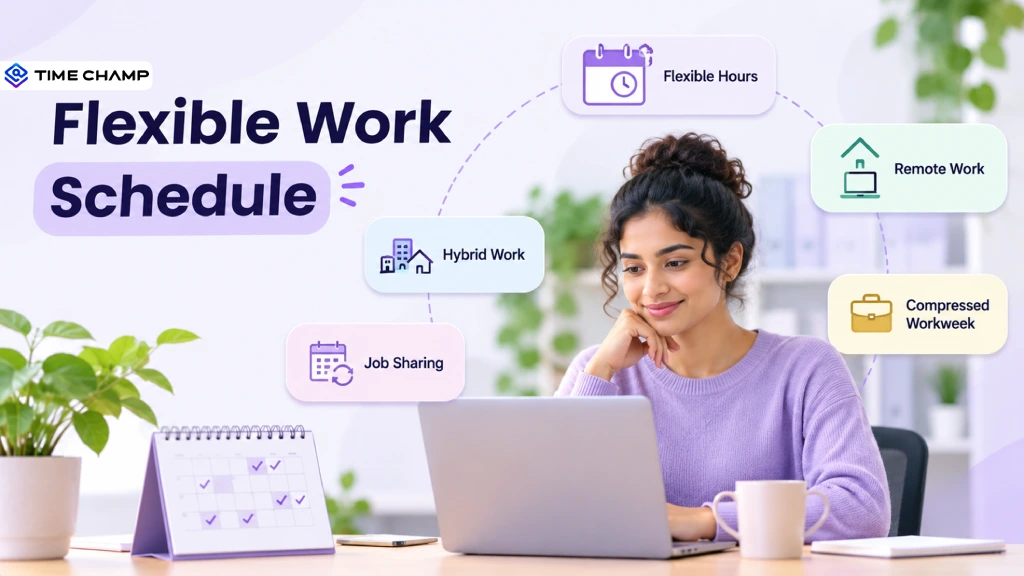
A flexible work schedule gives employees more control over when and where they work. Instead of following the same fixed hours every day, employees may adjust their schedules based on business needs and personal preferences. But what does a flexible work schedule actually look like, and which types work best for different teams?
Let’s explore the common types, key benefits to help you understand how flexible scheduling works.
What Is a Flexible Work Schedule?
A flexible work schedule is a work arrangement that allows employees to adjust their working hours or start and finish times instead of following a fixed schedule. It gives employees greater control over when they work while ensuring they complete their required hours and responsibilities.
Depending on the organization, flexibility can include different start and end times, compressed workweeks, or staggered schedules. These arrangements can help employees balance work with personal commitments while allowing businesses to maintain productivity and meet operational needs.

Did You Know?
According to Randstad's Workmonitor 2025 survey, sixty percent of Indian employees say they would turn down a job that does not offer flexible working hours.
Types of Flexible Work Schedules
Flexible work schedules can take different forms depending on your business needs, job requirements, and level of flexibility you want to provide. Understanding these types of work schedules can help you choose a schedule that supports both employee needs and business operations.
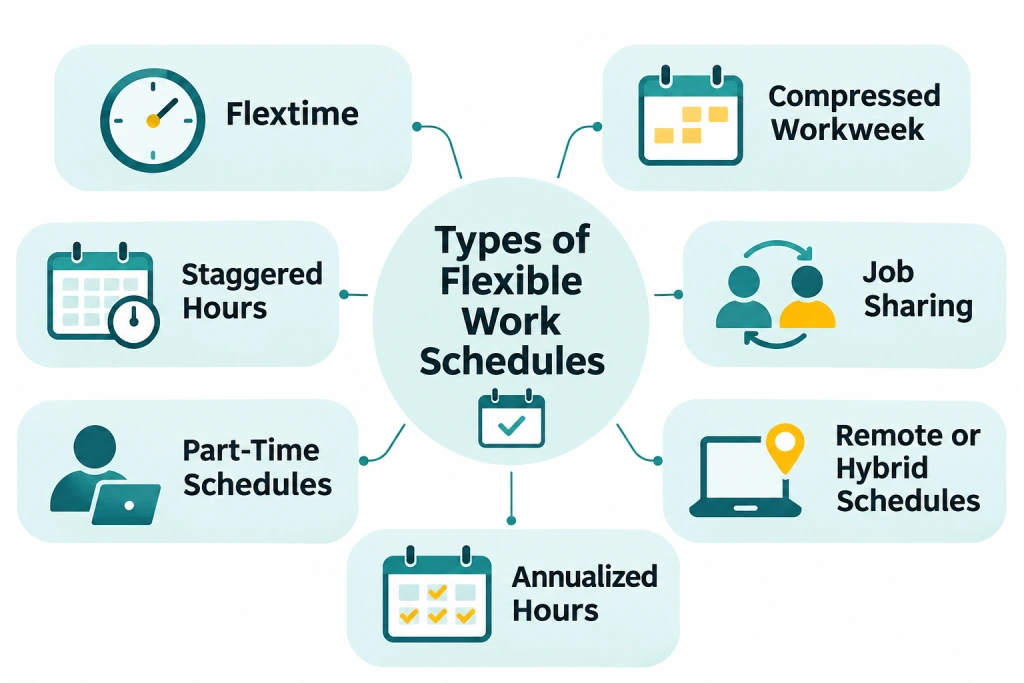
1. Flextime
Flextime allows employees to choose when they start and finish work within specific limits. You can set core hours when everyone must be available while allowing flexibility around those hours.
2. Compressed Workweek
A compressed workweek allows employees to complete their standard weekly hours over fewer working days. For example, you could offer a four-day workweek where employees work longer hours each day.
3. Staggered Hours
Staggered hours allow employees to start and finish their work at different times. You can use this approach to extend business coverage, reduce workplace crowding, or accommodate different employee schedules.
4. Part-Time Schedules
Part-time schedules allow employees to work fewer hours than a standard full-time schedule. You can use this arrangement for roles where full-time coverage is not required or where employees need reduced working hours.
5. Job Sharing
Job sharing allows two employees to share the responsibilities and working hours of one full-time position. You can use this option when you want to provide flexibility while ensuring the role remains covered.
6. Remote or Hybrid Schedules
Remote and hybrid work arrangements offer employees flexibility in choosing where they work, with some also allowing them to adjust their working hours. You can define which days employees work remotely and when they need to be available for in-person collaboration.
7. Annualized Hours
Annualized hours allow you to set a total number of working hours that employees must complete over a specific period, usually a year. Employees have the flexibility to choose when they complete their working hours, as long as business requirements are met.
How Does a Flexible Work Schedule Work?
A flexible work schedule gives you the freedom to offer employees different working hours while still meeting your business requirements. To make it work effectively, you need to establish clear guidelines, define availability, and ensure that work continues without disruption. Here’s a step-by-step process you can follow:
1. Define the Work Requirements
Start by defining the working hours, responsibilities, deadlines, and availability required for each role. This helps you set clear expectations while giving employees room to adjust their schedules. You can also identify roles that are suitable for flexible scheduling based on their work requirements.
2. Set Core Working Hours
Set specific hours when employees need to be available for meetings, collaboration, customer support, or other important activities. Core hours give your team a common time to work together. Clearly communicating these hours helps employees plan their flexible schedules without affecting team coordination.
3. Allow Flexible Hours
Give employees the option to choose their preferred start and finish times within your guidelines. For example, you could allow employees to start between 8 AM and 10 AM and finish accordingly. You can define the level of flexibility based on each role and your operational needs.
Did You Know?
According to Randstad’s Workmonitor 2026, 46% of more than 27,000 workers across 35 markets said work-life balance is the main reason they stay in a job.
4. Create the Work Schedule
Work with employees to create schedules that support both their needs and your business requirements. Consider workload, team availability, customer needs, and collaboration when setting the schedule. Make sure each schedule provides enough coverage during important business hours.
5. Ensure Required Hours Are Completed
Make sure employees complete their required working hours and responsibilities. A flexible schedule should provide freedom over working times without affecting deadlines, performance, or business operations. You can use timesheets or scheduling tools to maintain visibility into working hours and workload.
6. Coordinate with the Team
Encourage employees to communicate their working hours and availability with their teams. This helps you reduce scheduling conflicts and ensures employees are available when collaboration is needed. Ask team members to keep their availability updated so everyone knows when colleagues can be reached.
7. Review and Adjust the Schedule
Regularly review whether the flexible schedule is working for your business and employees. If workloads, business requirements, or team needs change, adjust the schedule while maintaining productivity and service quality. Regular reviews can help you identify scheduling issues early and make timely adjustments.
Example of a Flexible Work Schedule
An organization requires employees to complete eight working hours per day but allows them to choose their start and finish times within a defined window of 8 AM to 10 AM.
For example:
- Employee A: Works from 8 AM to 4 PM.
- Employee B: Works from 9 AM to 5 PM.
- Employee C: Works from 10 AM to 6 PM.
Although employees follow different schedules, each completes the required eight working hours. This arrangement provides greater flexibility while ensuring consistent work coverage and meeting organizational requirements.
Flexible Work Schedule vs Fixed Schedule vs Shift Work
Not all work schedules offer the same level of flexibility or control. The table below highlights the key differences between these three work schedules.
| Aspect | Flexible Work Schedule | Fixed Schedule | Shift Work |
|---|---|---|---|
| Working hours | Employees can adjust their start and finish times within set guidelines. | Employees work the same scheduled hours each day. | Employees work assigned shifts at specific times. |
| Schedule flexibility | High | Low | Moderate |
| Employee choice | Employees have more control over their working hours. | Employees have little or no control over working hours. | Employees follow the shifts assigned by the employer. |
| Core hours | May include specific core hours when employees must be available. | Employees are available throughout their fixed working hours. | Availability depends on the assigned shift. |
| Common use | Offices, professional services, hybrid teams, and knowledge-based roles. | Traditional office roles and businesses with standard operating hours. | Healthcare, customer support, manufacturing, retail, and 24/7 operations. |
| Main advantage | Provides flexibility while maintaining work requirements. | Makes scheduling and team coordination predictable. | Provides continuous coverage across different operating hours. |
Want to manage flexible work schedules without losing visibility?
Simplify workforce scheduling with Time Champ and keep your team's working hours and attendance organized.
Benefits and Challenges of Flexible Schedules
Flexible work schedules can give your team greater freedom while helping you meet business needs. However, they also come with challenges that you need to manage carefully to maintain productivity and coordination.
| Benefits | Challenges |
|---|---|
| Flexible hours can help employees manage personal responsibilities alongside work. | Different working hours can make it harder to arrange meetings and team discussions. |
| Giving employees more control over their schedules can improve their overall work experience. | Employees working at different times may not always be available when colleagues need them. |
| Employees can work during the hours when they are most focused and productive. | Teams may need additional planning to ensure tasks are completed without delays. |
| Flexible scheduling can make roles more attractive and encourage employees to stay longer. | It can be harder for managers to understand employee availability and workload without clear scheduling practices. |
| Flexible schedules can help you attract candidates who need alternatives to traditional working hours. | Poorly managed flexibility can result in some employees carrying more work than others. |
| Flexible schedules can reduce the need for constant office space and other workplace resources. | Excessive flexibility may create gaps during important operating hours if schedules are not planned properly. |
Struggling to coordinate different employee schedules?
Use Time Champ to simplify shift planning, manage employee availability, and keep your workforce organized.
How to Implement a Flexible Work Schedule Policy
A well-defined flexible work schedule policy gives you a clear framework for offering flexibility while keeping business operations on track. You can follow these steps to create a policy that works for your organization.
1. Define the Purpose of the Policy
Start by explaining why you are introducing flexible work schedules and what you want to achieve. This could include improving employee flexibility, supporting work-life balance, or meeting changing business needs.
2. Identify Eligible Roles
Determine which roles and employees can use flexible schedules based on job responsibilities and business requirements. Some positions may require fixed hours because they depend on customer availability, on-site work, or continuous coverage.
3. Set Clear Working Hours
Define the minimum working hours, core hours, availability requirements, and expected schedules. Clear boundaries help employees understand when they need to be available and what flexibility they have.
4. Establish Scheduling Guidelines
Specify how employees can request, change, or maintain their flexible schedules. You can also define how much advance notice employees need to provide when requesting schedule changes.
5. Set Performance Expectations
Focus on responsibilities, deadlines, and outcomes rather than only when employees are online. Clearly communicate the performance standards employees are expected to meet under the flexible schedule.
6. Define Communication Requirements
Establish expectations for meetings, team collaboration, response times, and availability. This helps ensure flexible schedules do not create communication gaps across teams.
7. Explain the Approval Process
Define who reviews and approves flexible schedule requests and what factors they will consider. A consistent approval process can help you apply the policy fairly across eligible employees.
8. Review the Policy Regularly
Evaluate how the policy affects productivity, employee experience, collaboration, and business operations. Use these insights to make adjustments when your workforce or business requirements change. Also learn how to create a hybrid work policy!
Did You Know?
According to the CIPD’s 2025 research, 30% of UK employees feel uncomfortable requesting flexible working, showing that having a policy does not always mean employees will use it.
How Time Champ Supports Flexible Work Schedules
Managing flexible schedules becomes easier when you have visibility into working hours, attendance, schedules, and employee availability. Time Champ helps you bring these activities together in one platform, making it easier to manage flexible work arrangements while maintaining visibility across your workforce.
- Smart Employee Scheduling: Create and manage employee work schedules to organize shifts, assign working hours, and accommodate different work arrangements.
- Automatic Time Tracking: Capture working hours automatically so you can understand how employees are spending their work time.
- Attendance Management: Manage employee attendance and maintain visibility into working schedules.
- Timesheets: Give employees a simple way to record and review their working hours.
- Leave Management: Manage employee leave alongside working schedules to maintain better workforce visibility.
- Reports & Analytics: Use workforce data to understand working patterns, hours, and team activity.
- Productivity Analytics: Gain insights into workforce productivity and identify areas that may need attention.
Ready to simplify flexible work schedule management?
Time Champ helps you manage working hours, attendance, and productivity with real-time insights.
Conclusion
A flexible work schedule gives employees greater control over their working hours while helping you meet business needs. With clear guidelines, communication, and regular reviews, you can maintain flexibility without compromising productivity or visibility.
The right approach can also help you create a more adaptable, efficient workplace. A well-planned schedule ensures flexibility works for both your employees and your business.

Guna Lakshmi

Table of Content
 What Is a Flexible Work Schedule?
- Types of Flexible Work Schedules
- How Does a Flexible Work Schedule Work?
- Example of a Flexible Work Schedule
- Flexible Work Schedule vs Fixed Schedule vs Shift Work
- Benefits and Challenges of Flexible Schedules
- How to Implement a Flexible Work Schedule Policy
- How Time Champ Supports Flexible Work Schedules
- Conclusion
Related Blogs

Hybrid work combines office and remote time to fit how teams actually work. Learn hybrid work models, benefits, challenges, and how to measure success.
Thasleem Shaik | Jun 22, 2026
Looking to build a better hybrid work schedule? Explore popular schedule types, weekly examples, and practical tips for a more productive team.
Guna Lakshmi | Jul 21, 2026
Compare hybrid and remote work models to determine which improves your team's productivity, collaboration, flexibility, and long-term business performance.
Anjali | Jun 16, 2026
Learn what a work schedule is, its types, benefits, challenges, legal factors, and how to create effective employee schedules with practical tips.
Guna Lakshmi | Apr 13, 2026
Learn what a hybrid work policy is, see the 9 essential components to include, and download, edit, and use your free hybrid-work-policy-template.docx.
Guna Lakshmi | Jun 13, 2026
Discover what schedule adherence is, why it matters, how to calculate it, factors affecting it, common challenges, and proven ways to improve it effectively.
Thasleem Shaik | Aug 08, 2025


 4.7/5 avg.
Ready to Manage Your Workforce Smarter?
Join our family of 1500+ companies using smart insights to redefine workforces!

Free Trial
No Credit Card Required