Claims Processing Outsourcing: The Complete Guide for Insurers
Claims processing outsourcing can improve capacity, speed, and operating costs. Learn what to outsource, what to retain, and how to choose a partner.
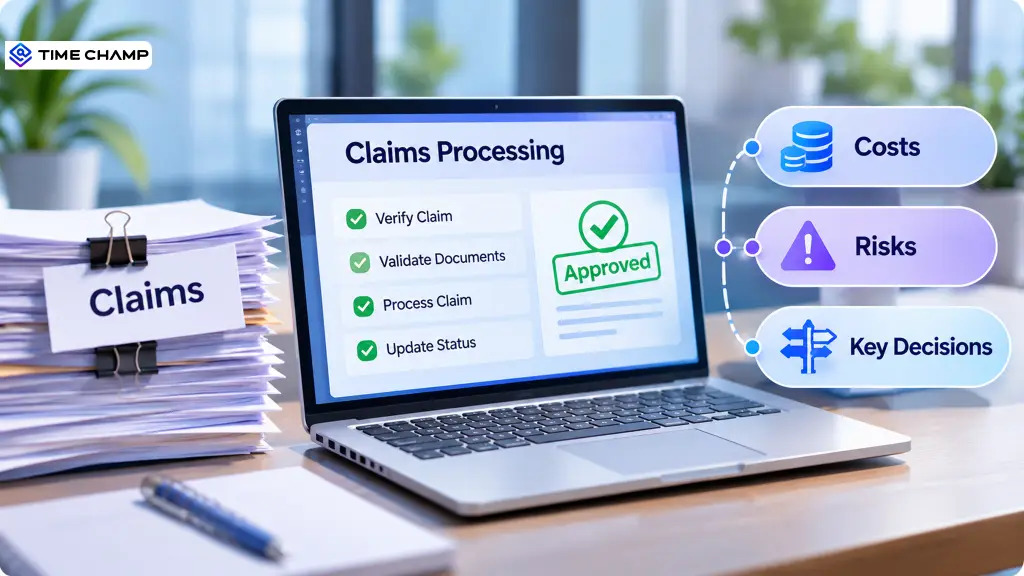
Claims processing outsourcing means handing off some or all of your claims workflow, such as intake, data entry, document review, and payment processing, to a specialized third-party team while your own staff keeps control of final decisions. It lets you handle higher claim volumes without adding permanent headcount, and it usually cuts per-claim processing costs. This guide walks you through what to outsource, what to keep in-house, and how to pick a partner that won't put your compliance or customer experience at risk.
What Is Claims Processing Outsourcing?
Claims processing outsourcing means using an external service provider to handle specific activities within your insurance claims workflow. The provider can take responsibility for administrative and operational tasks while you retain authority over the claims decisions that require internal oversight.
The scope can range from a small set of back-office activities to a broader claims operation. For example, you might outsource insurance claims processing for document handling and data entry while keeping coverage decisions, complex claims, and final settlement authority with your internal team.
Common Outsourced Claims Activities Include:
- First notice of loss intake and data capture
- Claims data entry and system updates
- Document indexing and classification
- Policy and coverage verification
- Medical bill review and coding support
- Claims status follow-up
- Customer communication
- Subrogation identification
- Payment and settlement processing
- Quality checks and reconciliation
The key is to define exactly where the external team starts and where your internal team takes over. A clear division of responsibilities prevents duplicate work and reduces confusion when a claim moves between teams.
Why Are Insurers Outsourcing Claims Processing in 2026?
Rising claim volumes, staffing gaps, and pressure to control costs are pushing insurers to rethink how they handle claims. Here are the key reasons insurers choose to outsource claims processing.
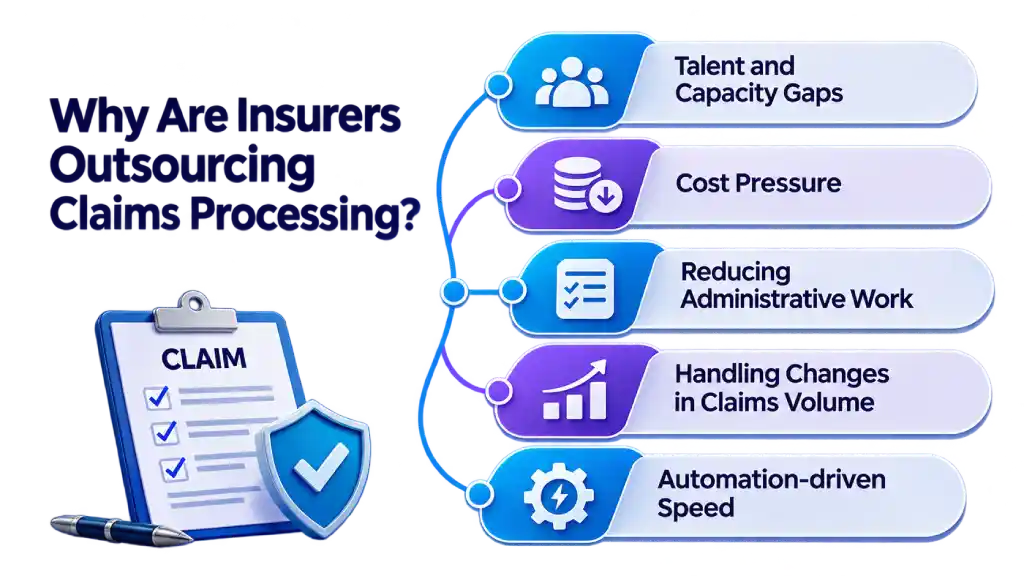
1. Talent and Capacity Gaps
A large share of experienced claims adjusters and examiners are approaching retirement, and replacing their institutional knowledge takes years, not months. Outsourcing claims processing partners can help fill this gap with trained staff who can scale up during catastrophe seasons and scale back down afterward. An in-house team built for average claim volumes may not have the same flexibility.
2. Cost Pressure
Global industry research puts the insurance business process outsourcing market at roughly $9.1 billion in 2026, up from $8.4 billion the year before, a growth rate of about 8.5% a year. Carriers are outsourcing not just to save money on labor, but because a specialized provider can spread technology and training costs across many clients.
3. Reducing Administrative Work
Claims professionals often spend time on tasks that support a claim rather than directly determine its outcome.
Document handling, data entry, status updates, file maintenance, and administrative follow-up can consume substantial working time. Moving suitable tasks to an external team can free up your internal staff to focus on work that requires their expertise.
This approach also supports insurance operations outsourcing when you want to shift specific operational activities without transferring the entire claims function.
4. Handling Changes in Claims Volume
A claims operation may work well under normal volumes but struggle when claim intake increases sharply. Adding permanent staff for every potential surge can leave you with excess capacity when volumes return to normal.
An external team can provide additional processing capacity for defined activities. You can use that capacity to reduce backlogs and keep routine work moving while your internal team focuses on higher-priority claims.
5. Automation-driven Speed
Recent AI adoption in claims has pushed straight-through processing rates for simple claims well beyond what rules-based systems could achieve. It has also reduced the cost of processing routine claims by roughly 30% to 40%. Many insurance BPO providers have already integrated this automation into their workflows. As a result, claim processing outsourcing can now provide access to better technology, not just lower-cost labor.
Still relying on reports to understand where work gets stuck?
Use Time Champ to get real-time visibility into team productivity.
What Should You Outsource and What Should Stay In-House?
The best outsourcing strategy does not mean moving every claims activity outside your organization. You should separate repeatable operational work from activities that require direct authority, specialized judgment, or close internal control.
A simple way to make the decision is to assess each activity based on four factors:
- Decision Authority: Does the task require a final coverage, payment, or claims decision?
- Complexity: Does the work involve unusual facts, litigation, high-value losses, or specialized judgment?
- Repeatability: Can you document the process clearly and apply consistent rules?
- Control Requirements: Would transferring the activity create unacceptable regulatory, security, or operational risk?
| Good Candidates to Outsource | Better Kept In-house |
|---|---|
| FNOL intake and data entry | Final decisions on complex or high-value claims |
| Document collection and indexing | Litigation and disputed claims |
| Claims data entry and coding | Fraud investigation findings and sign-off |
| Routine customer status updates | Regulatory reporting and filings |
| Payment processing for approved claims | Reinsurance and large-loss negotiations |
| Back-office claims support and reconciliation | Strategic underwriting decisions |
Outsourcing insurance claim management works best when you keep this line clear in your contract. A provider handling insurance claims processing outsourcing at the intake and data layer can move fast without ever touching a decision that carries legal or reputational weight. This split also matters for intake, as it can take up a lot of insurance claim processing services, where health data adds a compliance layer your in-house compliance team should still own.
How Does Outsourced Claims Processing Work?
A typical outsourced claims workflow starts when you define the activities that the external team will handle. You then establish the process, provide access to the required systems and information, train the team, and set quality and performance requirements.
The workflow can look like this:
Step 1. FNOL and Information Capture: The process begins with the first notice of loss. The external team can capture claim information, validate required fields, and enter the information into the appropriate system.
Step 2. Document Processing: The team can collect, classify, index, and route supporting documents. This helps ensure that the claim file contains the information required for the next stage.
Step 3. Data Entry and Validation: The provider can enter claim information into your system and perform defined validation checks. Clear procedures matter here because incorrect data can create rework later in the process.
Step 4. Coverage and Pre-Adjudication Support: The external team can perform defined checks against policy and claim information. Where the workflow allows it, the team can prepare the claim for internal adjudication.
Step 5. Adjudication and Settlement Support: Your internal team or an appropriately authorized provider can complete the required adjudication activities. The process may then move to payment or settlement processing.
Step 6. Quality Checks and Reconciliation: Quality assurance helps identify errors before they affect downstream work. Reconciliation also helps confirm that system records, payments, and supporting documentation remain consistent.
This structured approach makes outsourcing claims handling easier to manage because each team knows its responsibilities and handoff points.
Need more clarity on how your outsourcing teams are working?
Use Time Champ to understand productivity, identify gaps, and improve operations.
In-House vs. Outsourced Claims Processing: Which Model Fits?
Choosing between in-house and outsourced claims processing depends on your workload, costs, control, and capacity needs. The table below compares both models to help you see which option fits your operation.
| Factor | In-House Team | Outsourced Partner |
|---|---|---|
| Cost structure | Fixed salaries and benefits year-round | Variable cost tied to claim volume |
| Scalability | Slow to flex up during catastrophe spikes | Built to absorb sudden volume swings |
| Speed | Depends on internal staffing levels | Often faster due to dedicated shifts and automation |
| Control over decisions | Full and direct | Requires clear escalation rules in the contract |
| Compliance ownership | Sits entirely with you | Shared, but final accountability stays with you |
| Access to specialized talent | Limited to local hiring pool | Wider pool through insurance BPO services |
What Are the Real Risks of Outsourcing Claims Processing?
Outsourcing can improve capacity and reduce workload, but it also introduces risks you need to manage carefully. Here are the key risks to consider before you outsource claims processing.
- Data Security Exposure: Claims files contain personal, financial, and sometimes medical data. Any insurance outsourcing service provider you work with needs verified certifications, such as SOC 2 or ISO 27001, rather than just a promise.
- Compliance Gaps: State insurance regulations and HIPAA rules for health-related claims still apply when a third party handles the work. You remain responsible for how the data is handled.
- Quality Inconsistency: A provider working with multiple clients may not follow your specific claims guidelines as consistently as your own trained staff.
- Communication Friction: Time zone differences and unclear escalation paths can delay claims that need quick attention.
- Vendor Lock-in: Deep integration with one insurance outsourcing company can make it costly to switch providers if the service quality drops.
- Hidden Costs: Onboarding, integration, and management costs are often left out of the initial pricing discussion.
None of these risks rule out outsourcing insurance claims processing. They simply mean you need to build the contract, SLAs, and your own oversight process around these gaps from day one.
How Do You Choose a Claims Processing Outsourcing Partner?
Choosing the right outsourcing partner requires more than comparing prices. You need to check their experience, security, service quality, and ability to handle your claims workflow. Here are the key factors to review before you make a decision.
- Insurance-specific Experience: A general BPO may not have the same knowledge as established insurance BPO providers that already understand claims terminology, regulatory language, and typical turnaround times.
- Security and Compliance Credentials: Ask for current SOC 2 Type II or ISO 27001 certification. For health claims, also ask for proof of HIPAA-aligned data handling. Do not rely on verbal assurances instead of proper documentation.
- Technology Fit: Make sure the provider's systems can integrate with your claims management platform without manual re-keying. Manual data entry can lead to more errors and delays.
- Clear SLAs: Include turnaround times, accuracy rates, and escalation triggers in the contract. Do not leave these as informal expectations.
- Workforce Visibility: When claims work moves offsite or becomes hybrid, you lose the day-to-day visibility you have with an in-house team. This is where a workforce productivity tool like Time Champ can help. It does not process claims or make adjudication decisions, but it provides attendance, activity, and productivity visibility across your remote or hybrid claims staff. This helps you track your side of the SLA and identify bottlenecks before they appear in your partner's reports.
- References and Audit Rights: Ask for references from insurance clients and make sure the contract gives you the right to audit the provider's security and process controls.
Need better visibility across your remote and hybrid claims teams?
Try Time Champ to understand productivity and spot bottlenecks faster.
Conclusion
Claims processing outsourcing can help you add capacity, reduce administrative workload, and manage operating costs when you transfer the right activities to the right partner.
The goal should not be to outsource as much work as possible. Instead, identify repeatable activities that an external team can perform consistently while keeping critical decisions and high-risk claims under appropriate internal control.
Before you outsource claims processing, define the scope, compare delivery models, assess the risks, understand the full cost, and establish clear performance and governance requirements. A well-defined operating model gives you a stronger foundation for outsourcing without losing control of the claims process.

Thasleem Shaik

Table of Content
 What Is Claims Processing Outsourcing?
- Why Are Insurers Outsourcing Claims Processing in 2026?
- What Should You Outsource and What Should Stay In-House?
- How Does Outsourced Claims Processing Work?
- In-House vs. Outsourced Claims Processing: Which Model Fits?
- What Are the Real Risks of Outsourcing Claims Processing?
- How Do You Choose a Claims Processing Outsourcing Partner?
- Conclusion
Related Blogs

In-house vs outsourcing explained with key differences, pros, cons, costs, and practical tips to help you choose the best approach for your organization.
Anjali | Jul 02, 2026
Learn why billing breakdowns damage BPO trust, why clients value workforce intelligence billing, how it strengthens billing models & implementation steps.
Thasleem Shaik | Feb 11, 2026
Explore top BPO companies offering tailored solutions. Find the right partner to boost efficiency, cut costs, and drive your business growth!
Mounika Sai | Nov 24, 2023
Discover the 18 global best call center outsourcing companies to optimize customer support. Choose from leading names for exceptional service and efficiency.
Mounika Sai | Nov 16, 2023
Discover the essence of outsourcing, you will get to know its various types and the driving factors behind its high demand
Shabana Shaik | May 17, 2024
Strategic outsourcing involves delegating specific tasks to external experts for efficiency. Explore its types, advantages, and how it optimizes operations.
Mounika Sai | Nov 24, 2023


 4.7/5 avg.
Ready to Manage Your Workforce Smarter?
Join our family of 1500+ companies using smart insights to redefine workforces!

Free Trial
No Credit Card Required