Time Champ > Blog > What is Business Intelligence (BI)? A Complete Guide (2026) > Content
What is Business Intelligence (BI)? A Complete Guide (2026)
Learn what business intelligence (BI) is, why it matters, how it works, explore key benefits, challenges & how AI is used to enhance business decisions.

61% of organizations actively reshaping their data and analytics models by 2025, due to advanced technologies, highlighting the extent of business intelligence adoption in modern decision-making. Are you also finding it difficult to process a huge volume of data, delayed reports or assumptions instead of real facts? If yes, this guide is for you. Business intelligence (BI) is the process of analyzing, collecting, and visualizing data to help you understand what is happening across your business, why it is happening, and what actions you need to take before losing any opportunities.
In this guide, you’ll explore what business intelligence (BI) is, how it works, why it is important, and how AI-driven BI reshapes the performance, strategy, and competitive advantage across different industries.
What is Business Intelligence (BI)?
Business intelligence (BI) collects, integrates, analyzes, and visualizes data to deliver timely insights. It helps you monitor performance, identify operational patterns, reduce challenges, and make data-driven decisions across your organization in real-time with clarity, speed, accuracy, and confidence.
Business intelligence is not just a report or dashboards, but it provides you with continuous visibility of how your business really operates. Through connecting data from multiple departments and systems, BI allows you to identify problems early, uncover hidden inefficiencies and understand what drives results. You stay informed in real time, when your decisions can still shape outcomes and drive meaningful results.
When you use the BI effectively, every action you take becomes intentional. You can compare performance across your teams, monitor the progress against objectives, and adjust strategies based on real facts. This ability to recognize the patterns early helps you have a competitive edge by enabling smarter decisions and long-term success in the changing markets.
Make Smarter Business Decisions with Real-time Insights.
Use Time Champ to turn data into clear, actionable intelligence.
Is Business Intelligence the Same as Business Analytics?
No, business intelligence and business analytics serve distinct purposes, although they often work together. Business intelligence is all about understanding what is happening in your business at present and what has already happened using dashboards, reports and visual insights. Meanwhile, business analytics explores the depth of analysis of why such results occurred and predicts what could happen next, so that you can plan future strategies efficiently with confidence. It uses advanced analysis, statistical models and forecasting techniques to support future planning. Together, BI and business analytics create a comprehensive data-driven approach, combining clarity on historical and present performance with confidence and accurate decision-making.
Why is Business Intelligence Important?
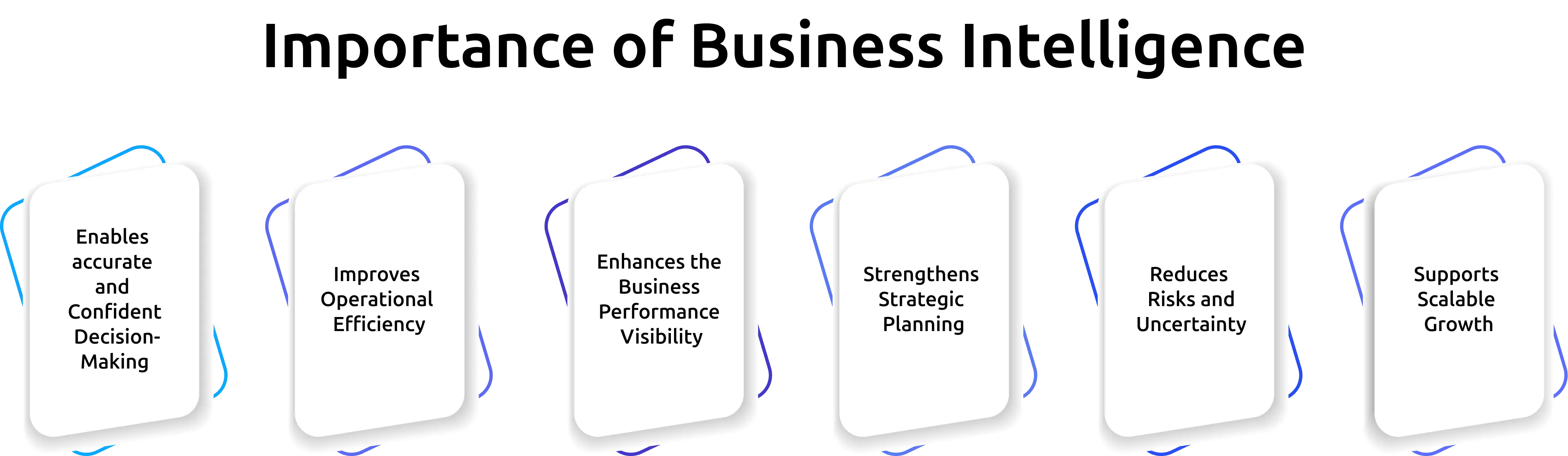
Business intelligence helps you manage growing data complexity by offering trusted insights which keep you informed, agile and support confident and accurate decisions for consistent performance.
- Enables accurate and Confident Decision-Making
Business intelligence provides real-time access to accurate information, so that you don’t have to wait for the delayed reports. You can assess the situations immediately, minimize the guesswork, and make confident decisions with real facts.
- Improves Operational Efficiency
BI helps you to identify bottlenecks, inefficiencies, and resource gaps across the procedures. By monitoring performance in real-time, you can automate processes, reduce waste and optimize operations without disrupting daily operations.
- Enhances the Business Performance Visibility
Using the BI reports and dashboards helps you get a clear view of KPIs across the departments and teams. This transparency can help you monitor progress, analyze results and ensure that every function aligns with your business goals.
- Strengthens Strategic Planning
BI supports long-term planning through uncovering trends and performance patterns. You can easily evaluate what really works, predict the challenges and adjust strategies before challenges impact the results.
- Reduces Risks and Uncertainty
Business intelligence helps you detect potential problems early. By analyzing historical and current data, you can respond instantly and reduce the inconsistencies to protect your business with informed actions.
- Supports Scalable Growth
BI scales with the data needs as your organization continues to grow. It ensures consistent insights across functions, which help you maintain the agility, control, and performance while expanding the operations.
How Does Business Intelligence Work?
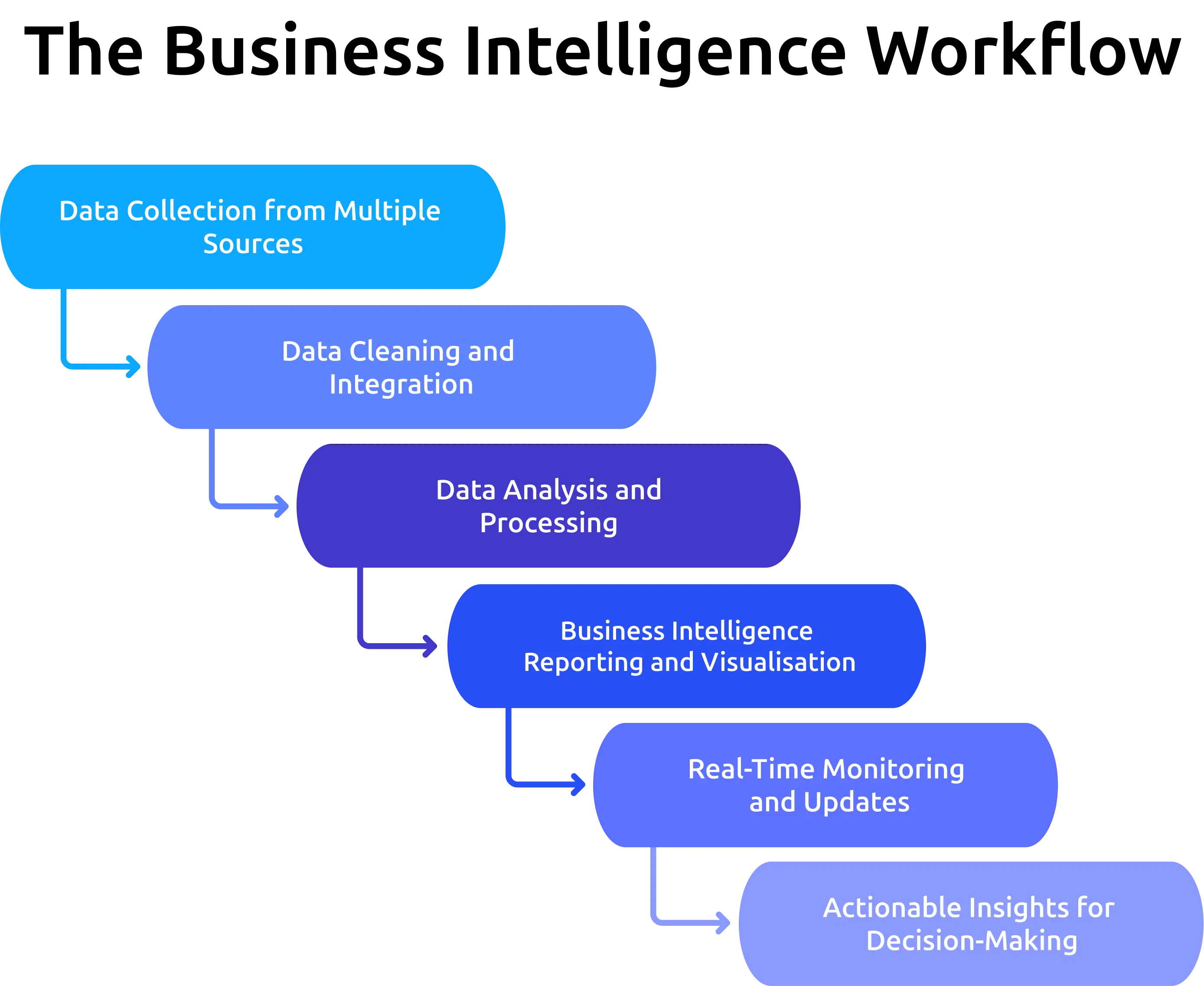
1. Data Collection from Multiple Sources
Business intelligence collects raw data from systems, like finance, ERP, CRM, and HR, and other operational tools, to build an effective and complete data foundation.
2. Data Cleaning and Integration
The data gathered is cleaned, standardized, and consolidated in a central data model. This ensures accuracy, consistency, and one source of truth throughout the organization.
3. Data Analysis and Processing
BI tools examine the prepared data to provide valuable insights, trends and relationships that represent what actually happens in the business.
4. Business Intelligence Reporting and Visualization
Business intelligence reporting transforms analyzed data into dashboards, visualizations and structured reports. These outputs help you to track KPIs, identify the trends and compare performance without manual spreadsheet work.
5. Real-Time Monitoring and Updates
The BI systems update data in real-time and keep you updated as the conditions change, and decisions still impact the results.
6. Actionable Insights for Decision-Making
You can clearly understand the performance gaps of the company, enhance operational efficiency, respond instantly to market changes, and uncover new business opportunities.
What Are the Benefits of Business Intelligence (BI)?
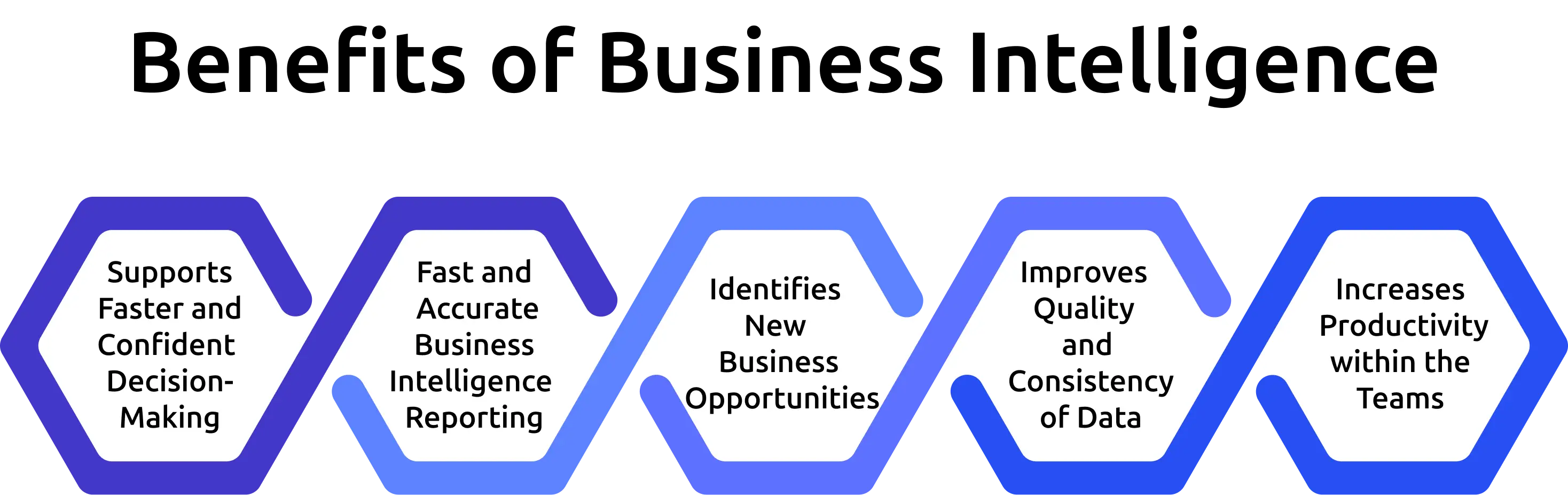
Business intelligence provides reliable insights which replace uncertainty with control by integrating business objectives, enhancing efficiency, enabling accurate decisions, and delivering efficient outcomes.
Supports Faster and Confident Decision-Making
BI provides you with real-time access to accurate data, which helps you to no longer depend on assumptions and delayed reports. You can assess the situations instantly, respond accurately while decisions still impact the results, and reduce expectations. Such clarity and accuracy will enhance the quality of decisions made directly at each level.
Fast and Accurate Business Intelligence Reporting
Business intelligence supports fast and accurate reporting through automating data collection and analysis across systems. You can receive real-time and regular reports without manual errors and delays. This accuracy helps you react instantly to changes and make decisions depending on reliable information.
Identifies New Business Opportunities
Business intelligence helps you uncover new opportunities through identifying gaps, trends and hidden patterns in your data. You can understand changing customer requirements, underperforming markets, and emerging market streams early. This transparency helps you to react fast before competitors and transform insights into strategic development opportunities.
Improves Quality and Consistency of Data
Business intelligence enhances data quality through cleaning, standardizing, and validating data from various sources. You can eliminate duplicate, inconsistent, and inaccurate information so that every report relies on one clear and trusted source of information. This consistency builds confidence in insights and boosts decision-making within the organization.
Increases Productivity within the Teams
Business intelligence improves productivity through minimizing the time spent on manual reporting and data validation. Dashboards help your teams access insights immediately, without spending time searching through spreadsheets. This effectiveness helps your employees to focus on the strategy, analysis, and implementation, driving accurate outcomes with less effort.
When workforce intelligence integrates with BI, it demonstrates how your employees actually work across processes, teams, and tools. You can acquire clear transparency into workload management, productivity levels, collaboration trends, and performance gaps. This helps you to make more accurate decisions on staffing, capability planning, and resource allocation, ensuring that the decisions are both performance-driven and people-oriented.
What Are the Challenges of Business Intelligence (BI)?

Business intelligence provides great value, but you might encounter challenges when strategy, data, or adoption is poor. Understanding these challenges early will help you prevent the pitfalls and develop a BI system that provides consistent and reliable insights.
Poor Data Quality & Inaccurate Sources
Business intelligence depends on accurate data. When the data is acquired from disconnected systems or contains errors or gaps, the insights might lose credibility. To address this, you can regulate the data sources, apply validation regulations, and maintain a single source across your organization.
Lack of a Clear Business Intelligence Strategy
The reports often become disconnected from the business objectives without a proper BI strategy. You can monitor the various metrics without knowing what is actually important. Setting goals, prioritizing KPIs and aligning BI to decision-making requirements make the insights appear actionable and relevant.
Poor User Adoption and Data Literacy
BI tools fail because the team lacks understanding or trust in data. The complicated dashboard and lack of training minimize usage. You can easily overcome this by simplifying the reports, improving data literacy and ensuring that the insights directly support every decision made by your teams.
Integration Difficulties within Systems
Most organizations fail to incorporate data from ERP, CRM, HR, and operational tools. These integration gaps slow down the reporting and minimize the visibility. Scalable business intelligence platforms and automated data pipelines help you combine the systems efficiently.
High Implementation and Maintenance Effort
Implementation of BI can feel a bit complex because of its customization, tool selection, and constant maintenance. You can reduce this challenge by starting small, scaling gradually, and then selecting BI solutions which support flexibility, automation, and long-term development.
Gain Complete Visibility into Performance and Productivity.
Start using Time Champ to strengthen your business intelligence strategy.
How is Artificial Intelligence Used in Business?
Artificial intelligence plays a vital role in enhancing the way you access data and scale business decisions. AI-powered systems automate complex information processing, analyze large data volumes accurately, and identify trends, anomalies, and associations more quickly than traditional approaches. When AI integrates with business intelligence, it enhances predictive analytics, forecasting, and real-time information, helping you move beyond static reports. By analyzing trends and real-time data, you can predict future outcomes, identify challenges early, and uncover new growth opportunities. Through new knowledge, AI constantly learns and gains accuracy of insight over time. This relationship between AI and business intelligence makes BI an active decision-making system that ensures smarter, quicker and more confident decisions.
Conclusion
Business intelligence helps you to transform complex data into simple, actionable insights that drive confident decisions within your organization. BI helps you act instantly, minimize challenges, and grow with control through enhancing efficiency, visibility, and strategic alignment. When integrated with workforce intelligence and artificial intelligence, BI evolves into an effective decision-making platform that contributes to sustainable development and long-term competitive advantage.

Anjali

Table of Content
-
 What is Business Intelligence (BI)?
-
Why is Business Intelligence Important?
-
H2: How Does Business Intelligence Work?
-
What Are the Benefits of Business Intelligence (BI)?
-
What Are the Challenges of Business Intelligence (BI)?
-
How is Artificial Intelligence Used in Business?
-
Conclusion
Related Blogs

Discover what workforce intelligence is, why it's critical, real examples, implementation steps, key benefits, challenges & how AI transforms the future.
Guna Lakshmi | February 11, 2026
Understand operational intelligence: definition, real examples, benefits, challenges, how it differs from business intelligence & helps scale businesses.
Anjali | February 11, 2026
Learn why businesses need workforce intelligence software, how it transforms business strategy, and how it works to drive strategic decision-making.
Thasleem Shaik | February 11, 2026
Learn what workplace intelligence is with real examples, how to implement it, key benefits, major challenges, and how it helps businesses scale effectively.
Anjali | February 11, 2026
Learn what productivity intelligence is, why it's important, how it works, ways it transforms team performance, pros & cons, and how to measure it.
Shabana Shaik | February 11, 2026
Productivity metrics are becoming a norm for businesses and organizations of all sizes, but only because it gives managers, executives, some insight
Mounika Sai | December 1, 2023


 4.7/5 avg.
Ready to Manage Your Workforce Smarter?
Join our family of 1500+ companies using smart insights to redefine workforces!

Free Trial
No Credit Card Required