Downsizing is more than simply reducing the number of employees. It can change team structures, workloads, responsibilities, and the way a business operates. But why do companies downsize, what are the different types, and what does the process look like in practice? Understanding these aspects can help you see how downsizing affects both organizations and employees.
This guide explains the meaning of downsizing, its types, common examples, and its impact on both businesses and employees.
What Is Downsizing?
Downsizing is the process of reducing a company’s workforce or organizational structure to lower costs, improve efficiency, or adapt to changing business needs. It may involve eliminating roles, closing departments, restructuring teams, or reducing the number of employees.
Unlike temporary cost-cutting measures, downsizing often involves permanent changes to the organization’s workforce and operations. It can also reshape workloads, responsibilities, and team dynamics across the organization.

Did You Know?
According to a Leadership IQ study of more than 4,000 layoff survivors, 74% of employees who remain after a layoff report a decline in their productivity.
Downsizing vs Layoffs vs Rightsizing vs Restructuring
Downsizing, layoffs, rightsizing, and restructuring are often used when an organization needs to make workforce or operational changes. However, each approach serves a different purpose and can affect the workforce and business structure in different ways.
| Term | What It Means | When It Might Be Used |
|---|---|---|
| Downsizing | Reducing the overall size of the workforce or organization to lower costs or adapt to changing business conditions. | When an organization needs to reduce operating costs or adjust to lower demand. |
| Layoffs | Ending employees’ roles because their positions are no longer required, usually due to business or economic reasons. | When specific roles or positions need to be eliminated. |
| Rightsizing | Adjusting the workforce to match current workload, capacity, and business needs. | When an organization needs to align staffing levels with its operational requirements. |
| Restructuring | Reorganizing teams, departments, roles, reporting lines, or business processes. | When an organization needs to change how it operates, with or without reducing its workforce. |
Why Do Companies Downsize?
Companies may choose to downsize for several business and operational reasons. The decision is usually driven by the need to control costs, respond to changing market conditions, or adjust the organization to its current business needs.
Reduce Operating Costs
Companies may downsize to lower expenses such as salaries, benefits, office costs, and other workforce-related expenses.
Respond to Declining Demand
A drop in customer demand or sales can leave companies with more employees than their current workload requires.
Improve Operational Efficiency
Downsizing can help remove overlapping roles, simplify team structures, and reduce unnecessary layers of management.
Adapt to Business Restructuring
When companies reorganize departments, merge teams, or change their business model, some existing roles may no longer be required.
Adopt New Technology
Automation and new technologies can change how certain tasks are performed, reducing the need for some roles or changing workforce requirements.
Respond to Market Changes
Economic conditions, industry shifts, increased competition, or changes in customer preferences can lead companies to adjust their workforce.
Focus on Core Business Areas
Companies may reduce staff in non-core functions while concentrating resources on products, services, or departments that support their main business objectives.
Manage Financial Challenges
When a company faces sustained financial pressure, downsizing may be considered as part of a broader effort to manage expenses and maintain business operations.
What are the Types of Downsizing
Companies use different types of downsizing depending on their financial situation, workforce requirements, and long-term business goals. While some approaches focus on reducing employee numbers, others involve eliminating specific roles, departments, or business operations. Here are the common types of downsizing:
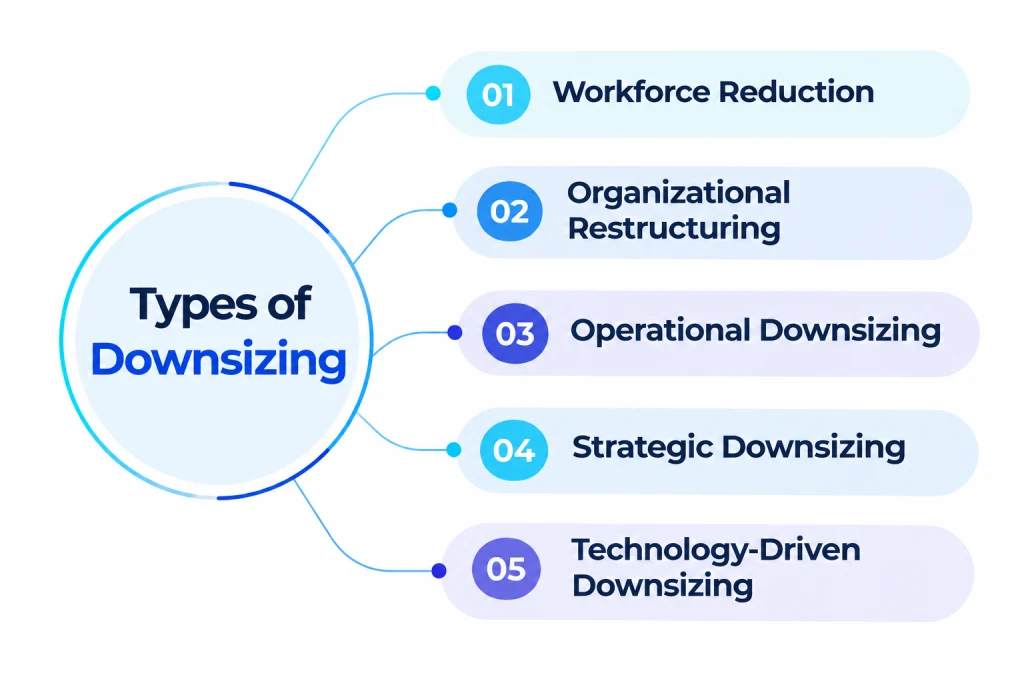
1. Workforce Reduction
Workforce reduction involves decreasing the number of employees to lower labor costs or adjust staffing levels to current business needs. Companies may achieve this through layoffs, voluntary separation programs, early retirement offers, or hiring freezes combined with natural attrition.
Example: A manufacturing company reduces its workforce after experiencing a prolonged decline in product demand.
2. Organizational Restructuring
Organizational restructuring involves changing the company's internal structure by merging departments, removing management layers, or eliminating overlapping positions. This approach focuses on simplifying operations and adjusting how teams and responsibilities are organized.
Example: A company combines its sales and marketing departments and eliminates duplicate managerial positions.
3. Operational Downsizing
Operational downsizing involves reducing the scale of business activities by closing facilities, discontinuing services, or limiting operations in certain locations. Companies typically adopt this approach when specific business units become financially unsustainable or no longer align with their goals.
Example: A retail company closes several underperforming stores and reduces the workforce associated with those locations.
4. Strategic Downsizing
Strategic downsizing is a planned reduction in workforce or business operations to support long-term organizational goals. Companies may discontinue non-core activities, exit certain markets, or redirect resources toward more important business areas.
Example: A technology company discontinues a less profitable product line and reallocates resources to its primary software services.
5. Technology-Driven Downsizing
Technology-driven downsizing occurs when companies introduce automation, artificial intelligence, or digital systems that reduce the need for certain manual or repetitive roles. This approach may involve eliminating positions, redesigning responsibilities, or retraining employees for different tasks., or digital systems that reduce the need for certain manual or repetitive roles. This approach may involve eliminating positions, redesigning responsibilities, or retraining employees for different tasks.
Example: A logistics company introduces automated inventory management software and reduces the number of employees handling manual stock records.
Need better visibility into your workforce before making decisions?
Time Champ helps you understand employee workloads and productivity so you can make more informed workforce decisions.
Advantages and Disadvantages of Downsizing
Downsizing can help companies reduce costs and simplify operations, but it can also create challenges for employees and business continuity. Let’s look at the key advantages and disadvantages to understand how downsizing can affect an organization.
| Advantages | Disadvantages |
|---|---|
| Reduces operating and workforce costs | May result in the loss of experienced employees |
| Improves operational efficiency | Can increase workloads for remaining employees |
| Aligns workforce size with business needs | May reduce employee morale and engagement |
| Supports organizational restructuring | Can disrupt day-to-day business operations |
| Creates a leaner organizational structure | May affect the company’s employer reputation |
| Allows resources to be redirected to key business areas | Can involve short-term costs such as severance and restructuring expenses |
How to Downsize Responsibly
Responsible downsizing requires more than reducing headcount. Employers need to balance business requirements with employee impact, legal obligations, and continuity of operations. These seven steps can help make the process more structured and transparent.
1. Identify the Business Need
Clearly define why downsizing is necessary. Review financial performance, workload, customer demand, business priorities, and workforce costs to determine the actual need for reducing roles.
2. Assess Workforce Requirements
Evaluate current roles, workloads, skills, and team capacity. Identify which functions are essential and where there may be overlapping or unnecessary positions.
3. Explore Alternatives First
Consider options that may reduce costs without immediately eliminating jobs. These can include hiring freezes, reduced overtime, redeployment, voluntary retirement, flexible work arrangements, or reskilling employees. redeployment, voluntary retirement, flexible work arrangements, or reskilling employees.
4. Establish Fair Selection Criteria
If job reductions are necessary, define objective and consistent criteria for selecting affected roles or employees. Avoid decisions based on personal preferences and ensure the criteria comply with applicable employment laws.
5. Communicate Clearly and Respectfully
Provide affected employees with clear information about the decision, timeline, benefits, notice requirements, and available support. Communicate with remaining employees as well to reduce uncertainty and maintain trust.
6. Complete the Legal and Administrative Process
Follow all applicable notice, compensation, documentation, consultation, and approval requirements. Employers should also maintain accurate records throughout the process.
7. Support the Remaining Workforce
After downsizing, review workloads and responsibilities to prevent unnecessary pressure on remaining employees. Provide clear role expectations, address concerns, and make adjustments where needed to keep operations running effectively.

Decisions Backed by Data
Trends and team-level analytics that show what matters.
Explore Workforce Analytics →