Balancing productivity and work-life balance has become a priority for many organizations. A compressed work week offers a practical way to achieve both by allowing employees to complete their regular weekly hours in fewer working days.
Instead of following the traditional five-day schedule, employees work longer days and gain an additional day off without reducing their total working hours.
But a compressed schedule is not just about enjoying a longer weekend. It changes how you plan workdays, how your team stays available, and how your employees manage energy, focus, and personal time. That is why understanding its types, benefits, and challenges is important before deciding whether this flexible work model is the right fit for your workplace. Let’s break it down and see how it can work for you.
What Is a Compressed Work Week?
A compressed work week is a work schedule where employees complete their regular full-time hours in fewer days than a traditional five-day work week. Instead of reducing total work hours, this model rearranges them into longer workdays, giving employees an extra day off or more extended time away from work.
Types of Compressed Work Schedules
Let’s look at the common types of compressed work schedules you can choose from. Each option follows the same idea of completing full weekly hours in fewer days, but the structure can vary based on your team’s needs and work style.
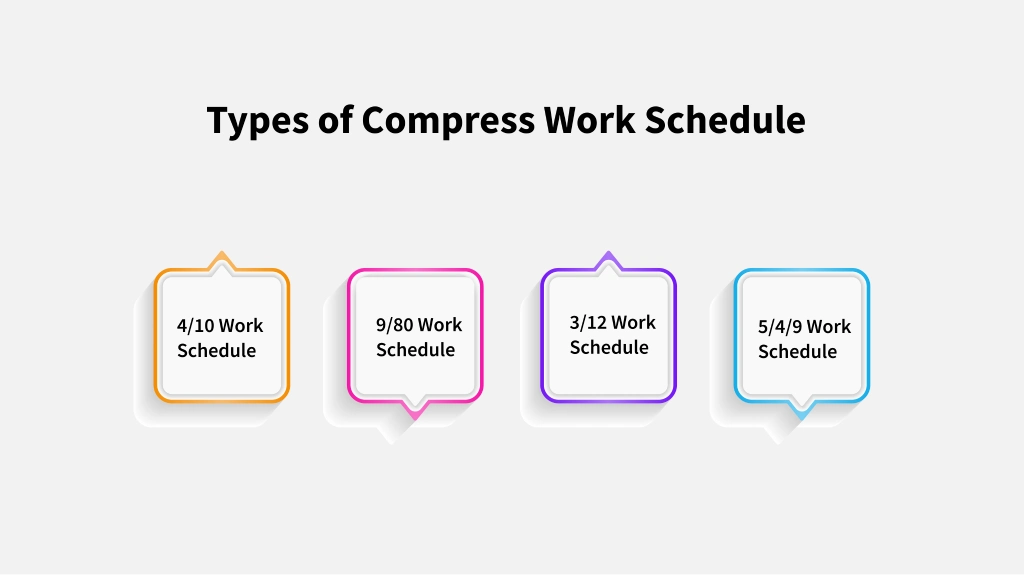
1. 4/10 Work Schedule
The 4/10 schedule is the most common type of compressed work week. Your employees work four days a week for 10 hours each day instead of five 8-hour days. For example, employees may work Monday through Thursday for 10 hours each day and take Friday, Saturday, and Sunday off. This gives your team an extra day off every week while still completing the standard 40 working hours. It is a popular choice for organizations that want to improve work-life balance without changing workloads.
2. 9/80 Work Schedule
A 9/80 schedule spreads 80 working hours across nine days over two weeks. Your team works eight 9-hour days and one 8-hour day, followed by an additional day off every other week. This schedule offers longer weekends without reducing total working hours and works well for project-based teams that can accommodate slightly longer workdays.
3. 3/12 Work Schedule
The 3/12 schedule works best for workplaces where longer shifts are already common. Your employees work three 12-hour shifts each week, completing a full-time schedule while receiving four days off. Organizations that require extended daily coverage, such as healthcare, manufacturing, and emergency services, often use this model.
4. 5/4/9 Work Schedule
The 5/4/9 schedule follows a two-week cycle. During the first week, your team works four 9-hour days and one 8-hour day. In the second week, they work four 9-hour days and take the fifth day off. This arrangement provides an extended weekend every other week while maintaining the same total working hours across the pay period.
Compressed Work Week vs Other Flexible Work Arrangements
A compressed schedule is just one of several flexible work schedules used in modern workplaces. While each option gives your organization more flexibility, they differ in how working hours, schedules, and locations are managed. Understanding these differences can help you choose the approach that best supports your business goals and your team's needs.
| Flexible Work Arrangement | Compressed Work Week | Flextime | Hybrid Work | Remote Work | Part-Time Work |
|---|---|---|---|---|---|
| Working Hours | Standard weekly hours completed in fewer days | Standard weekly hours with flexible start and finish times | Standard weekly hours split between home and office | Standard weekly hours completed from a remote location | Fewer than standard full-time hours |
| Work Location | Usually at the workplace | Usually at the workplace | Combination of office and remote work | Fully remote or another approved location | Depends on the role and agreement |
| Daily Schedule | Longer workdays | Flexible daily hours | Regular working hours | Regular or flexible working hours | Reduced daily or weekly hours |
| Total Weekly Hours | Remain the same | Remain the same | Remain the same | Remain the same | Reduced compared to full-time |
| Main Purpose | Provide extra days off without reducing hours | Give flexibility in when work begins and ends | Offer flexibility in where work happens | Enable work from anywhere | Reduce overall working hours |
| Best Suited For | Organizations seeking longer weekends while maintaining full-time hours | Teams that need flexible schedules | Organizations balancing office collaboration and flexibility | Roles that can be performed entirely online | Organizations needing reduced-hour roles or flexible staffing |
Benefits of Compressed Work Week
Andrew Barnes, author of the book “4 Day Week”, explains that organizations should focus more on productivity and outcomes instead of simply counting the number of hours employees spend at work. He highlights that this approach can help create a better work-life balance, increase employee satisfaction, improve retention, and support stronger mental well-being. Here are some of the key benefits you can expect.
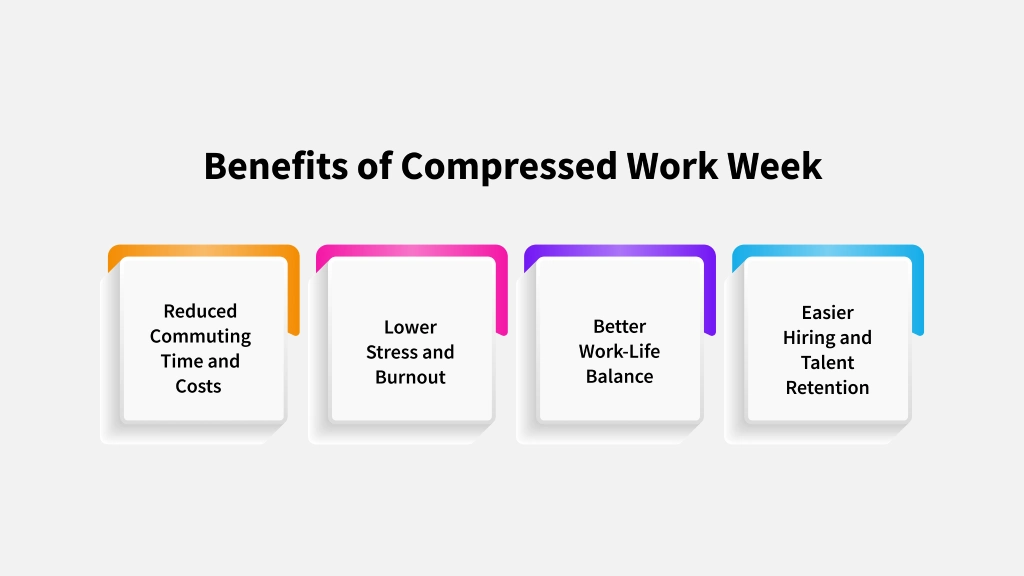
1. Reduced Commuting Time and Costs
Fewer working days mean fewer commuting days. This helps your employees save time spent commuting while reducing transportation costs. For organizations with on-site teams, it can also lower daily office occupancy and related operating expenses.
2. Lower Stress and Burnout
A well-structured compressed work schedule can help your employees feel less overwhelmed by giving them longer breaks between work cycles. Studies have shown that 39% of employees were less stressed, and 71% had reduced levels of burnout when working under compressed schedules, highlighting its positive impact on overall well-being.
3. Better Work-Life Balance
Working fewer days each week gives your employees more free time without cutting their total work hours. An extra day off can make it easier to manage personal commitments, spend time with family, or simply recharge before the next workweek. This often leads to a healthier balance between work and personal life.
4. Easier Hiring with a Flexible Work Schedule
83% of employers reported that hiring became easier after adopting a four-day workweek. Offering the same pay for fewer working days makes your organization more attractive in a competitive job market. This approach helps you attract more applicants, improve candidate quality, and reduce time-to-hire. As a result, you can lower recruitment costs while filling roles more efficiently.
Drawbacks and Challenges of Compressed Work Week
A compressed work week offers several advantages, but it also comes with practical challenges that you should consider before adopting it. The impact often depends on your industry, workload, and the way your team collaborates. Below are some of the most common challenges that can affect day-to-day operations.
1. Longer Workdays Can Lead to Fatigue
Working 10 to 12 hours a day can be physically and mentally demanding. As the day progresses, your employees may find it harder to stay focused, which can affect both performance and decision-making. Longer shifts can also lead to increased fatigue, making it more difficult for employees to maintain consistent energy levels and overall well-being throughout the workday.
2. Not Suitable for Every Role
This work schedule does not fit every business or job function. Roles that require continuous customer support, shift coverage, or frequent client interaction may find it difficult to operate with fewer working days. In these situations, maintaining service quality often requires additional capacity planning and staffing.
3. Scheduling Can Become More Difficult
When different teams take different days off, coordinating meetings and collaborative work becomes more challenging. Project discussions, approvals, and cross-functional tasks may take longer if key team members are unavailable. A clear schedule and good communication are essential to avoid delays.
4. Maintaining Consistent Performance Can Be Challenging
Longer workdays do not always result in better output. As energy levels decline, the quality of work may decrease, especially during the final hours of the shift. This can lead to slower task completion and a higher chance of mistakes if workloads are not managed carefully.
How to Implement a Compressed Work Week in Your Organization
Introducing a compressed work week requires careful planning to ensure it supports both your business goals and your team's productivity. Here are the key steps to implement it successfully.
1. Evaluate Business Requirements
- Review whether your daily operations can support longer workdays.
- Identify teams and roles that are suitable for a compressed schedule.
- Consider customer support, project timelines, and workload distribution before making changes.
2. Gather Employee Feedback
- Discuss the proposed schedule with your employees before implementation.
- Collect feedback through surveys or meetings to understand concerns and expectations.
- Use this input to build a schedule that works for both your team and your organization.
3. Choose the Right Schedule
- Select a schedule that matches your business needs, such as 4/10 or 9/80.
- Keep workloads realistic, so longer workdays remain manageable.
- Ensure the schedule supports both productivity and service continuity.
4. Start with a Pilot Program
- Test the compressed work week with a small team or department first.
- Monitor productivity, employee feedback, and operational performance during the trial.
- Use the results to refine the schedule before expanding it across your organization.
5. Use Time Tracking and Scheduling Tools
- Track working hours accurately to maintain visibility across your team.
- Monitor attendance, workloads, and schedule changes from one place.
- Use workforce insights to identify productivity trends and improve planning.

Decisions Backed by Data
Trends and team-level analytics that show what matters.
Explore Workforce Analytics →