Time Champ > Blog > What Is Aggregate Planning? Examples, Strategies & Benefits > Content
What Is Aggregate Planning? Examples, Strategies & Benefits
Learn what aggregate planning is, why it matters, examples, how to create plans, key strategies, benefits & how to overcome challenges effectively.

Why do operational plans break down even when demand forecasts seem accurate? The gap usually appears when demand shifts faster than the workforce and capacity decisions can respond. Aggregate planning addresses this challenge by aligning demand, workforce, and capacity across a defined medium-term planning horizon.
In this blog, you can explore what aggregate planning is, why you need to rely on it, and how it works through practical examples and proven strategies. You can also examine the benefits of aggregate planning and the challenges that often limit its effectiveness.
By the end, you will understand how aggregate planning helps bring clarity to workforce decisions, improve cost control, and create stability across medium-term operational planning cycles.
What Is Aggregate Planning?
Aggregate planning is a medium-range planning process that helps organizations meet demand by aligning workforce, production capacity, and inventory over a defined time horizon, typically between 3 and 18 months. It focuses on total output or service levels instead of individual products, projects, or employees, enabling consolidated and more effective planning decisions.
At its core, aggregate planning helps translate demand forecasts into actionable capacity decisions. Instead of reacting to demand changes as they occur, this approach evaluates options in advance, such as adjusting workforce size, using overtime, building inventory, or outsourcing work to maintain a balance between demand and capacity.
This level of planning sits between strategic planning and day-to-day scheduling. Strategic plans define long-term goals, while detailed schedules assign tasks and shifts. Aggregate planning connects the two by setting realistic boundaries for execution. With a clear aggregate plan in place, workforce allocation, budgeting, and operational scheduling become more predictable and controlled.
Why Is Aggregate Planning Important?
As demand patterns shift and capacity remains constrained, planning decisions made in isolation often lead to inefficiencies. Aggregate planning provides a structured way to evaluate workforce, production, and capacity choices before they impact cost and delivery.
- Cost Control: Aligns workforce, production, and inventory decisions early to prevent cost escalation from overtime, excess inventory, or last-minute outsourcing.
- Workforce Stability: Reduces frequent hiring, layoffs, and unplanned overtime by smoothing capacity decisions over the planning horizon.
- Demand Alignment: Matches team capacity with forecasted demand to minimize backlogs, missed deadlines, and service disruptions.
- Operational Predictability: Creates a stable planning baseline that reduces reactive decision-making during execution.
- Cross-Functional Alignment: Ensures finance, HR, and operations plan against the same demand and capacity assumptions.
Do you want to spot capacity gaps before costs rise?
Discover how Time Champ reveals utilization trends early and helps prevent reactive workforce decisions.
What Are the Examples of Aggregate Planning?
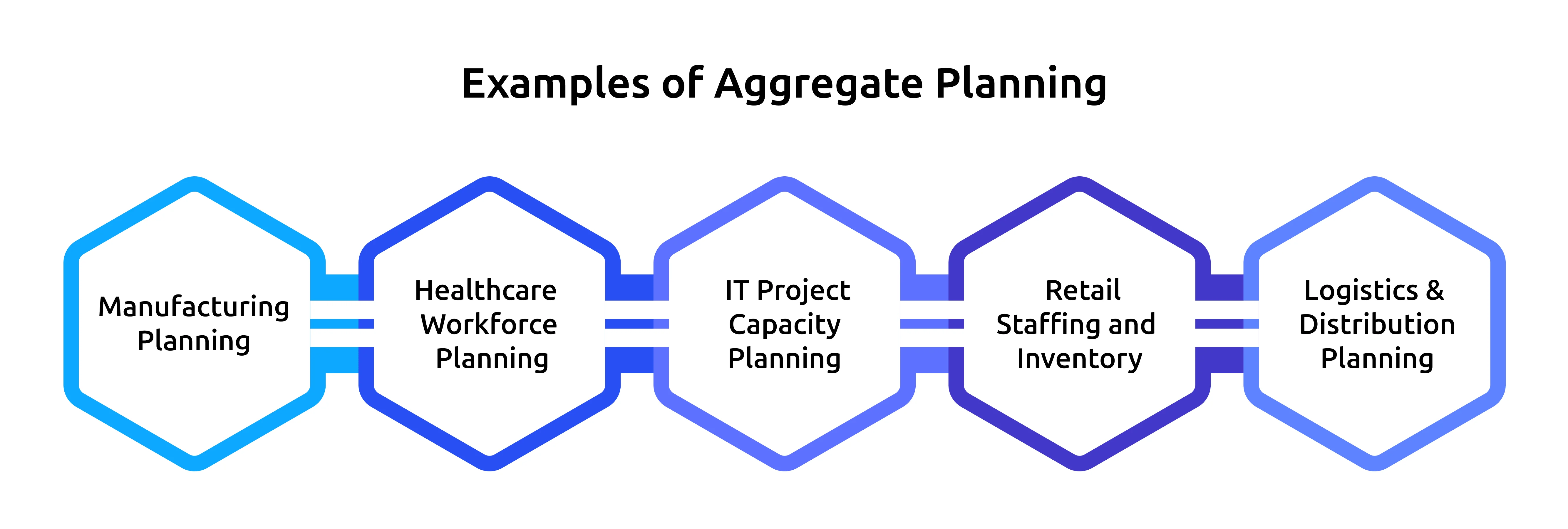
Aggregate planning often shows its value when everyday operations start drifting away from forecasts. These examples reflect how you can apply aggregate planning in your organization to regain balance between demand, capacity, and cost.
Manufacturing Production Planning
A manufacturer sees demand rising for an entire product line over the next two quarters. Instead of increasing production week by week, planners forecast demand at a family level, evaluate whether overtime or inventory buildup makes more sense, and lock production targets early to avoid costly last-minute changes. This approach reflects standard aggregate planning practice by evaluating production, inventory, and labor decisions together over a 3-18 month horizon.
Healthcare Workforce Planning
A hospital anticipates higher patient volumes during flu season. Leadership reviews historical admission trends, plans staffing capacity and overtime limits, and supplements teams with temporary staff where needed. According to Definitive Healthcare, labor-related expenses make up roughly 37% of hospital operating costs, increasing the financial risk of reactive staffing decisions.
IT Services and Project Capacity Planning
An IT services firm expects multiple client projects to overlap in the coming months. Instead of assigning resources project by project, managers forecast total workload, assess team availability at an aggregate level, and decide whether to hire, reskill, or outsource early. Aggregate planning helps prevent delivery delays without locking the firm into unnecessary long-term hiring.
Retail Staffing and Inventory Management
A retailer prepares for a seasonal sales peak where both staffing and inventory must scale together. Instead of reacting to daily sales fluctuations, planners forecast overall demand, set inventory targets at a category level, and plan workforce hours in advance. This aggregate-level approach enables retail teams to avoid overstaffing during slow periods, prevent stockouts during peak periods, and maintain cost control throughout the season.
Logistics and Distribution Operations
A logistics provider expects higher shipment volumes during a promotional period. Teams forecast demand, plan labor capacity, and align fleet and warehouse throughput before volumes rise. Early capacity planning helps the organization avoid bottlenecks, last-minute subcontracting, and delivery delays that typically emerge when demand outpaces preparation.
How to Create an Aggregate Plan?
Creating an aggregate plan requires a structured approach that balances demand expectations with available capacity. Each step builds clarity around workforce, production, and cost decisions before execution begins.
Forecast Demand
Start by estimating demand over the planning horizon, typically 3 to 18 months. Use historical data, seasonality, and known business drivers to create a realistic demand outlook at an aggregate level rather than by individual products or tasks.
Assess Available Capacity
Evaluate current workforce size, production capability, and operational limits. This assessment covers regular working hours, overtime capacity, subcontracting options, and inventory constraints that shape how the organization meets demand.
Identify Capacity Alternatives
List available options for handling demand fluctuations, such as overtime, temporary staffing, inventory buildup, outsourcing, or demand smoothing. Each alternative carries different costs and workforce implications.
Evaluate Costs and Trade-offs
Compare alternatives by estimating labor costs, inventory holding costs, training expenses, and service-level impact. This step helps identify trade-offs between cost efficiency and workforce stability.
Select and Document the Aggregate Plan
Choose the plan that best balances cost, service levels, and operational feasibility. Document target output levels, workforce requirements, and capacity adjustments to guide detailed scheduling and execution.
What Are the Common Aggregate Planning Strategies?
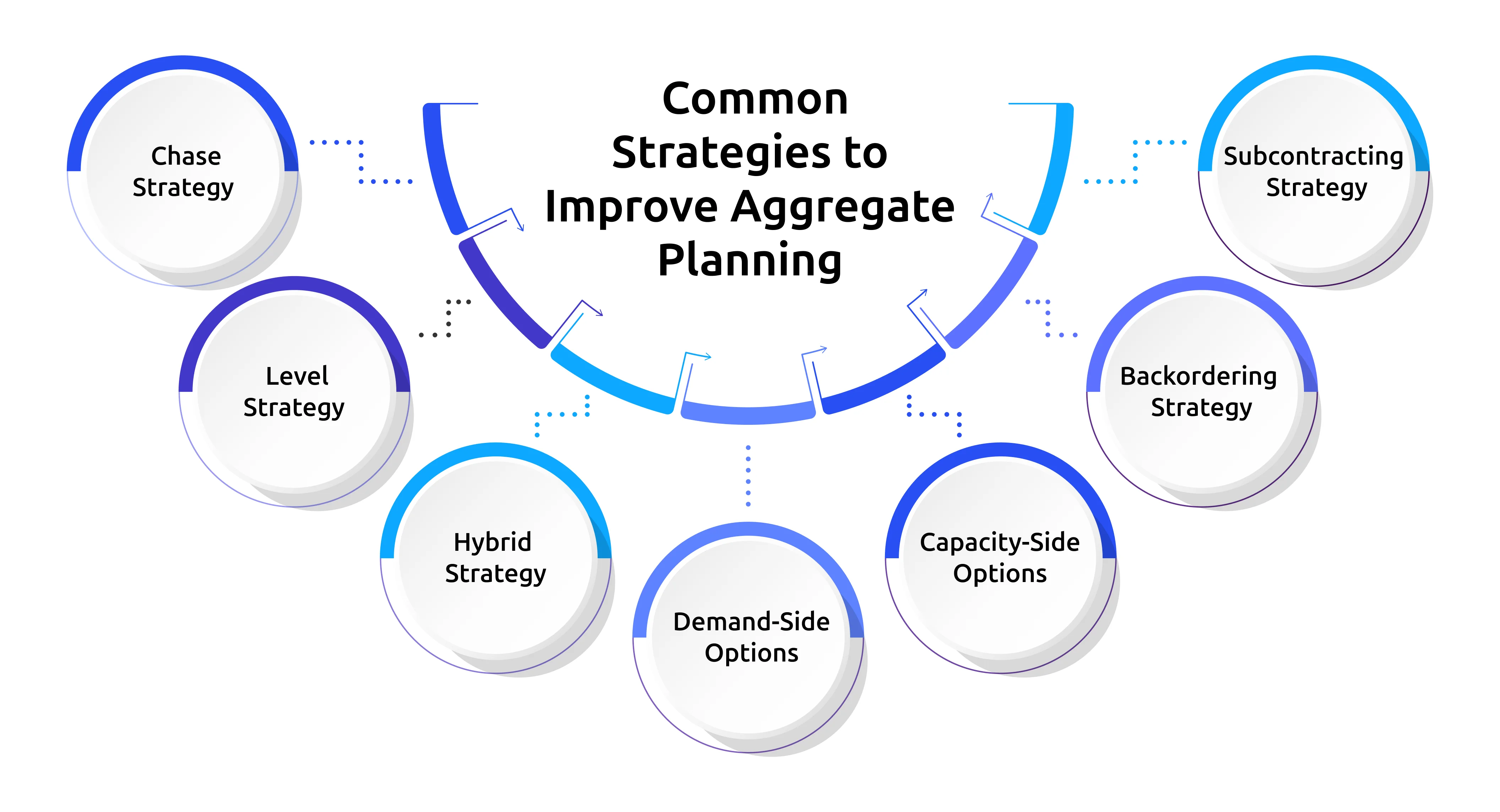
You can use different aggregate planning strategies based on demand volatility, cost sensitivity, and workforce flexibility. Each strategy offers a different balance between cost control, workforce stability, and flexibility.
Chase Strategy
The chase strategy aligns production or workforce levels directly with demand periodically, such as monthly or quarterly planning cycles. This approach reduces inventory holding costs but requires a highly flexible workforce and may increase hiring, training, or overtime expenses.
Level Strategy
The level strategy maintains a constant production rate and workforce size throughout the planning horizon. Absorb demand fluctuations by building inventory during low-demand periods and drawing it down or allowing backlogs during peak demand.
Hybrid (Mixed) Strategy
The hybrid strategy combines elements of both chase and level approaches. Maintain a stable core workforce and manage short-term demand spikes using overtime, temporary labor, or limited outsourcing. This creates a balance between cost control and service levels.
Demand-Side Options
Demand-side options influence customer demand to better match available capacity. Common methods include promotional campaigns, pricing adjustments, controlled backordering, or shifting demand across time periods to reduce capacity pressure.
Capacity-Side Options
Capacity-side options focus on adjusting available resources to meet demand. This includes hiring or terminating employees, using part-time workers, subcontracting work, and cross-training staff to improve flexibility across roles.
Backordering Strategy
The backordering strategy accepts customer orders even when stock or capacity is unavailable and fulfills them later once supply becomes available. This approach works best when customers are willing to wait, and service-level agreements permit delayed fulfillment.
Subcontracting Strategy
Subcontracting involves outsourcing part of production or service delivery to third-party providers during periods of high demand. It offers flexibility without long-term capacity expansion but requires careful cost and quality management.
Want to validate aggregate plans before costs escalate?
Use Time Champ to uncover capacity gaps & workload pressure early, before plans break down.
What Are the Benefits of Aggregate Planning?
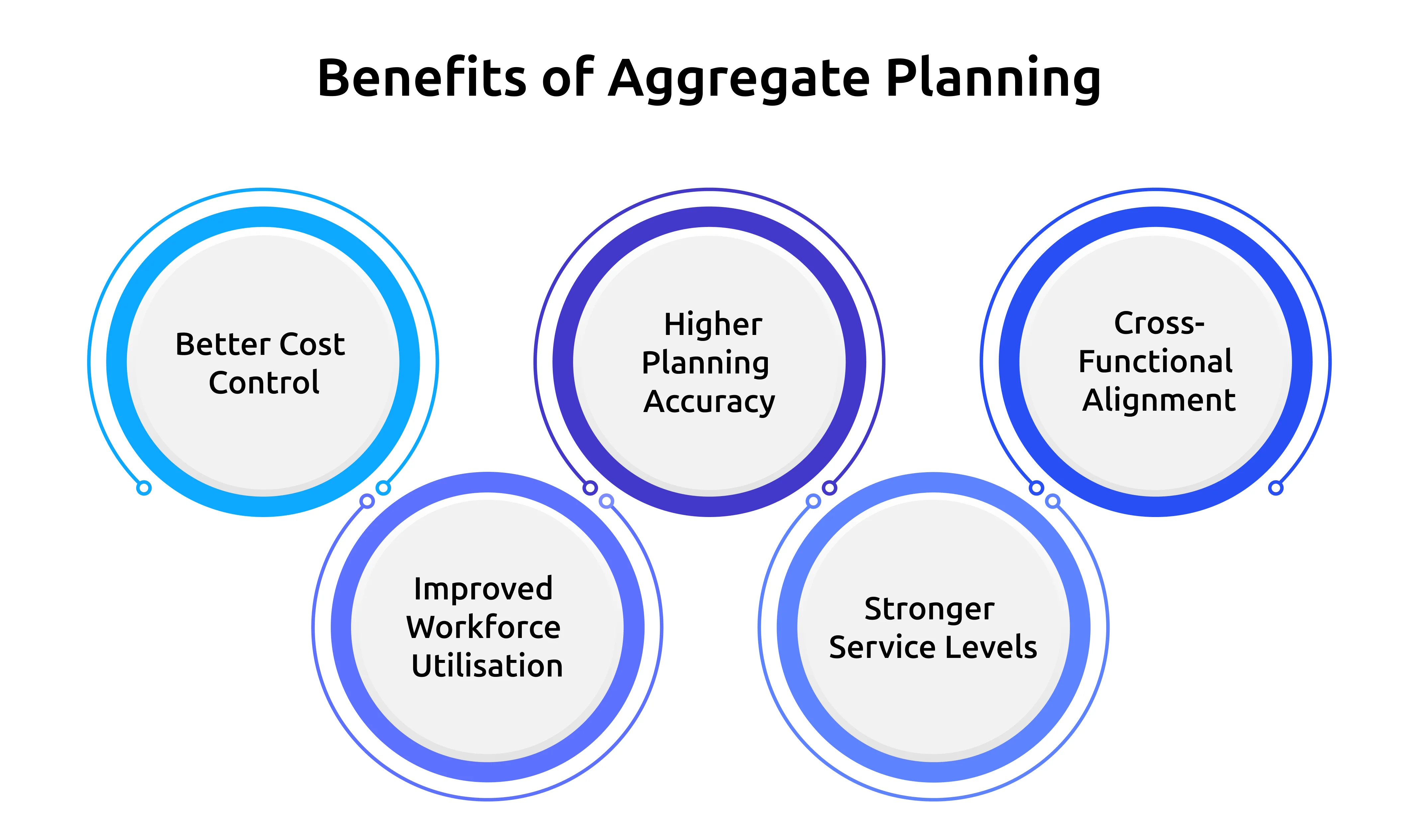
Aggregate planning delivers value by bringing structure and foresight to workforce and capacity decisions. When applied consistently, it helps you manage demand changes without disrupting operations or increasing risk.
- Better Cost Control: Reduces unplanned overtime, limits emergency outsourcing, and prevents excess inventory or idle capacity.
- Improved Workforce Utilization: Balances workloads across teams, minimizes burnout, and supports stable hiring and scheduling decisions.
- Higher Planning Accuracy: Aligns demand forecasts with realistic capacity limits and reduces dependence on reactive, short-term fixes.
- Stronger Service Levels: Improves on-time delivery, reduces backlogs, and maintains consistency during peak and off-peak periods.
- Cross-Functional Alignment: Aligns operations, HR, and finance around a shared plan, improving coordination and execution.
What Are the Challenges of Implementing Aggregate Planning?
Even well-designed aggregate plans can fail when you lack real-time data, flexibility, or cross-functional coordination. The following challenges often affect aggregate planning, and workforce intelligence provides practical ways to overcome them.
Inaccurate Demand Forecasts
Static or overly simplistic forecasts often fail to reflect changing workload patterns and lead to capacity mismatches. Workforce intelligence improves forecast reliability by combining real utilization and activity data with demand signals, reducing the gap between plan and execution.
Limited Workforce Visibility
Many organizations lack real-time insight into utilization, availability, and skills, making it hard to translate aggregate plans into operational capacity. Modern workforce intelligence platforms provide visibility into headcount, utilization, and performance trends that support more realistic planning assumptions. According to Jobspikr, only 38% of organizations currently use dynamic workforce analytics, indicating a large gap in visibility that workforce intelligence can address.
Rigid Workforce Structures
Rigid staffing models restrict the ability to respond to demand fluctuations or redeploy talent across functions. Workforce intelligence highlights hidden capacity and underutilised skills across the organization, enabling more flexible workforce allocation and cross-training decisions.
Disconnected Planning Across Teams
Operations, HR, and finance often plan independently, leading to misaligned assumptions and execution gaps. Workforce intelligence creates a shared data layer across functions, aligning capacity, cost, and planning metrics so all teams make decisions on the same operational reality.
Static and Manual Planning Tools
Spreadsheets and periodic reports fail to reflect ongoing shifts in demand and workforce behavior. Workforce intelligence tools like Time Champ offer real-time insights into capacity trends and utilization metrics, allowing aggregate plans to remain dynamic, responsive, and actionable instead of static and outdated.
How Time Champ Workforce Intelligence Supports Aggregate Planning
Aggregate planning depends on accurate inputs such as workforce capacity, utilization, and shifting demand patterns. Time Champ, a workforce intelligence tool, strengthens this process by turning daily work activity into practical, decision-ready insights. Instead of depending on static forecasts or manual reporting, you can analyze capacity usage across roles, projects, and time periods in real time.
With clear visibility into utilization trends, workload distribution, and productivity signals, you can validate whether aggregate plans align with actual execution. You can spot capacity issues early, identify demand spikes faster, and plan staffing changes in advance. This keeps aggregate plans accurate and aligned with real workload changes throughout the planning period.
Conclusion
Aggregate planning helps align demand and workforce capacity over the medium range, improving cost control, workforce stability, and operational predictability. Understanding how aggregate planning works and applying the right strategies makes planning decisions more proactive and less reactive.
To keep aggregate plans accurate as demand and workloads shift, visibility into real workforce utilization matters. Time Champ strengthens aggregate planning with real-time capacity and utilization insights, helping plans stay aligned with how work actually happens.
Struggling to keep your aggregate plan aligned with real workforce capacity?
Try Time Champ today and gain real-time visibility into resource & utilization trends.

Chethana

Table of Content
-
 What Is Aggregate Planning?
-
Why Is Aggregate Planning Important?
-
What Are the Examples of Aggregate Planning?
-
How to Create an Aggregate Plan?
-
What Are the Common Aggregate Planning Strategies?
-
What Are the Benefits of Aggregate Planning?
-
What Are the Challenges of Implementing Aggregate Planning?
-
How Time Champ Workforce Intelligence Supports Aggregate Planning
-
Conclusion
Related Blogs
Find out the difference between short-term and long-term planning. Learn how businesses set short-term goals and lay the foundation for long-term success in simple terms.
Jahnavi Pulluri | May 24, 2024
Learn the art of long-term planning with us! Explore practical advice and user-friendly tools to achieve Everlasting success on your terms.
Jahnavi Pulluri | May 25, 2024
Learn what short-term planning is, its importance, and how it helps businesses stay focused for immediate success.
Shabana Shaik | May 27, 2024
Discover dynamic workforce planning: what it is, why it’s important, key components, how to create a plan, and how it differs from strategic planning.
Guna Lakshmi | September 15, 2025
Discover 10 key workforce planning metrics for 2025. Learn how these analytics metrics impact hiring, retention, productivity & strategic HR planning.
Guna Lakshmi | September 15, 2025
Discover strategic workforce planning: definition, process, tools, and templates. Align talent with business goals and prepare your workforce for the future.
Shabana Shaik | September 16, 2025


 4.7/5 avg.
Ready to Manage Your Workforce Smarter?
Join our family of 1500+ companies using smart insights to redefine workforces!

Free Trial
No Credit Card Required