Time Champ > Blog > How to Transform Business Strategy with Workforce Intelligence Software? > Content
How to Transform Business Strategy with Workforce Intelligence Software?
Learn why businesses need workforce intelligence software, how it transforms business strategy, and how it works to drive strategic decision-making.

Businesses collect massive amounts of work data, but most struggle to turn it into actionable insights that drive smarter decisions. Without a clear view of how tasks, teams, and processes perform, strategies often rely on guesswork instead of real evidence.
Workforce intelligence software solves this problem by capturing, analyzing, and connecting daily work data to business outcomes. It helps you understand team performance, identify bottlenecks, and make informed decisions that align with your strategic goals.
In this blog, you will see how workforce intelligence software transforms business planning, improves operational efficiency, and strengthens decision-making across teams. You can also learn how to use these insights to optimize resources, increase productivity, and achieve measurable business growth.
Why Does Business Need Workforce Intelligence Software?
Every business needs clear visibility into how teams execute work, how they perform, and how they allocate resources. Without this insight, decisions often rely on guesswork and miss opportunities for improvement. Here are the key reasons why workforce intelligence software is essential for your business.
- Clear Visibility into How Work Happens: Workforce intelligence software lets you see how your teams actually use time, effort, and resources. This visibility removes blind spots and supports better operational decisions without relying on assumptions.
- Accurate Time, Cost, and Output Alignment: Gain a direct link between work performed and costs incurred. This alignment improves billing accuracy, payroll confidence, and financial planning by ensuring your numbers reflect real activity.
- Stronger Accountability Without Micromanagement: Workforce intelligence gives you clear insights into attendance and task activity, helping teams take responsibility for their work. You can identify issues early and set clear expectations for employees, reducing the need for constant oversight and improving overall efficiency.
- Better Workforce Planning and Utilization: Workforce intelligence highlights workload imbalances, idle time, and capacity gaps. These insights help you plan staffing more effectively and avoid burnout or underuse.
- Reduced Operational Errors and Rework: Automated workforce data collection reduces operational errors by eliminating manual data entry and rework. This lowers administrative overhead, improves process consistency, and allows operations to scale without increasing complexity or risk.
Unsure where work hours, effort, and resources are really going?
Use Time Champ to bring clarity to work patterns and keep teams aligned.
How Workforce Intelligence Software Transforms Business Strategy?
The rising focus on workforce intelligence is hard to ignore. Demand for workforce intelligence dashboards has increased by 48 %, leading large organizations to invest more in these solutions. This shift shows how you can gain clear visibility into real work patterns, helping you shape strategies that are practical and ready for execution. Here’s how workforce intelligence software helps you make smarter, more focused business decisions.

1. Turns Workforce Data into Strategic Insight
Workforce intelligence software tracks daily workforce activity and transforms it into clear and useful insights. Leaders gain a deeper understanding of how teams function and which efforts contribute most to business goals. This visibility supports strategic direction rather than short-term fixes. Similar data-driven thinking can help ecommerce businesses analyse customer behaviour and use optimization techniques to increase Shopify AOV, supporting long-term revenue growth.
2. Enables Proactive Decision-Making
Early signals around workload shifts and performance gaps help leaders act in advance. Workforce intelligence highlights patterns before they turn into risks. This allows timely adjustments that protect productivity and service quality.
3. Connects Workforce Performance to Business Outcomes
Strategy becomes stronger when employees' data links directly to delivery, cost, and results. Workforce intelligence tools like Time Champ clearly show how staffing levels, workload balance, and productivity trends impact revenue, margins, and service quality. This connection helps leaders align workforce decisions with business goals.
4. Improves Resource Allocation at Scale
As organizations grow, misaligned resources quickly slow execution. Workforce intelligence shows you where teams underuse effort or stretch it too far, so you can redirect resources to the areas that deliver the most value. You can use resources efficiently as your teams and projects grow.
5. Strengthens Accountability Across the Organization
Workforce intelligence platforms help you hold teams accountable by tracking progress and performance clearly. You can see who is responsible for each task, monitor results, and ensure everyone meets their commitments. This creates a culture where teams own their work, and you can drive consistent performance across the organization.
How Does Workforce Intelligence Software Work with Business Strategy?
Business strategy works best when it reflects how operations perform in real time. Workforce intelligence software helps connect daily operations with long-term business goals. It gives you clear visibility into performance, capacity, and trends, so decisions stay aligned with strategy. Let’s take a look at how workforce intelligence software supports your business in strategic planning and execution.editorjs
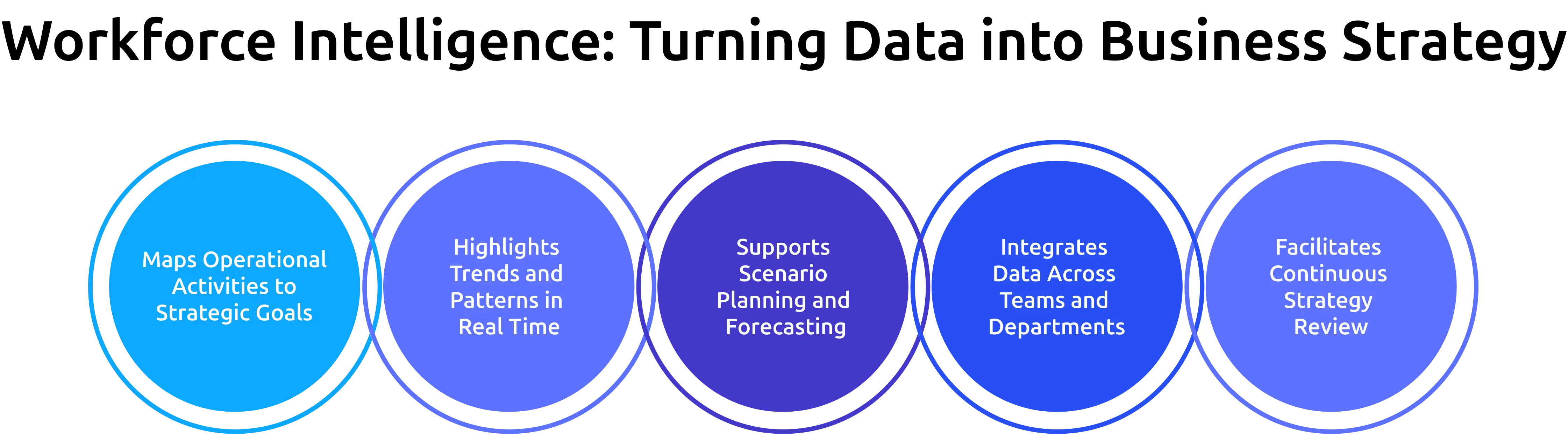
1. Maps Operational Activities to Strategic Goals
Workforce intelligence software tracks tasks, projects, and workflows, showing how each activity contributes to broader objectives. You can see which actions drive results and which need adjustment, helping you prioritize initiatives that move your strategy forward effectively.
2. Highlights Trends and Patterns in Real Time
Using a workforce intelligence platform to continuously monitor performance, capacity, and workflow trends makes it easier to see where teams need to improve. The software helps you spot bottlenecks and workload imbalances early, so you can act quickly and keep operations aligned with your business priorities.
3. Supports Scenario Planning and Forecasting
With predictive insights and simulations, the tool shows how changes in resources, timelines, or initiatives could impact outcomes. This helps you make informed decisions, keeping plans realistic and aligned with what your teams can deliver.
4. Integrates Data Across Teams and Departments
Integrating a workforce intelligence platform lets you bring together data from all teams and departments into a single view. With this centralized workforce data, you can clearly see what each team is working on, coordinate efforts more effectively, avoid duplicated work, and ensure everyone’s activities support shared strategic goals.
5. Facilitates Continuous Strategy Review
Ongoing visibility into execution makes it easier to track progress against goals and identify gaps early. Regular insight from the tool supports timely adjustments, keeping strategy practical, actionable, and aligned with evolving business needs.
Making forecasts without reliable workforce data?
Use Time Champ to plan with confidence and adapt strategy as work evolves.
How Can Time Champ Turn Workforce Data into a Stronger Business Strategy?
Many businesses struggle to connect strategy with what actually happens on the ground. Plans are good on paper, yet poor visibility of day-to-day operations, unbalanced utilization of resources, slow feedback, and poor performance indicators often weaken execution. You end up relying on assumptions, reacting late to issues, and adjusting strategy only after results fall short.
Time Champ addresses these challenges as a workforce intelligence platform that brings structure and visibility to everyday operations. These insights help you align priorities, plan resources with precision, and make timely decisions that keep strategy practical and grounded. Instead of reacting to results after the fact, you gain the clarity needed to guide strategy proactively, using workforce data to improve focus, efficiency, and long-term growth.
Conclusion
Workforce intelligence software helps you move from assumption-based planning to insight-driven strategy. It gives you clear visibility into execution, supports timely decisions, and keeps your priorities aligned with actual performance. With the right insights, you can respond quickly, stay on track, and create strategies that achieve reliable, measurable results.
Ready to replace assumptions with real workforce insights?
Try Time Champ to turn workforce insights into actionable results.

Thasleem Shaik

Table of Content
-
 Why Does Business Need Workforce Intelligence Software?
-
How Workforce Intelligence Software Transforms Business Strategy?
-
How Does Workforce Intelligence Software Work with Business Strategy?
-
How Can Time Champ Turn Workforce Data into a Stronger Business Strategy?
-
Conclusion
Related Blogs
Find the 10 best workforce intelligence software for 2026. Compare features, pricing, pros, cons to boost operational clarity and team performance.
Thasleem shaik | February 11, 2026
Learn why workforce intelligence matters for investment & strategy teams, what makes it a strategic asset, how teams use it & how it supports decisions.
Chethana Choudary | February 11, 2026
Learn what external workforce intelligence is, why it matters for enterprise strategy, real examples, how it shapes strategy & which teams benefit most.
Anjali | February 11, 2026
Learn what business intelligence (BI) is, why it matters, how it works, explore key benefits, challenges & how AI is used to enhance business decisions.
Anjali | February 11, 2026
Learn why filtering workforce data is essential, how to filter data for effective workforce intelligence step-by-step, and how it supports better outcomes.
Guna Lakshmi | February 11, 2026
Learn what productivity intelligence is, why it's important, how it works, ways it transforms team performance, pros & cons, and how to measure it.
Shabana Shaik | February 11, 2026


 4.7/5 avg.
Ready to Manage Your Workforce Smarter?
Join our family of 1500+ companies using smart insights to redefine workforces!

Free Trial
No Credit Card Required