Time Champ > Blog > Workforce Intelligence for Investment and Strategy Teams > Content
Workforce Intelligence for Investment and Strategy Teams
Learn why workforce intelligence matters for investment & strategy teams, what makes it a strategic asset, how teams use it & how it supports decisions.

Investment and strategy decisions often fail when you lack visibility into execution capacity. Traditional workforce metrics focus on headcount and cost, but they do not answer the questions you need to plan with confidence. You still need clarity on where pressure builds, how productivity shifts under workload, and whether your teams can realistically deliver strategic priorities.
Workforce intelligence solves this gap by turning workforce activity, workload trends, and capacity signals into actionable insights. In this blog, you will learn why workforce intelligence matters for investment and strategy teams, what makes it a strategic asset, and how you can use it to support better investment decisions and long-term growth.
Why Workforce Intelligence Matters for Investment and Strategy Teams?
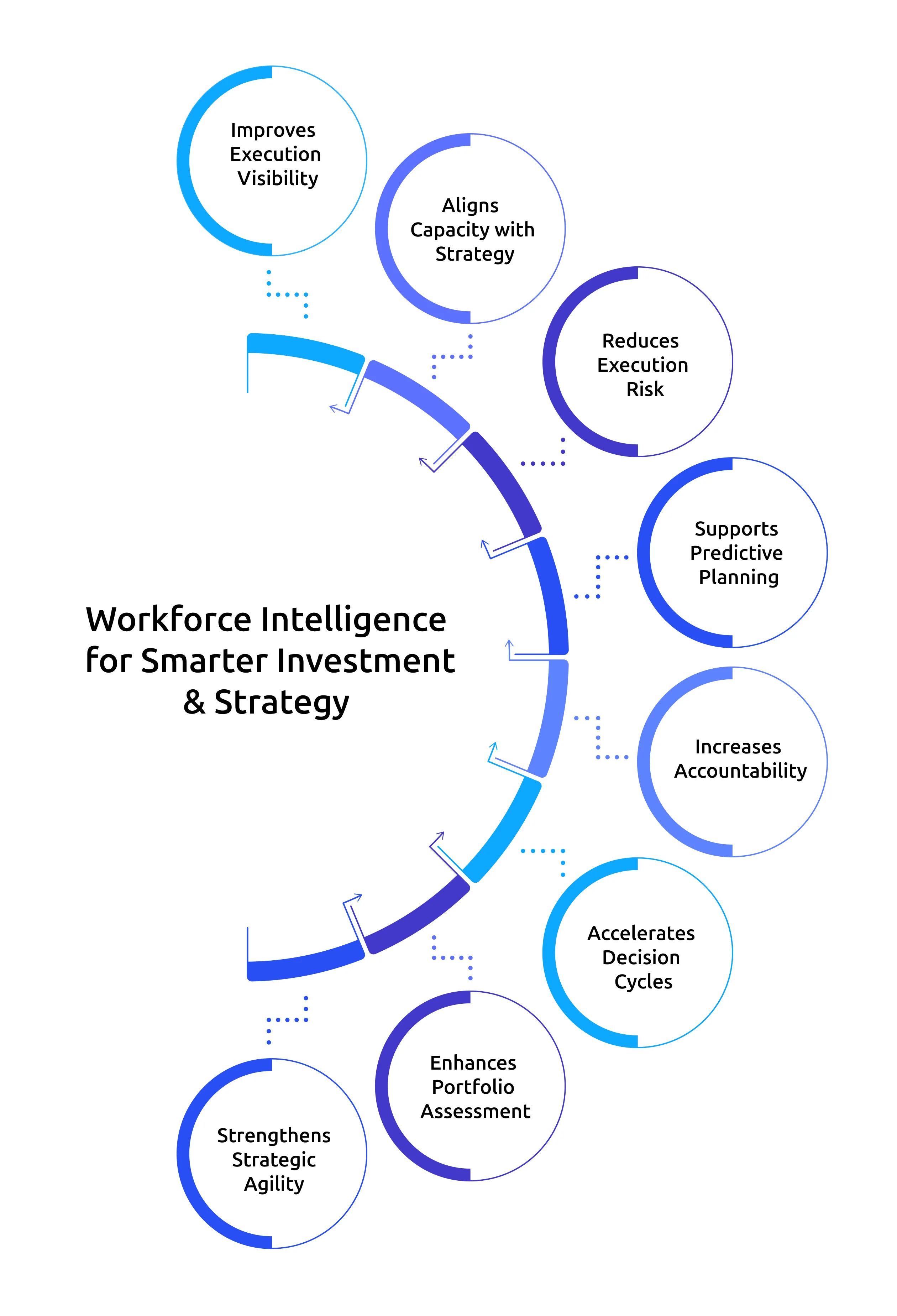
You make investment and strategy decisions based on execution assumptions. When teams hit capacity limits, delivery slows and strategic initiatives slip without early warning. Workforce intelligence shows you how much capacity your teams have, where workload pressure is rising, and whether they can take on new priorities without delaying committed delivery.
Below are the key reasons why workforce intelligence matters:
- Improves Execution Visibility - Understand how work is progressing across teams, along with what was planned.
- Aligns Capacity with Strategy -Identify where capacity is strong and where gaps remain before you invest.
- Reduces Execution Risk - Identify patterns of overload,imbalance, or unsustainable workload that may undermine strategic initiatives.
- Supports Predictive Planning - Use historical workforce signals to predict future readiness and resource strain.
- Increases Accountability - Replace assumption-driven or fragmented inputs with objective workforce metrics that drive aligned action.
- Accelerates Decision Cycles - Gain real-time insights into performance and bottlenecks instead of waiting for quarterly reports.
- Enhances Portfolio Assessment - Evaluate team execution capacity and delivery reliability when prioritizing investments, along with financial KPIs.
- Strengthens Strategic Agility - Track work progress across teams in real time so you can spot slowdowns early and adjust priorities quickly.
What would your strategy look like with full execution visibility?
See how Time Champ’s workforce intelligence helps you align investment decisions with real execution capacity.
What Makes Workforce Intelligence a Strategic Asset?
You require more than traditional data to make investment and strategy decisions. Rely on workforce intelligence, a strategic resource that shows how work happens, explains why results fall short of plan, and highlights where execution risks occur.
Workforce intelligence goes beyond basic reporting and gives you a real strategic advantage. Here’s why:
Real-Time Operational Visibility
Unlike static metrics such as headcount or budget reports, workforce intelligence continuously tracks how work flows across teams, giving you a real-time view of execution capacity, bottlenecks, and performance variability. This allows timely strategic adjustments as operating conditions shift. It also highlights early signs of execution stress, allowing you address risks before they affect outcomes.
Predictive Insights for Better Planning
Workforce intelligence strengthens forecasting by combining historical execution patterns with current workforce signals. It helps you predict talent needs, assess execution capacity, and identify rising workload pressure across the organization. This clarity improves scenario planning and helps you manage risks before they impact delivery.
Data-Driven Decision Frameworks
Strong strategic decisions depend on evidence, not assumptions. Workforce intelligence connects workforce data across tools and provides a unified view of capacity, workload, and execution trends. This clarity helps evaluate investment trade-offs, quantify impact, and support strategic decisions with measurable proof.
Continuous Alignment with Business Goals
Workforce intelligence remains aligned with shifting strategic priorities. Because it integrates with ongoing work patterns and organizational priorities. It enables continuous alignment between business direction and execution capacity, so your forecasting and planning aren’t out of sync with reality.
Scalability Across Teams and Functions
Whether assessing enterprise-wide initiatives or strategic priorities within individual business units, workforce intelligence scales across teams. This ensures consistent decision frameworks, comparable performance metrics, and standardized risk signals no matter the scope of strategy.
Measurable Impact on Business Outcomes
Organizations using data-driven workforce strategies often achieve measurable performance improvements. Industry research shows that workforce analytics adoption delivers measurable financial returns, with organizations achieving up to $13.01 for every dollar invested. This evidence reinforces workforce intelligence as a value-creating strategic asset rather than a purely operational tool.
How Investment and Strategy Teams Use Workforce Intelligence?
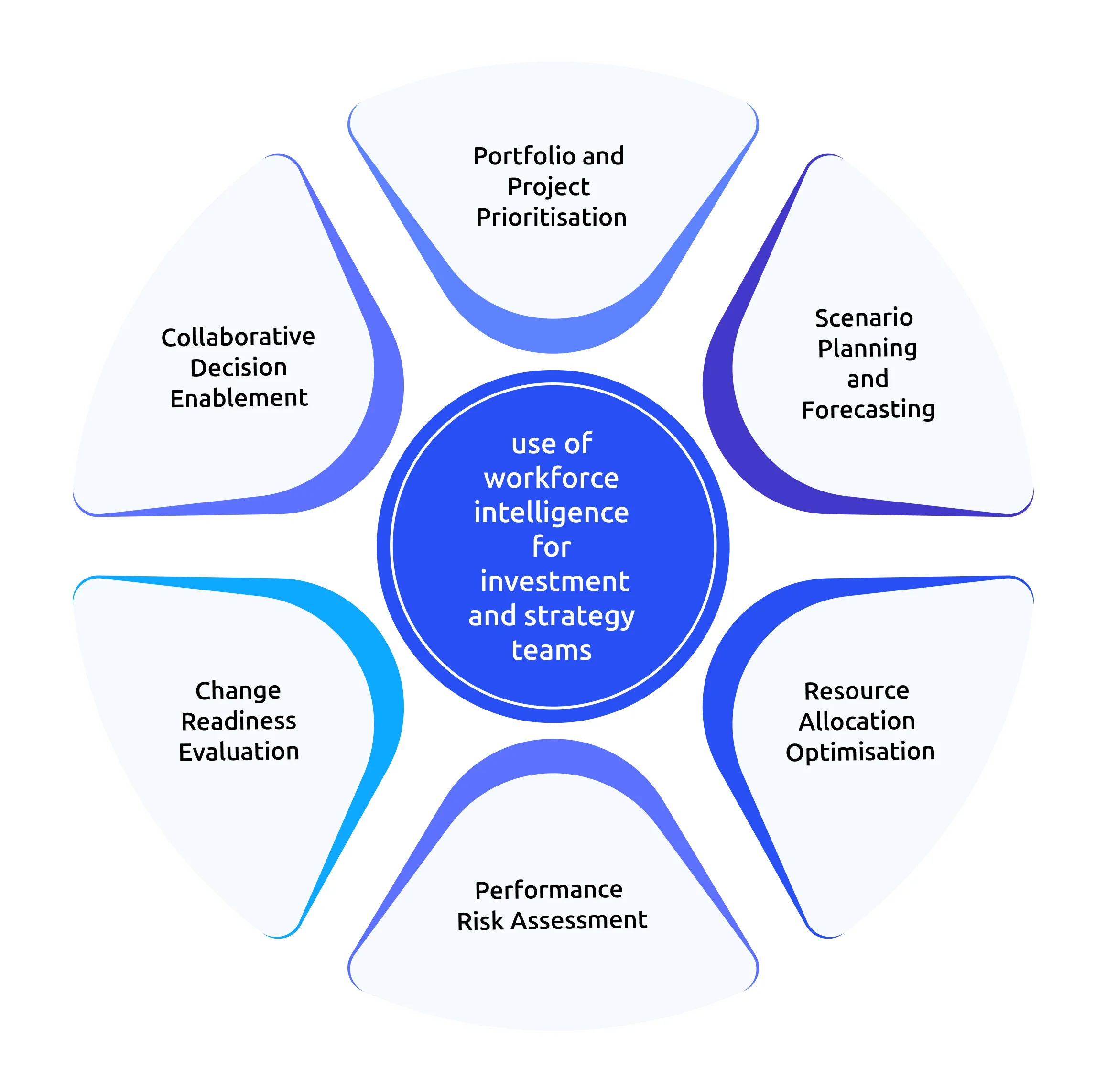
Workforce insights make it easier to see what your organization can truly deliver. Here’s how investment and strategy teams use workforce intelligence to prioritize initiatives, forecast capacity, and manage execution risk early.
Portfolio and Project Prioritization
Compare execution capacity across initiatives to identify where delivery risk is higher. Workload and utilization insights show which projects operate under pressure and which have capacity headroom. This allows you to prioritize initiatives based on execution reality rather than projected returns alone.
Scenario Planning and Forecasting
Workforce intelligence adds capacity and workload trends to financial and market scenarios. You can test how different strategic choices affect execution stress and delivery timelines. This reduces uncertainty before capital or resource commitments are made.
Resource Allocation Optimization
Real-time workforce signals identify overworked and underutilised teams, allowing you to redistribute resources based on actual capacity rather than static assumptions. This improves allocation accuracy and limits inefficiencies across portfolios.
Performance Risk Assessment
Workforce intelligence provides early signs of execution risk that financial data may miss. Signals such as rising workload intensity and uneven task distribution point to potential delivery issues. You can address these risks before they affect outcomes.
Change Readiness Evaluation
Current work patterns provide insight into how much disruption teams can absorb. Capacity buffers and workload stability help you assess readiness for transformation initiatives. This allows you to sequence changes more effectively and reduce operational strain.
Collaborative Decision Enablement
Shared workforce metrics create a common decision framework across strategy, finance, and HR. You align faster because discussions rely on the same execution signals. This improves decision speed and reduces cross-functional friction.
Are you relying on assumptions to prioritize strategic initiatives?
Explore how Time Champ transforms workforce activity into decision-ready intelligence that supports execution-ready strategy.
How Does Workforce Intelligence Support Investment and Strategy Decisions?
Workforce intelligence supports decisions in investment and strategy by converting day-to-day workforce activity into structured, decision-ready insights. These insights move through a clear progression, from raw data to strategic action, ensuring decisions reflect execution reality.
Capturing Meaningful Workforce Signals
Workforce intelligence shows you how work actually runs across your organization. It tracks workload balance, utilization levels, work distribution, and performance shifts across teams. Instead of relying on assumptions, you get a consistent view of execution patterns over time. This baseline helps you spot inefficiencies early, identify uneven capacity, and act before delivery slows down.
Structuring Signals into Strategic Indicators
Workforce intelligence organizes raw workforce data into strategic indicators such as execution capacity, delivery risk, and operational resilience. These indicators simplify complex workforce data into interpretable insights. You can review them alongside financial and market metrics without added complexity.
Contextualising Signals with Business Priorities
Workforce indicators gain relevance when you map them to strategic initiatives and investment goals. You align capacity and workload indicators with portfolios, programs, and growth plans. This context shows where strategy aligns with execution strength and where friction exists.
Integrating Workforce Insights into Decision Models
You can integrate workforce intelligence into your planning and evaluation models to improve investment and strategy decisions. These insights help you estimate delivery timelines, test scalability limits, and assess how much additional work teams can take on. This ensures you make decisions based on proven execution capacity, not optimistic assumptions.
Triggering Strategic Adjustments
When workforce indicators cross defined thresholds, such as sustained overload or declining execution stability, they prompt a strategic review. You can delay initiatives, rebalance portfolios, or adjust capital deployment. This ensures your decisions remain responsive rather than reactive.
Reinforcing Decisions Through Continuous Feedback
Workforce intelligence enables continuous feedback following strategic decisions. Track how execution responds to strategic changes in real time. This closes the loop between decision, execution, and outcome, strengthening future strategy formulation.
Time Champ: Workforce Intelligence for Execution-Ready Strategy
Investment and strategy decisions require more than headcount and cost metrics. You need clear visibility into how teams execute work and whether your organization has the capacity to deliver strategic priorities. Time Champ is a workforce intelligence software that connects work patterns, workload pressure, and capacity realities into one clear view, so you can make decisions with confidence.
Time Champ shows you where teams spend the most effort, where workload pressure slows delivery, and which initiatives lack enough capacity to stay on schedule. With this visibility, you can prioritize investments based on execution readiness, allocate resources with accuracy, and reduce delivery risk before it turns into delays.
Conclusion
To make confident investment and strategy decisions, you need clear visibility into how execution actually happens across your organization. Tools like Time Champ provide this clarity by connecting workforce behavior, capacity signals, and execution patterns directly to strategic planning and capital allocation.
When you align strategy with delivery capacity, you reduce execution risk, improve prioritization, and avoid pushing teams beyond capacity. As planning cycles get shorter and delivery demands grow more complex, workforce intelligence helps you build strategies that match real execution capacity and support sustainable success.
Does your investment strategy reflect how work actually happens?
Learn how Time Champ brings workforce intelligence into strategic planning to align capital allocation with real execution readiness.

Chethana

Table of Content
-
 Why Workforce Intelligence Matters for Investment and Strategy Teams?
-
What Makes Workforce Intelligence a Strategic Asset?
-
How Investment and Strategy Teams Use Workforce Intelligence?
-
How Does Workforce Intelligence Support Investment and Strategy Decisions?
-
Time Champ: Workforce Intelligence for Execution-Ready Strategy
-
Conclusion
Related Blogs

Learn why businesses need workforce intelligence software, how it transforms business strategy, and how it works to drive strategic decision-making.
Thasleem Shaik | Feb 11, 2026
Learn what external workforce intelligence is, why it matters for enterprise strategy, real examples, how it shapes strategy & which teams benefit most.
Anjali | February 11, 2026
Learn what workplace intelligence is with real examples, how to implement it, key benefits, major challenges, and how it helps businesses scale effectively.
Anjali | February 11, 2026
Discover how workforce intelligence improves workload distribution, balances team capacity, prevents burnout & how to manage it with data effectively.
Tarun Kumar Reddy | February 11, 2026
Learn why filtering workforce data is essential, how to filter data for effective workforce intelligence step-by-step, and how it supports better outcomes.
Guna Lakshmi | February 18, 2026
Learn why trust matters in workforce intelligence, how a privacy-first approach builds it, the key benefits, and how it protects company culture.
Thasleem Shaik | February 11, 2026


 4.7/5 avg.
Ready to Manage Your Workforce Smarter?
Join our family of 1500+ companies using smart insights to redefine workforces!

Free Trial
No Credit Card Required